
Landlord and Rental Property Insurance in Illinois
Coverage at a Glance
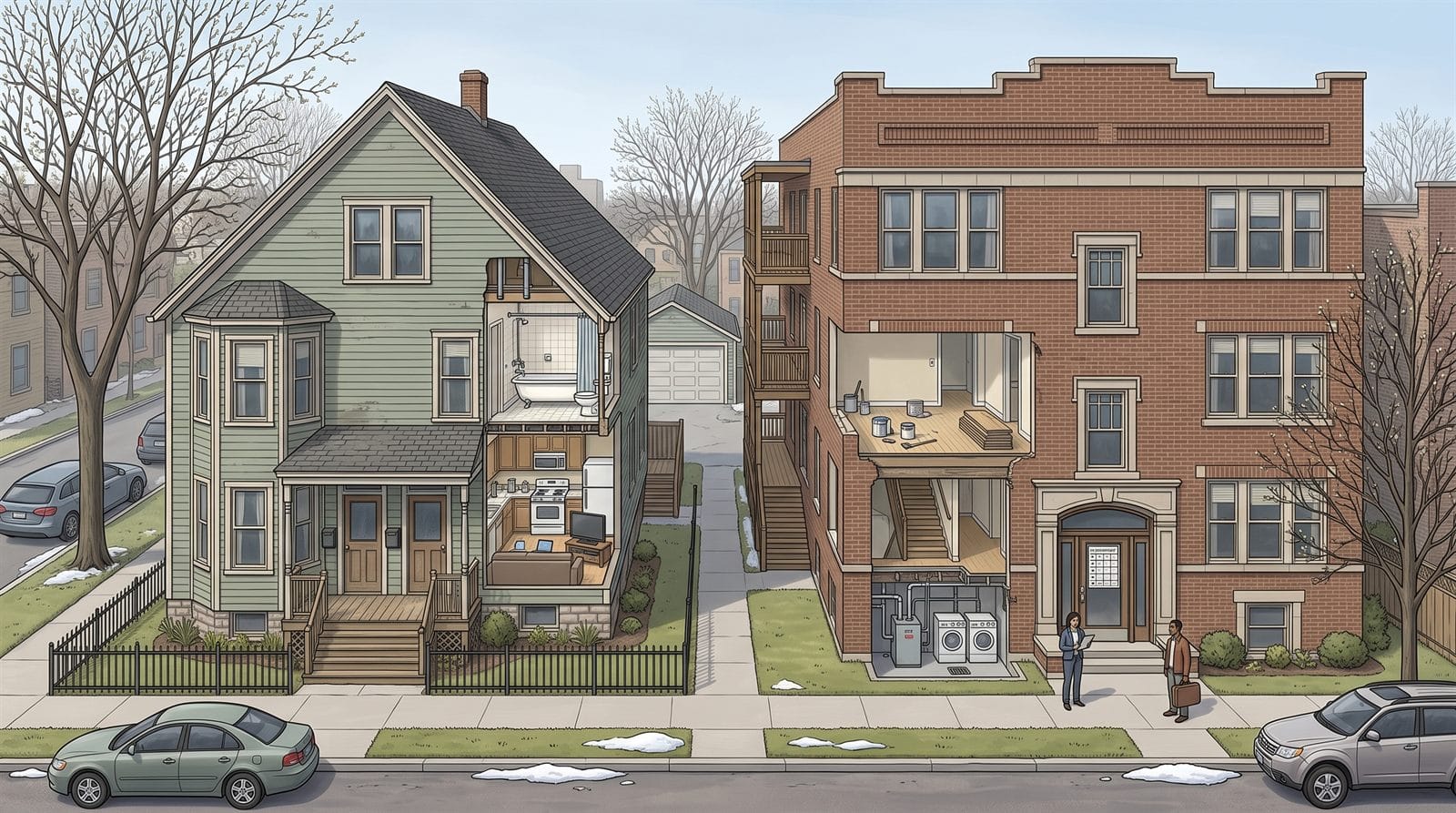
Select a part of either building, a numbered marker, or a coverage name below the picture to see how landlord insurance applies.
- Building coverage
From one unit to the whole building
A fire or storm can damage anything from one rental unit to an entire building. Building coverage can help repair covered damage to the insured structure. Coverage should reflect each property’s construction, size, occupancy, and rebuilding cost, not simply its purchase price.
- Loss of rental income
What happens to rent during repairs?
Covered damage can make apartments uninhabitable and interrupt your rental income. Loss-of-rents or rental-value coverage can help replace qualifying lost rent during repairs. This coverage generally responds to covered property damage; ordinary vacancies and tenants failing to pay rent are different exposures.
- Landlord liability
A fall on the steps becomes a claim
A tenant or guest falls on the steps and claims you failed to maintain them. Landlord liability coverage can help pay legal defense costs and covered damages when you’re legally responsible for an injury or damage to someone else’s property.
- Water damage
Water travels to the unit below
An overflowing tub or burst pipe can damage ceilings, walls, and the apartment below. Your building policy may cover resulting damage from a covered water event. Review exclusions for repeated leakage, maintenance issues, and damage to the plumbing component itself.
- Sewer and drain backup
Water coming up the drain is a separate question
A backed-up drain can damage basement finishes, laundry equipment, and building systems. Sewer and drain backup protection may require an endorsement or separate coverage. Review the limit, deductible, and whether associated lost rental income is covered.
- Equipment breakdown
Several households without heat
A sudden mechanical or electrical breakdown can leave multiple households without heat. Equipment breakdown coverage can help repair or replace covered building equipment after a qualifying failure. Routine servicing, aging, and ordinary wear and tear remain maintenance expenses.
- Ordinance or law coverage
Repairs may have to meet today’s code
Repairing an older building after covered damage may trigger current code requirements. Ordinance or law coverage can help with specified demolition expenses and increased rebuilding costs. Review coverage for undamaged portions that must also be altered or removed.
- Landlord-owned appliances
The appliances you provide
The appliances and furnishings you provide need to be included in your coverage review. Depending on the policy and installation, they may fall under building or landlord personal property coverage. Covered damage is different from an appliance simply wearing out.
- Detached structures
The garage needs its own listing
A detached garage, fence, or storage shed may need its own coverage allocation or listing. Review the structures on each property, their insured values, and how they’re used. Tell your agent if a garage is rented separately or used for business activities.
- Vacancy and renovation
Turnover changes the picture
Tenant turnover and renovation can change your insurance needs. Let your agent know about extended vacancies, major construction, or changes in occupancy. Review vacancy provisions and whether renovation or builders risk coverage is needed before work begins.
- Tenant-caused damage
Accident, vandalism, or wear?
Accidental damage, deliberate damage, and ordinary wear are treated differently. A covered kitchen fire may trigger building coverage, while worn flooring or neglected housekeeping generally will not. Ask specifically how your policy handles vandalism or malicious damage by tenants.
- Renters insurance and temporary housing
Your policy doesn’t cover the tenant’s belongings
Your landlord policy generally does not insure tenants’ belongings. Renters insurance can protect their possessions and provide additional living expenses, such as a hotel, after a covered loss. Your loss-of-rents coverage protects your rental income; it does not automatically pay tenants’ hotel bills.
- Umbrella or excess liability
When one accident involves several people
A serious accident involving several people can produce claims beyond your primary liability limits. Umbrella or excess liability can add protection above specified underlying policies. Confirm that both buildings, the ownership entities, and their rental operations are included.
Tell us how many units you own and how each is occupied, and we will check that every building is on the right form.
Illustrative coverage options. Coverage varies by property and policy. Terms, limits, deductibles, and exclusions apply.
The moment a property stops being owner-occupied, the homeowners policy on it becomes the wrong contract. Carriers check occupancy at claim time, and a rental unit insured on an owner-occupied form is one of the more common ways a large claim gets denied outright.
Longmeadow Insurance writes landlord coverage from our Wilmette office for single-family rentals, condos held as investments, two-flats and three-flats, and small multi-unit buildings across the North Shore, Chicago, and the surrounding suburbs.
What a Landlord Policy Covers
A dwelling fire policy, usually written as DP-1, DP-2, or DP-3, is the standard landlord form. The DP-3 is the one worth having, because it covers the building on an open-perils basis rather than a short named-perils list.
- The building itself, at replacement cost rather than actual cash value wherever the carrier will write it
- Loss of rents, replacing the rental income while the unit is uninhabitable after a covered loss. This is the coverage owners most often carry at too low a limit
- Landlord liability, for injury to a tenant or visitor arising from the property
- Landlord contents: appliances, window treatments, and furnishings you supply. Tenants generally insure their own belongings through renters insurance.
- Other structures, meaning garages, fences, and detached buildings
Loss of Rents Is the Limit to Check
A fire that makes a unit uninhabitable stops the rent immediately, and it does not restart until the rebuild is finished and a tenant has moved back in. On the North Shore and in Chicago, permitting and reconstruction routinely run longer than owners assume.
Most landlord policies default to twelve months of loss of rents. For an older building, a historic district, or anything requiring a variance, twelve months can fall short. We size that limit against the actual rent roll and a realistic rebuild timeline rather than accepting the default.
Where Landlords Get Caught
- Still on a homeowners policy. Common after an owner moves out and rents the former residence. The carrier can deny the claim that matters most.
- No tenant insurance requirement in the lease. Illinois does not require tenants to carry renters insurance, but your lease can, and requiring proof of it moves tenant-caused losses onto their policy instead of yours.
- Not listed as additional insured on the tenant’s policy. A lease clause that requires it, where the tenant’s carrier allows it, gives you standing on their liability coverage; at minimum, ask to be listed as an interested party so you hear if the policy lapses.
- Title held in an LLC, policy in a personal name. If the deed says the LLC owns it, the LLC belongs on the policy as the named insured. This mismatch creates an entirely avoidable coverage argument.
- Liability limits left at the default. Rental property is one of the exposures a personal umbrella can extend over, but only if the rental is scheduled on the umbrella.
- Short-term rental use. A standard landlord policy is written for conventional leases. Furnished short-term rental activity generally needs a specific endorsement or a different form.
Condos Held as Rentals
An investment condo needs a landlord HO-6, not the owner-occupied version. The association’s master policy still governs how much of the interior falls to you, so bare walls, single entity, and all in each produce a different dwelling limit. Loss assessment coverage matters here too, since the board can assess owners regardless of whether the unit is owner-occupied or leased.
See our condo insurance page for how the master policy types differ.
When You Cross Into Commercial
A landlord policy fits residential rental property, generally up to four units. Once you own a commercial building or a mixed-use property, the right structure is a lessor’s risk policy instead, which is built for leasing space to business tenants and handles certificate tracking, tenant improvements, and the liability that comes with commercial occupancy.
Between those two sits the residential building you own as an investment: a three-flat, a six-unit courtyard building, or several rentals held in an LLC. Those are often written on a commercial package that pairs property and liability with lost-rent coverage, and our Honeycomb landlord insurance page explains one carrier built for that market.
Common Questions
Can I keep my homeowners policy if I rent out my old house?
No. Occupancy is a material fact on the policy, and renting the property without changing the form gives the carrier grounds to deny a claim. Switching to a landlord policy is straightforward, and we can quote it before the first tenant moves in.
Does my landlord policy cover my tenant’s belongings?
Your building policy generally does not insure a tenant’s belongings. The tenant’s renters policy handles that property; your own liability coverage is a separate question if you are responsible for damage.
What if the property is held in a trust or LLC?
Entirely workable, and common. The entity on the deed needs to appear as a named insured on the policy so there is no question about who suffered the loss.
Do I need flood or sewer backup on a rental?
Same answer as any property: flood is excluded from the landlord form and needs a separate policy, and sewer and drain backup is an endorsement. For garden units and lower levels, the water backup endorsement is the one that gets used most.
Related Coverage
- Lessor’s risk for commercial and office buildings
- Umbrella insurance, which can extend over scheduled rentals
- Condo insurance for investment units
- Renters insurance to require of your tenants
- Home insurance for your own residence
Where We Write Landlord Coverage
We write landlord coverage from our main office in Wilmette and our offices in Evanston, Elmhurst, Elk Grove Village, Antioch, Wicker Park, Lakeview, and North Center, covering Cook, Lake, and DuPage counties.
Get a Landlord Insurance Quote
Send us the address, the current rent roll, and your existing declarations page. We will confirm the form is right for the occupancy and size the loss of rents limit properly. Call 847.242.1040 or request a quote online.
Erie Landlord Coverage
As an appointed Erie Insurance agent we can quote Erie on residential rental property, and for owners who already have their own home and auto with Erie, keeping the rental on the same carrier often simplifies both billing and claims.
Appetite varies with the number of units, the age of the building, and whether the property is held personally or in an LLC. We compare Erie against the other landlord markets rather than assuming a single answer.