
Renters Insurance on the North Shore and in Chicago
Coverage at a Glance
Select an item in the apartment, a numbered marker, or a coverage name below the picture to see how renters insurance applies.
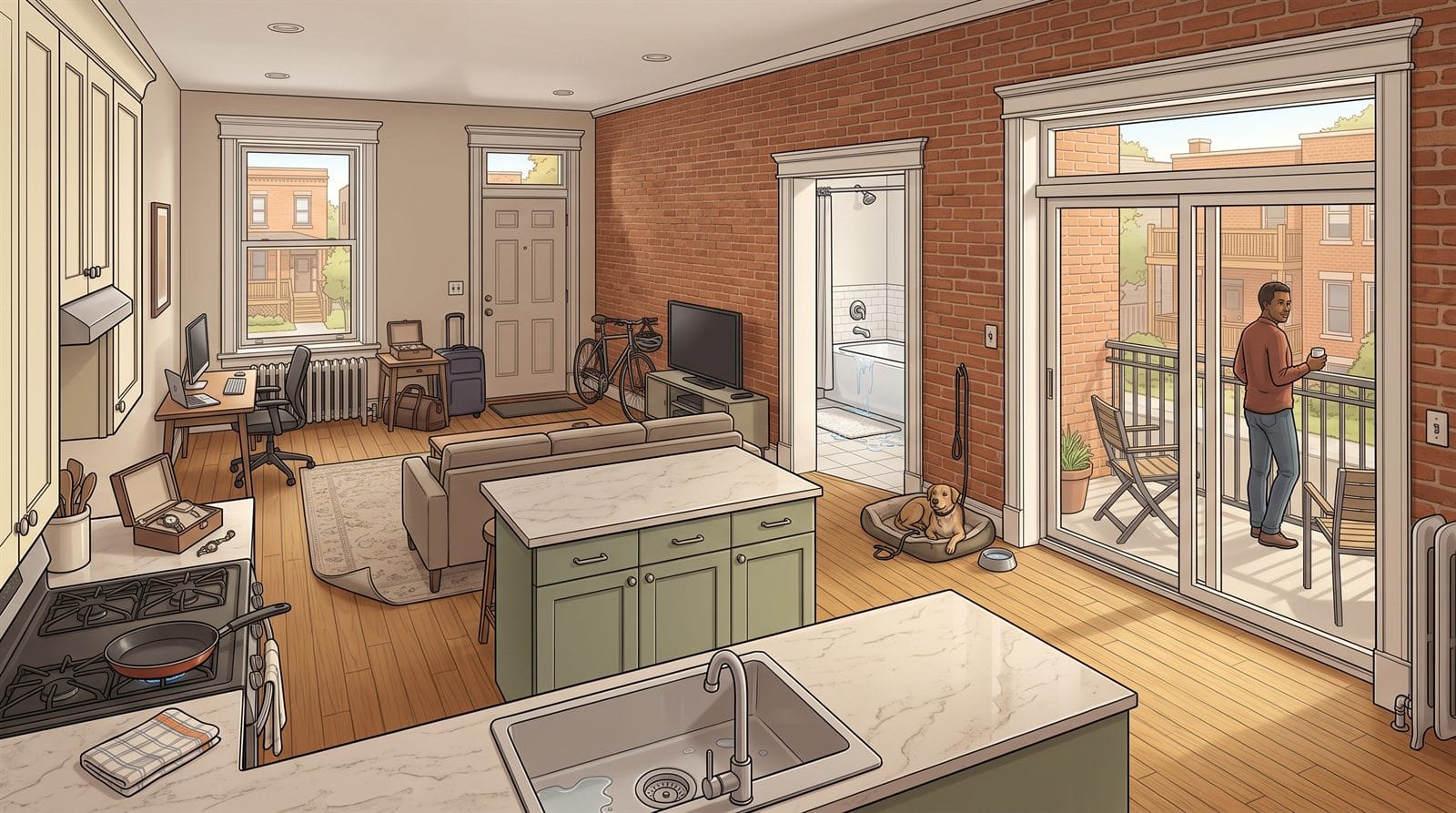
- Personal property
What would it cost to replace your belongings?
Your furniture, clothes, electronics, and kitchenware add up quickly. Personal property coverage helps repair or replace belongings after a covered loss. Ask about replacement cost coverage, which avoids deductions for depreciation, subject to the policy’s limits and claim requirements.
Choose a limit that covers everything.
Could you replace everything you own after a major fire? Your personal property limit is the maximum available for a covered belongings claim, and some categories have smaller limits. A room-by-room inventory helps you choose coverage and document a loss.
- Fire and smoke damage
A kitchen fire can affect the whole apartment.
Even a small cooking fire can spread smoke and soot throughout your home. Renters insurance generally covers your belongings damaged by fire or smoke, subject to your deductible and limits. Your landlord’s building insurance does not replace your possessions.
- Water damage
What if the bathtub overflows?
Sudden, accidental overflow can damage clothing, rugs, and other belongings. Renters insurance may cover those items. Damage to the building or a downstairs neighbor involves separate responsibility and coverage questions. Ask us how your policy handles an overflow you cause. Flooding and sewer backup are different risks.
- Personal liability
An accident could become a liability claim.
If you accidentally knock a planter from the balcony and injure someone below, you could face a claim. Personal liability coverage can help pay covered damages and legal defense costs when you’re legally responsible for injury or damage to someone else’s property.
- Medical payments to others
A guest trips and needs medical care.
Medical payments to others coverage can help with a guest’s medical bills after a qualifying accident, even when you aren’t legally at fault. It has a separate, usually smaller limit and generally doesn’t cover you or household residents.
- Loss of use
Where would you stay during repairs?
If a covered loss makes your apartment unlivable, loss of use coverage can help pay additional living expenses, such as a hotel and increased meal costs. Coverage applies to eligible costs above your normal spending, subject to dollar and time limits.
- Belongings away from home
Your belongings leave home with you.
A bike stolen while you’re out may be covered by renters insurance. Protection for personal belongings generally extends beyond your apartment, subject to deductibles, limits, and exclusions. Tell us about expensive bikes or belongings kept in storage so we can check for gaps.
- Scheduled jewelry and valuables
Does your jewelry need extra protection?
Renters policies often limit payment for stolen jewelry, and accidentally losing a necklace may not be covered. Scheduling valuable items or buying separate jewelry coverage can provide higher limits and broader protection for losses such as disappearance or accidental damage.
- Pet liability
Your pet can create liability, too.
If your dog bites someone or causes an injury, personal liability coverage may help with a covered claim. Animal exclusions and eligibility rules vary, so tell us about your pets. This protection is different from pet health insurance and does not pay your dog’s veterinary bills.
- Water backup endorsement
Water coming up the drain is different.
Sewer or drain backup is generally excluded from standard renters coverage. An optional water backup endorsement may help protect your belongings if this happens. Ask whether it’s available and what limit applies; it does not replace flood insurance.
- Landlord versus tenant coverage
Who insures the building?
Your landlord generally insures the building; your renters policy protects your belongings and provides other tenant coverages. Renting a condo does not make you responsible for buying an owner’s condo policy. Tell us about improvements you paid for, since coverage for those can differ.
Coverage varies by insurer and policy. Limits, deductibles, exclusions, and optional endorsements apply.
Renters insurance is the cheapest coverage we sell and the one tenants most often skip. A policy usually runs $10 to $25 a month and covers three things your landlord’s insurance does not touch: your belongings, your liability, and your cost of living somewhere else while the unit is repaired.
Longmeadow Insurance writes renters coverage for tenants in Wilmette, Evanston, Winnetka, and across Chicago neighborhoods including Lakeview, Wicker Park, North Center, and the West Loop.
Your Landlord’s Policy Does Not Cover You
This is the single most common misunderstanding we correct. The building owner insures the building. If a fire, a burst pipe, or a burglary destroys what is inside your unit, the landlord’s policy pays them, not you.
It also does nothing for your liability. If your bathtub overflows into the unit below, or a guest is injured in your apartment, the claim comes to you personally.
What a Renters Policy Covers
- Personal property. Furniture, electronics, clothing, bikes, and kitchen equipment, on or away from the premises. Property stolen from your car is covered by this policy, not your auto policy.
- Personal liability. Usually $100,000 to $500,000 for damage or injury you are responsible for, including damage to other units.
- Loss of use. Hotel and meal costs if your unit becomes uninhabitable. In a tight rental market this is often the most valuable piece.
- Medical payments. Small no-fault coverage if a guest is hurt in your unit.
Replacement Cost, Not Actual Cash Value
Ask for replacement cost on personal property. Actual cash value depreciates everything before it pays, so a six-year-old laptop settles for a fraction of what a new one costs. The premium difference is a few dollars a month and the claim difference is substantial.
Sublimits Catch People Off Guard
Even a policy with a $40,000 property limit caps certain categories far lower. Jewelry theft is commonly limited to $1,500. Cash is often $200. Firearms, silverware, and business equipment carry their own caps.
An engagement ring, a musical instrument, camera equipment, or a bike worth more than the sublimit should be scheduled individually; see jewelry and valuables insurance. Scheduling also usually removes the deductible for that item.
How Much Coverage to Buy
Two numbers matter and most tenants get both wrong in the same direction.
Personal property
Do not guess. Walk one room at a time and add up what it would cost to replace the contents today, not what you paid. A modest one-bedroom usually lands between $25,000 and $40,000 once you count the mattress, the couch, the television, the laptop, the bike, the coffee maker, and a closet of clothes. People who guess almost always guess low, because the total is made of many ordinary items rather than a few expensive ones.
Photograph each room on your phone while you do it and email the photos to yourself. That five minute habit is worth more at claim time than any coverage election, and it costs nothing.
Liability
The default is often $100,000, and that is low for anyone with income to garnish or savings to reach. Moving to $300,000 or $500,000 usually costs a few dollars a year, because the claims that reach those limits are rare. The scenario to price against is not a broken window. It is a guest injured at your place, or a fire that starts in your unit and damages several others.
Once liability matters enough to think about, it is worth asking whether an umbrella policy belongs on top. Umbrellas sit above renters policies the same way they sit above homeowners policies, and renting does not disqualify you.
What Renters Insurance Does Not Cover
- The building itself. Walls, roof, and systems belong to the owner. If the building burns, your policy pays for your things, not the structure.
- Surface flooding. Water that rises from outside is excluded and needs separate flood coverage, which tenants can buy for contents alone.
- Sewer and drain backup, unless you add the endorsement. This is the exclusion that catches Chicago tenants most often.
- Your roommate’s belongings, unless they are named on the policy.
- Damage from neglected maintenance you were responsible for reporting and did not.
- Your car, though items stolen from inside it are covered by this policy rather than the auto policy.
- Business inventory and equipment beyond a small sublimit. Running a business from a rental needs its own conversation.
Garden Units, Basements, and Water
If you rent below grade anywhere in Chicago or the older North Shore suburbs, water is your most likely claim by a wide margin, and the standard policy handles it badly.
Three separate things can put water in a garden unit, and they are covered three different ways. A pipe bursting inside the building is generally covered as written. Sewer or drain backup during heavy rain is excluded unless you add the endorsement, and the endorsement is inexpensive. Surface water entering at grade is flood, which is excluded outright and needs an NFIP or private flood policy.
Ask for the backup endorsement at a real limit rather than the minimum offered. Ten thousand dollars sounds adequate until you price replacing everything that was sitting on the floor. Our guide to sewer backup coverage in Illinois works through how the endorsement responds.
Renting Off Campus as a Student
A parent’s homeowners policy may cover a student’s belongings at school, including some off-campus arrangements. Age, enrollment, residence, and policy terms determine whether that protection continues. Review the new address and lease before deciding whether the student needs a separate renters policy.
Check the parent policy language before the lease is signed rather than after a laptop disappears. Where the extension does not reach, a renters policy in the student’s name is inexpensive and also gives them liability coverage, which matters more in a shared apartment than the property limit does.
Is Renters Insurance Required in Illinois?
No. No Illinois law requires tenants to carry renters insurance, and Chicago has no city requirement either. Your lease can require it, and most professionally managed buildings now do, usually with a minimum liability limit of $100,000 and a request to be listed on the policy. If the lease requires it, the policy has to be in place at move-in and stay in force, or you are in breach of the lease.
Even where nothing requires it, the case is simple. Your landlord’s policy covers the building, not your belongings, and it does not defend you if a guest is hurt in your unit or a kitchen fire spreads next door.
What Your Lease Is Likely to Require
Requirements have tightened, particularly in larger buildings and professionally managed properties. Leases now commonly specify a minimum liability limit, often 100,000 or 300,000, and ask to be named on the policy.
There are two ways a landlord gets named and they are not the same thing. Being listed as an interested party means they receive notice if the policy lapses or is canceled, which is what most landlords actually want. Being added as an additional insured extends your liability coverage to them, which is a broader request and not every carrier will do it on a renters form. Read which one the lease asks for, because sending the wrong certificate delays a move-in.
Send us the lease page with the insurance requirement and we will match the certificate to it.
What Moves the Price
- Your property limit and deductible. Raising the deductible from 500 to 1,000 saves less than most people expect, so keep it where a claim would still be worth filing.
- Building construction and age. A masonry building with updated systems rates better than a frame walk up.
- Location. Theft frequency by neighborhood shows up in the rate, and it varies more inside Chicago than across the North Shore suburbs.
- Claims history. Yours, over the last several years, including claims at previous addresses.
- Bundling. Adding renters to an auto policy with the same carrier usually earns a multi-policy discount, which is why we quote them together.
- Scheduled items. Adding a ring or a bike raises the premium slightly and removes both the sublimit and, usually, the deductible for that item.
Common Questions
Is renters insurance required by law in Illinois?
No. Illinois has no statute requiring renters insurance, and Chicago does not require it either. Landlords can require it in the lease, and many do, usually with a $100,000 liability minimum.
How much does renters insurance cost in Illinois?
Most tenants pay between $150 and $300 a year. Bundling with auto insurance usually earns a multi-policy discount on the auto policy.
Does renters insurance cover flooding?
Not surface flooding. Sewer and drain backup requires an endorsement, which matters if you rent a garden unit or basement apartment. Water from a burst pipe inside the building is generally covered.
Does it cover my roommate?
Only if they are named on the policy. Unrelated roommates should each carry their own, so each person controls their own limits and claims.
Is renters insurance required in Illinois?
Illinois law does not require it, but many leases do, and the liability coverage is the reason to carry it either way. Replacing your belongings out of pocket after a fire is a much larger number than most tenants estimate.
Does renters insurance cover my bike if it is stolen outside?
Yes. Personal property follows you away from the apartment, so a bike taken from a rack on the street is covered subject to your deductible and any sublimit. A bike worth more than a few hundred dollars is usually worth scheduling, which removes both the cap and, on most carriers, the deductible for that item.
Can my landlord’s insurance company come after me?
Yes, and this surprises people. If a fire or a water loss starts in your unit and the building’s carrier pays to repair it, that carrier can pursue you to recover what it spent. Your liability coverage is what answers that demand, which is the strongest practical argument for carrying more than the minimum limit.
Do I need it if I do not own much?
The property limit is the smaller half of the policy. Liability and loss of use are the reasons to carry it. Being held responsible for damage to several other units, or needing to pay for somewhere else to live for two months, are both far larger numbers than the value of your furniture.
Will filing a claim raise my premium?
It can, and a pattern of claims can affect renewal. For a loss close to your deductible, paying out of pocket is frequently the better decision. Call and ask before you file. We can tell you whether the claim is worth reporting given the amount and your history.
Related Coverage
- Condo insurance if you own rather than rent
- Auto insurance, which bundles well with renters
- Home insurance when you buy your first house
- Umbrella insurance for higher liability limits
Where We Write Renters Coverage
Our offices are in Wilmette, Evanston, Lakeview, Wicker Park, North Center, Elmhurst, Elk Grove Village, and Antioch. We also write renters policies in Winnetka, Skokie, and the West Loop.
Get a Renters Insurance Quote
Most renters quotes take a few minutes. Call 847.242.1040 or request a quote online.