
Home Insurance on Chicago’s North Shore
Coverage at a Glance
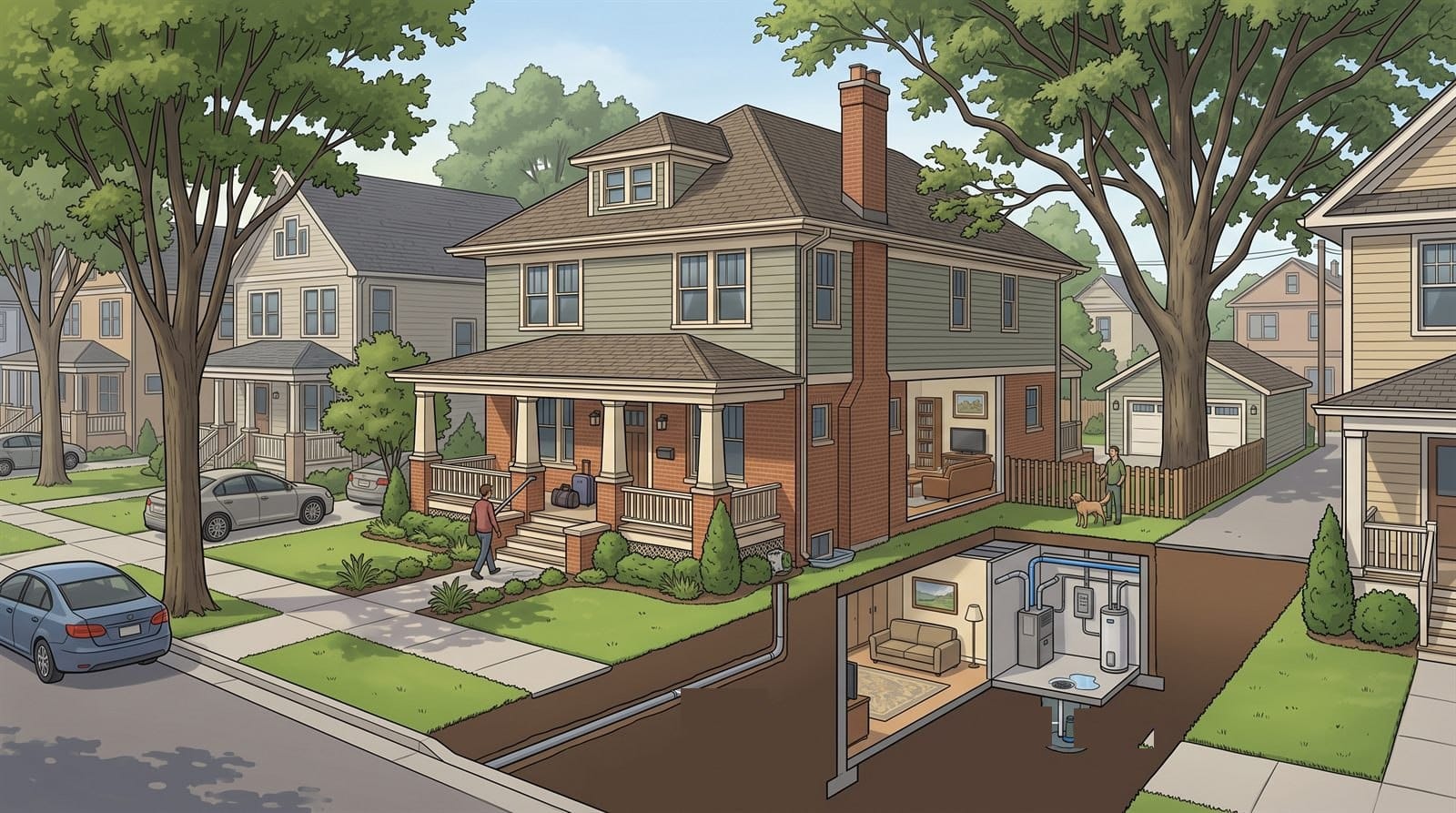
Select a part of the home, a numbered marker, or a coverage name below the picture to see how home insurance applies. The three labeled water markers show why the source of the water changes the coverage.
- Dwelling coverage
Could you rebuild the home you have?
Dwelling coverage helps repair or rebuild your house after a covered loss. Your limit should reflect reconstruction costs, including distinctive materials and finishes, not the home’s market value or mortgage balance. Ask about additional replacement cost protection if rebuilding exceeds your limit.
- Roof coverage
What would your policy pay for a damaged roof?
Wind and hail can damage shingles, flashing, and gutters. Ask whether covered roof damage is settled at replacement cost or with deductions for age, and whether a separate wind or hail deductible applies. Routine aging and maintenance aren’t the same as storm damage.
- Falling trees and tree removal
What if a tree falls on your home?
Home insurance generally covers damage when a tree falls onto an insured structure because of a covered event, even if the tree came from a neighboring yard. Tree-removal coverage has conditions and limits. Removing a standing hazardous tree is generally a maintenance expense.
- Other structures
Your protection should extend beyond the house.
Other structures coverage can help repair a detached garage, fence, or shed after a covered loss. Check that the limit reflects what you own. Vehicles generally need auto insurance, and business use or renting out a structure can change your coverage needs.
- Personal property
What would it cost to replace everything inside?
Personal property coverage protects belongings against covered losses such as fire and theft. Ask about replacement cost coverage and keep a home inventory. Jewelry, fine art, and other valuables may need separate attention because special limits and exclusions can apply.
- Additional living expense
Where would you stay during repairs?
If a covered loss makes your home unlivable, additional living expense coverage can help with a temporary rental or hotel and other eligible increases in living costs. It pays expenses above your normal spending, subject to policy terms and limits.
- Personal liability and medical payments
An injury could become a liability claim.
If you’re legally responsible for a visitor’s injury, personal liability coverage can help with covered damages and legal defense. Medical payments coverage may help with smaller qualifying medical bills regardless of fault. Ask whether an umbrella policy would provide useful additional liability protection.
- Pet liability
Your dog is part of your insurance picture.
If your dog bites someone or causes an injury, personal liability coverage may help with a covered claim. Animal exclusions and eligibility rules vary, so tell us about your pets. This protection is different from insurance for veterinary expenses.
- Ordinance or law coverage
An older home may need modern upgrades after a loss.
Repairing covered damage may require bringing affected work up to current building codes. Ordinance or law coverage can help with qualifying additional costs. It doesn’t pay for ordinary modernization or correcting existing violations simply because a home is older.
- Equipment breakdown
What if an essential home system breaks down?
Optional equipment breakdown coverage can help with qualifying sudden mechanical or electrical failures of covered home systems and appliances. It generally excludes wear, corrosion, and routine maintenance. Ask what equipment is included and what deductible applies.
- Water from inside the home: burst pipe
A burst pipe can damage much more than plumbing.
Sudden, accidental water damage from a burst pipe may be covered, including damage to insured finishes and belongings. Repairing the failed pipe can be a separate coverage question. Freezing, repeated leakage, and failure to maintain heat can affect how a claim is handled.
- Water from the drain: backup and sump overflow
Is your finished basement protected against backup?
Water backing up through a sewer or drain, or overflowing from a sump, generally needs specific coverage. Choose a limit that considers cleanup, flooring, walls, furniture, and equipment. Don’t assume a basic water-backup limit would restore a fully finished basement.
- Service line coverage
Who pays when an underground line fails?
You may be responsible for portions of underground utility lines serving your home. Optional service line coverage can help with qualifying repairs and excavation. Covered lines, causes of failure, and restoration limits vary. This is different from coverage for water backing up into the basement.
- Water from outside: flood and seepage
Not all basement water is sewer backup.
Water entering from the ground or outside the home can fall under flood or seepage exclusions. Standard home insurance generally excludes flood damage. Ask about separate flood protection and its basement limitations; neither flood nor water-backup insurance covers every kind of water intrusion.
If your house is older, has a finished basement, or sits under mature trees, send us your declarations page and we will check the policy against those risks.
Coverage varies by policy. Limits, deductibles, exclusions, and optional endorsements apply.
Longmeadow Insurance places homeowners coverage for families in Wilmette, Winnetka, Glencoe, Kenilworth, Evanston, Northbrook, and the surrounding North Shore. As an independent home insurance agent in Wilmette, we compare your home against the appetite and pricing of multiple carriers rather than fitting you into whatever one company happens to sell.
Most of the homeowners policies we review have the same problem. The dwelling limit was set years ago and never revisited, while the cost to rebuild the house has moved substantially. The gap stays invisible until a claim forces the comparison.
Your Dwelling Limit Is Probably Wrong
Rebuild cost is not market value and it is not your purchase price. It is what a contractor would charge today to reconstruct your house on its existing lot, at current material and labor rates, under current building codes. On the North Shore those three inputs have all climbed hard since 2020.
Older North Shore housing stock makes the gap worse. A 1920s colonial with plaster walls, quarter-sawn oak trim, leaded glass, and a slate roof cannot be rebuilt with builder-grade materials. If your policy was written off a generic square-footage calculation, the limit almost certainly does not reflect how your house was built. We look at loss settlement terms as closely as the limit itself, because replacement cost, extended replacement cost, and actual cash value produce very different checks after a total loss.
Water Is the Claim You Are Most Likely to File
Fire gets the attention, but water causes more of the claims. A standard homeowners policy excludes flood entirely, and it treats sewer and drain backup as a separate endorsement that many North Shore policies simply do not carry.
Flood is rising surface water, covered only by an NFIP policy or a private flood product. Sewer backup is water pushed up through your own drains during heavy rain, covered only if you bought the endorsement, and usually capped well below what a finished basement costs to restore. Lakefront communities carry both exposures at once. We walk through which one applies to your address and what limit is realistic.
High-Value Homes Need a Different Market
Above roughly $1 million in rebuild cost, standard carriers stop being the right answer. High-value homeowners markets underwrite differently, with agreed value or guaranteed replacement cost instead of a hard cap, cash settlement options, broader coverage for jewelry, art, wine, and collections without item-by-item scheduling, and claims handling built for complex properties.
The premium difference is often smaller than owners expect, and the coverage difference after a serious loss is large. If you own a home in Winnetka, Glencoe, Kenilworth, or lakefront Wilmette, read our high-value home insurance page before your next renewal.
Liability Is Where Households Are Thinnest
A homeowners policy typically carries $300,000 to $500,000 of personal liability. For a household with meaningful assets, retirement accounts, a family business, or teenage drivers, that number is low relative to what a serious judgment can reach. An umbrella policy sits above your home and auto liability and usually costs a few hundred dollars a year for a million dollars of additional protection.
Deductibles, and How a Roof Claim Settles
Two numbers on the declarations page decide what you collect after the most common North Shore claims, and neither is the premium.
The deductible tradeoff
Raising a deductible lowers the premium, and past a point it stops being worth it. The question is not how much you save annually but how many years of saving it takes to cover the extra you would pay at claim time. Work out that number before moving the deductible, and set it at a level you could write a check for tomorrow without rearranging anything.
Watch for percentage deductibles as well. Some policies apply a flat dollar amount to most losses but a percentage of the dwelling limit to wind and hail. On a house insured for a million dollars, a two percent wind and hail deductible is twenty thousand dollars, and homeowners are routinely unaware they have one until a storm.
Roof settlement is the term that matters most
A roof can be covered on a replacement cost basis, which pays what a new roof costs, or on an actual cash value basis, which subtracts depreciation for the roof’s age first. On a fifteen-year-old roof the difference can be most of the cost of the job.
Carriers have moved steadily toward actual cash value and scheduled roof endorsements on older roofs, and it is frequently how a cheaper premium was achieved without anyone mentioning it. If your roof is over ten years old, find the roof settlement wording on your policy before you compare quotes on price. Two policies at the same premium can differ by tens of thousands of dollars here.
Ordinance or Law Coverage for Older Homes
A standard policy pays to rebuild what was there. It does not automatically pay the extra cost of meeting building codes that have changed since the house was built, and on the North Shore a great deal of the housing stock predates most of the code that now applies to it.
After a significant loss that gap shows up in three places: bringing electrical and plumbing to current code during the repair, meeting current energy and structural requirements, and in some cases demolishing and rebuilding an undamaged portion because a partially damaged structure cannot be repaired under current ordinance. Ordinance or law coverage pays those differences, usually as a percentage of the dwelling limit.
Most policies include a small amount by default, often ten percent, and on a vintage Wilmette or Evanston house that is frequently not enough. It is inexpensive to increase and one of the first things we check on a home built before about 1970.
What Working With Us Looks Like
We start by reading your current policy rather than quoting against it blind. That review covers the dwelling limit and loss settlement basis, personal property limits and any scheduled items, additional living expense, water backup and service line coverage, liability limits, and deductible structure including any separate wind or hail deductible.
Then we shop it. Because we are independent, we can place the policy with any carrier we represent rather than one company’s book, and we explain why we are recommending the one we recommend.
Common Questions
How much does home insurance cost on the North Shore?
It varies more by house than by town. Rebuild cost, roof age and material, plumbing and electrical updates, claims history, and deductible structure drive the number far more than your zip code does. A home with a twenty-year-old roof and original galvanized plumbing prices very differently from the same house after those updates.
Does homeowners insurance cover basement flooding?
Not by default. Surface flooding requires separate flood insurance. Sewer and drain backup requires a water backup endorsement. Most standard policies include neither unless someone asked for them.
Do I need flood insurance if my mortgage company does not require it?
Lender requirements track FEMA flood zones, and FEMA maps do not capture every drainage and storm sewer exposure on the North Shore. Plenty of homes that flood are outside a mandatory zone. Coverage outside those zones usually costs less, and we can price your address.
Should I file a small claim or pay it myself?
Often you should pay it. A claim stays on your insurance history for years and can affect both eligibility and pricing. For losses near your deductible the long-term cost of filing usually exceeds the check.
Can you insure a home held in a trust or LLC?
Yes, and the titling has to be reflected correctly on the policy. A home deeded to a trust with the policy still in an individual name creates a coverage argument at claim time that is entirely avoidable.
Related Coverage
- Condo insurance for unit owners and HO-6 policies
- Renters insurance for tenants
- Flood insurance and water backup coverage
- Umbrella insurance for additional liability
- Auto insurance, usually bundled with your home policy
- Life insurance for income replacement and estate planning
Home Insurance by Town
Our main office is in Wilmette, with offices in Evanston, Elmhurst, Elk Grove Village, Antioch, Wicker Park, Lakeview, and North Center.
We also write homeowners coverage in Winnetka, Glencoe, Kenilworth, Northbrook, Northfield, Glenview, Highland Park, and Skokie.
Get a Home Insurance Quote
Send us your current declarations page and we will tell you what it actually covers before we quote anything. Call 847.242.1040 or request a quote online.
Getting an Erie Home Insurance Quote
Longmeadow Insurance is an appointed Erie Insurance agent, and Erie is one of the carriers we quote most often for homeowners coverage in Illinois. If you have been told Erie is worth looking at, we can quote it directly from our Wilmette office. Call 847.242.1040 and we will tell you whether Erie is likely to write your address.
We will also show you what the alternatives look like. Erie is competitive on a great many North Shore homes, but rebuild cost, roof age, claims history, and water exposure all move a house between carriers, and on higher-value properties a specialist high-value market is frequently the better answer. You see the comparison either way.
Related Reading on Home Insurance
- Why home insurance costs keep rising in Illinois
- What to do when your renewal comes in higher
- How aerial and satellite imagery is changing renewals
- Insurance checklist before buying a home
- What to settle before closing day
- Does homeowners insurance cover basement flooding?
- Home replacement cost vs. market value on the North Shore