
Condo Insurance in Illinois and Chicago
Coverage at a Glance
Select an item in the condo, a numbered marker, or a coverage name below the picture to see how condo insurance applies.
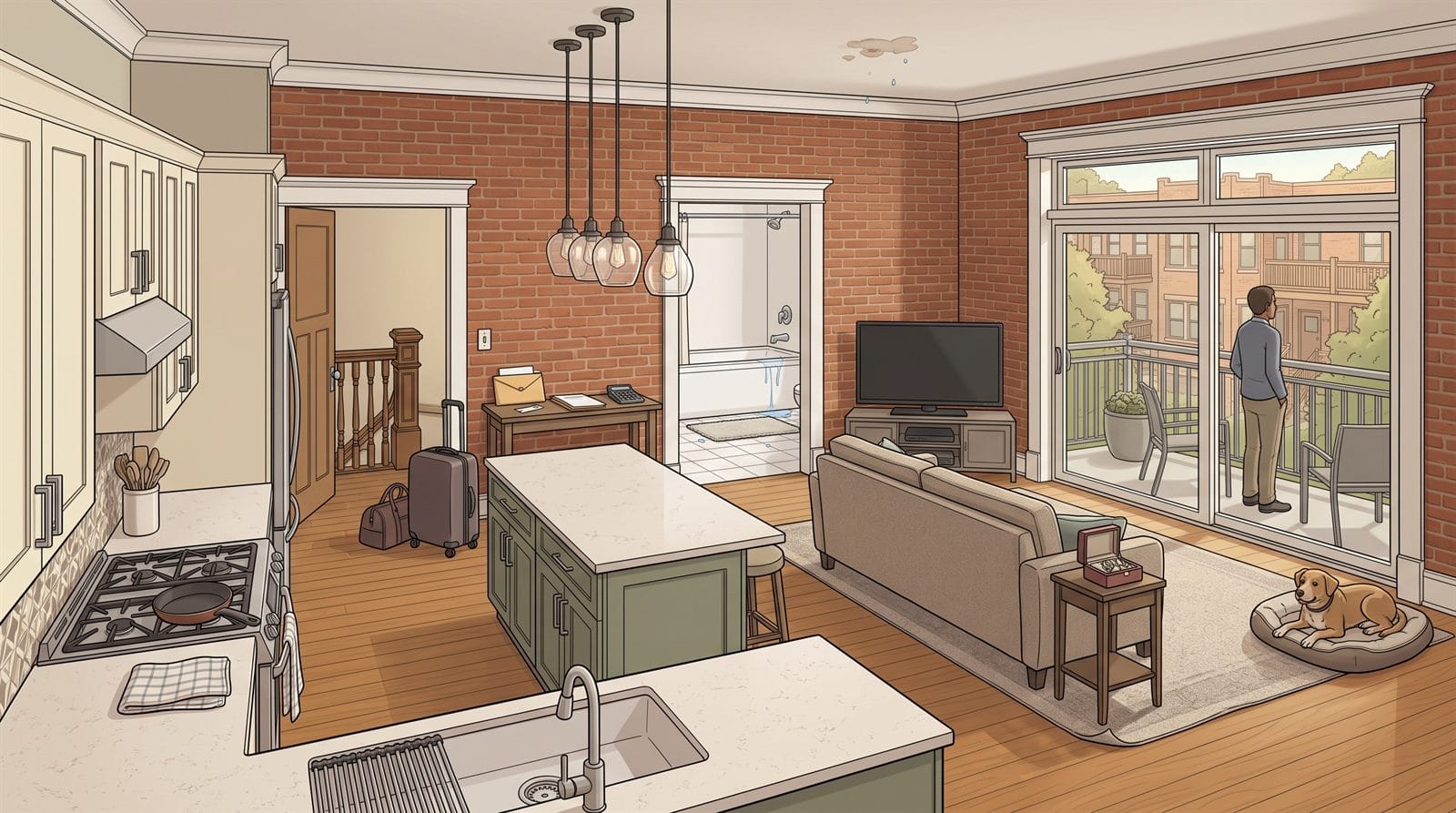
- Dwelling coverage (interior)
Who pays to rebuild your kitchen?
Custom cabinets, countertops, flooring, and other improvements can be expensive to replace. Your condo policy can help cover interior property you’re responsible for after a covered loss. We’ll review your association’s insurance and governing documents to help you choose the right dwelling coverage.
- Master policy versus unit policy
What does the association’s insurance cover?
The association generally insures shared building property, but coverage inside individual units varies. Don’t assume everything inside your walls is your responsibility, or that the association covers it all. Your condo policy should fit the master policy and the association’s governing documents.
- Loss assessment coverage
Could a building claim become your bill?
After certain shared property or liability losses, the association may assess unit owners for costs. Loss assessment coverage may help pay your share of a qualifying assessment. Routine maintenance and planned improvements aren’t covered. Assessments involving the master policy’s deductible may have special limits or exclusions.
- Water damage you cause
Your overflowing tub can affect more than your bathroom.
A sudden, accidental overflow may damage your belongings, interior finishes, and the unit below. Different coverages can apply to each. Your liability protection may respond if you’re legally responsible for someone else’s damage; responsibility isn’t determined simply by where the water started.
- Damage from another unit
What if the upstairs neighbor has a leak?
A leak from another unit can damage your ceiling, floors, and belongings. Your own policy may help with covered damage even when the water originated elsewhere. Notify your insurer and association promptly; which policy pays depends on the cause, damaged property, and applicable responsibilities.
- Water backup endorsement
Water backup needs its own coverage check.
Water backing up through a sewer or drain is generally excluded from standard condo insurance. An optional endorsement may cover resulting damage to insured belongings and interior property. Ask about available limits and exclusions. Water backup coverage does not replace flood insurance.
- Fire and smoke damage
A small cooking fire can cause a big loss.
Fire and smoke can damage belongings and interior finishes throughout your condo. Your policy can help pay for covered damage to property it insures. The association’s policy may also be involved when the building is damaged.
- Personal property
Protect everything you’ve made your own.
Furniture, clothing, electronics, and household items are protected by personal property coverage against covered losses. Ask for replacement cost coverage so depreciation doesn’t reduce the value used to settle eligible claims. Choose a limit based on replacing all your belongings.
- Loss of use
Where would you live during repairs?
If a covered loss makes your condo unlivable, loss of use coverage can help pay additional costs for a hotel or temporary rental, meals, and other eligible expenses. It covers increases above your normal living expenses, subject to policy limits and the covered repair period.
- Personal liability
An accident could put your savings at risk.
If you accidentally knock a planter from the balcony and injure someone below, personal liability coverage can help with a covered claim and legal defense. Ask whether your liability limit is enough and whether an umbrella policy would provide useful additional protection.
- Medical payments to others
A guest trips and needs treatment.
Medical payments to others coverage can help pay a guest’s medical expenses after a qualifying accident, regardless of fault. It has a separate limit and generally doesn’t cover you or household residents. Larger claims involving your legal responsibility fall under liability coverage.
- Scheduled valuables
Some valuables need more than standard coverage.
Your policy may limit payment for stolen jewelry, watches, and other valuables. Scheduling individual items or purchasing separate valuables insurance can provide higher limits and broader protection, potentially including accidental loss. Let’s check your valuable items before a claim reveals a gap.
- Pet liability
Your pet can create a liability claim.
If your dog bites someone or causes an injury, your personal liability coverage may help. Animal exclusions and eligibility rules differ by insurer, so tell us about your pets. This coverage protects against qualifying liability claims; it isn’t veterinary insurance.
Send us your association’s insurance documents and we’ll help identify gaps in your condo coverage.
Coverage varies by policy and association requirements. Limits, deductibles, exclusions, and optional endorsements apply.
Condo owners are the most frequently underinsured people we meet, and the reason is structural. Your association carries a master policy, you carry an HO-6 policy, and almost nobody has read both documents to find out where one stops and the other starts. That gap is where claims get denied.
Longmeadow Insurance writes condo coverage across Chicago and the North Shore, from Lakeview and Wicker Park three-flats to lakefront high-rises in Evanston and Wilmette. We read your association’s declaration before we quote.
Bare Walls, Single Entity, or All In
Every master policy falls into one of three types, and which one your building carries changes your HO-6 limit by tens of thousands of dollars.
- Bare walls in. The association covers the structure only. Drywall, flooring, cabinets, fixtures, and appliances are yours. This needs the largest HO-6 dwelling limit.
- Single entity. The association covers original construction as builder installed it. Your upgrades are yours.
- All in. The association covers original construction plus most fixtures. You still need coverage for upgrades, personal property, liability, and loss assessment.
If you renovated a kitchen or bath in a single entity building, that work is on your policy, not the association’s. Owners routinely discover this after a burst pipe.
Loss Assessment Is the Coverage Nobody Buys
When a loss exceeds the master policy limit, or when the association’s deductible has to be paid, the board can assess every owner for their share. A roof failure or a major water loss in a mid-size building can produce an assessment in the thousands per unit.
Loss assessment coverage handles that. Most HO-6 policies include a token $1,000 by default. Given that many association deductibles now run $25,000 or higher, that default is not a meaningful limit. Raising it is inexpensive.
Water Damage in Multi-Unit Buildings
In a condo, water rarely damages only one unit. A supply line that fails on the eighth floor affects everything below it, and the question of who pays turns on the association’s governing documents and on whether the escape was sudden or gradual.
Your HO-6 liability coverage responds if you are found responsible for damage to other units. Sewer and drain backup is a separate endorsement and matters in garden units and lower floors. Older Chicago buildings with original plumbing carry meaningfully higher risk here.
The Buildings We Write, and What Changes Between Them
Condo is not one risk. The building type decides which coverages matter, and this market has four distinct ones.
Vintage two and three flats, Lakeview through Wicker Park
Small associations, often self-managed, frequently with no property manager and a master policy chosen on price. Two things follow. Reserves tend to be thin, which makes an assessment after a roof or a sewer line failure more likely rather than less. And with three owners rather than three hundred, an assessment divides across very few people, so each share is large. This is the building type where a 1,000 dollar loss assessment limit is most dangerous.
Garden units in these buildings carry the additional water exposure, and sewer and drain backup should never be left off.
Downtown and West Loop high-rises and loft conversions
Professionally managed, usually with a substantial master policy and a correspondingly substantial deductible. The exposure moves from underinsurance to the deductible assessment: a supply line failure on a high floor damages many units, and the association’s deductible is passed along. Loft conversions add a wrinkle, because exposed brick, timber and open ductwork cost more to restore than a formula estimate suggests.
North Shore mid-rises and courtyard buildings
Wilmette, Evanston and Skokie have a large stock of mid-century courtyard and mid-rise buildings where the master policy is usually single entity. That means original finishes are covered and everything an owner has upgraded since is not. Kitchens and baths renovated over the last twenty years are the uninsured half, and almost nobody has raised their dwelling limit to match the work they did.
Newer construction in Elmhurst and the northwest suburbs
Townhome-style associations with newer systems and fewer water losses, where the live issues are usually the opposite: dwelling limits set at the builder’s original price and never adjusted for what construction costs now, and unit owners who assume newer means fully covered.
How to Read Your Association’s Certificate
Ask your board or property manager for the master policy certificate. It is one page and you are looking for four things.
- The form type. Bare walls, single entity, or all in. If the certificate does not say, the declaration does, and the answer changes your dwelling limit by tens of thousands.
- The property deductible, including any separate water deductible, which is often much higher than the standard one. That figure is what your loss assessment limit has to be sized against.
- Whether the association can assess owners for the deductible. This is in the declaration rather than the certificate, and most Illinois declarations allow it.
- The building limit and any coinsurance clause. An underinsured building takes a proportional cut on partial losses, and partial losses are most of what associations claim.
Send us that certificate and your declaration and we will read them against your HO-6 rather than asking you to interpret them. Board members reviewing this from the association side should see our page on condo association and HOA insurance.
Buying, Selling, or Refinancing a Unit
An HO-6 is required at closing on nearly every financed condo purchase, and it is one of the more common causes of a last minute delay. Three things cause most of them.
- The lender’s dwelling requirement. Many lenders require a specific minimum, frequently 20 percent of the purchase price, regardless of the master policy type. That can exceed what the building actually needs, and it is not negotiable at the closing table.
- A gap between the binder date and closing. The policy has to be effective on the closing date, not the day you bought it, and moved closings need the effective date changed.
- Association-side problems. Insufficient fidelity coverage or a lapsed master policy can stop a sale in the building entirely. Sellers usually discover this through the buyer’s lender.
Give us the address, the closing date and the lender’s insurance requirement sheet and we can usually issue the binder the same day.
Common Questions
How much condo insurance do I actually need?
It depends on your master policy type. Under bare walls, budget enough to rebuild the entire interior. Under all in, you need less dwelling coverage but the same personal property, liability, and loss assessment limits. We size it from your association’s declaration page rather than a rule of thumb.
Does my association’s policy cover my belongings?
No. Master policies never cover personal property. Furniture, clothing, electronics, and valuables are always the unit owner’s responsibility.
Do I need condo insurance if my building requires it?
Most associations and every lender require it. Beyond the requirement, the liability and loss assessment pieces are the ones that protect you from costs you cannot absorb.
What if I rent my condo out?
A standard HO-6 is written for owner occupancy. Renting the unit, long term or short term, requires a landlord policy or a specific endorsement. Carriers do check this at claim time.
How much loss assessment coverage should I carry?
Size it against your association’s property deductible, including any separate water deductible, rather than against a round number. If the building carries a 25,000 dollar deductible and the declaration lets the board assess owners for it, a 1,000 dollar limit is decorative. Raising it to 25,000 or 50,000 usually costs very little.
My building is small and self-managed. Does that change anything?
It raises your assessment exposure considerably. Reserves in a three or six unit association are usually thin, and any assessment divides across very few owners, so each share is large. Smaller buildings are where we recommend the highest loss assessment limits, which is the opposite of what most owners expect.
I renovated my kitchen. Do I need to tell my insurer?
Yes, particularly under a single entity master policy, where the association covers original construction and your improvements are yours to insure. A renovation that is not reflected in your dwelling limit is uninsured in exactly the amount it cost, and this is one of the most common gaps we find on North Shore condos.
What does my lender require at closing?
Most financed condo purchases require an HO-6 effective on the closing date, and many lenders set a minimum dwelling limit of around 20 percent of the purchase price regardless of the master policy type. Send us the lender’s requirement sheet with the closing date and we can usually issue the binder the same day.
Related Coverage
- Home insurance for single family homes
- Renters insurance if you lease rather than own
- Umbrella insurance above your condo liability limit
- Auto insurance, commonly bundled with an HO-6
- Our full condo insurance guide for Illinois unit owners
Where We Write Condo Coverage
We have offices in Wilmette, Lakeview, Wicker Park, North Center, Evanston, Elmhurst, Elk Grove Village, and Antioch, and we write condo coverage throughout the West Loop, Skokie, Glenview, and the North Shore.
Get a Condo Insurance Quote
Send us your current HO-6 declarations page and your association’s certificate of insurance. We will tell you exactly where the two overlap and where they leave you exposed. Call 847.242.1040 or request a quote online.
Erie Condo Insurance
We quote Erie Insurance HO-6 coverage for condo owners across Chicago and the North Shore as an appointed Erie agent.
What decides the right carrier for a condo is rarely the brand. It is your association’s master policy type, the loss assessment limit you carry, and whether the unit is owner-occupied or leased. We read the association documents first, then quote Erie against the other markets writing condos here.