
Many Chicago landlords own only one rental property: a condo they kept after moving, a two-flat, a single-family rental, or a small building inherited or purchased as an investment. Because it feels small, it is easy to underestimate the insurance exposure.
A rental property is not insured the same way as an owner-occupied home. The policy should reflect rental use, building coverage, liability, loss of rents, tenant exposure, and the specific property type.
On this page
- Owner-occupied coverage may not be appropriate
- Building coverage should reflect the structure
- Loss of rents can protect cash flow
- Liability exposure is real even with one tenant
- Short-term rentals require special attention
Owner-occupied coverage may not be appropriate
If you move out and rent the home, the old homeowners policy may no longer fit. Occupancy is a major underwriting factor. A policy written for the wrong use can create serious claim problems.
Tell the insurance provider how the property is actually used: long-term rental, short-term rental, owner-occupied multi-unit, vacant during renovation, or mixed use.
Building coverage should reflect the structure
Chicago rental properties vary widely. A condo, bungalow, greystone, two-flat, three-flat, coach house, and mixed-use building can all require different coverage approaches.
The building limit should reflect rebuilding cost, not purchase price or loan balance. Detached garages, porches, finished basements, masonry, and code requirements may affect the estimate.
Loss of rents can protect cash flow
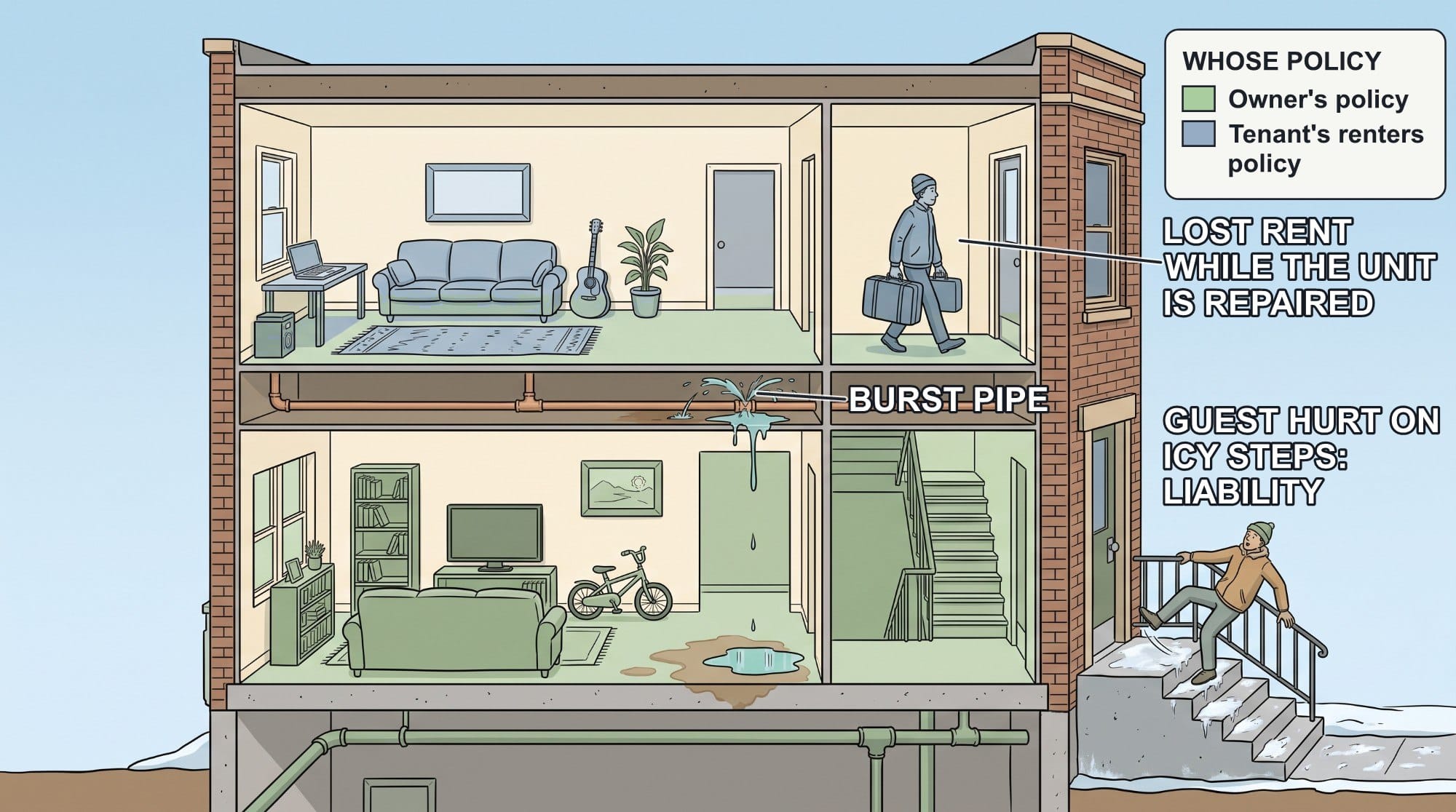
If a covered loss makes the property uninhabitable, repairs can take weeks or months. Loss of rents coverage can help replace rental income during the covered repair period, subject to policy terms.
This matters if rent helps pay the mortgage, taxes, insurance, utilities, or maintenance.
Liability exposure is real even with one tenant
Tenant injuries, visitor injuries, stairs, railings, sidewalks, snow and ice, dogs, maintenance disputes, and habitability issues can all create liability claims.
Review liability limits and consider whether umbrella coverage is appropriate, especially if you have personal assets or other properties.
Short-term rentals require special attention
Short-term rental, mid-term rental, Airbnb-style use, vacant periods, and renovation periods can all change eligibility. Some landlord policies are not designed for short-term rental activity.
Be accurate. A cheaper policy that does not match the use can fail at claim time.
Can I keep my homeowners policy if I rent the house?
Usually you should review and likely change coverage. Rental use changes the exposure.
Does landlord insurance cover tenant belongings?
Generally no. Tenants usually need renters insurance for their own belongings and liability.
Do small landlords need umbrella insurance?
Many should consider it because rental property creates liability exposure.
Talk with a local independent insurance agency
Longmeadow Insurance can help Chicago landlords review coverage for rental homes, condos, two-flats, three-flats, liability, loss of rents, and umbrella insurance. To start a review, use our get a quote form or call 847.242.1040.
Homeowners Policy vs. Landlord Policy, Side by Side
The two forms look similar on a declarations page and behave very differently at claim time. This is the comparison worth reading before you assume your existing policy stretched to cover the rental.
| Homeowners (HO-3) | Landlord (DP-3) | |
|---|---|---|
| Who it is written for | An owner living in the home | An owner renting the property to someone else |
| The building | Covered | Covered |
| Your personal belongings | Covered broadly | Limited, and only for items you keep on site such as appliances and maintenance equipment |
| Tenant’s belongings | Not covered | Not covered. That is the tenant’s renters policy |
| Lost income while the property is unrentable | Loss of use, for your own displacement | Loss of rents, sized to the actual rebuild timeline |
| Liability | Personal liability for your household | Premises liability arising from your ownership of the rental |
| Ownership in an LLC or trust | Usually a problem | Accommodated when the entity is properly named |
| Vacancy between tenants | Vacancy provisions can restrict coverage | Still restricted, but the form contemplates turnover |
| Claim while rented on a homeowners policy | Risk of denial for misrepresented occupancy | Not an issue |
The bottom row is the one that costs people money. A rental insured on an owner-occupied homeowners policy is not a small technicality. The carrier priced a risk that does not exist, and occupancy is a material fact. The scenario to worry about is a denied claim on a total loss, and it happens most often to accidental landlords: someone who moved, kept the old house, and never told the insurer.
Not All Landlord Policies Are the Same
Dwelling fire forms come in tiers, and the cheapest quote is usually the narrowest form rather than a better deal.
- DP-1. Basic named perils, often settled at actual cash value. Cheap, and rarely what an owner wants.
- DP-2. Broader named perils, usually replacement cost on the building.
- DP-3. Open perils on the building, meaning covered unless excluded. This is the form to compare against.
When two landlord quotes differ substantially, check the form tier and the settlement basis before assuming one carrier is simply cheaper.
Landlord Policy Questions
Can I rent out my house on my homeowners policy?
Not for an ongoing tenancy. Occupancy is a material fact on a homeowners policy, and renting the property out without telling your carrier risks denial of a claim and cancellation. Some carriers allow a short-term rental endorsement for occasional use, but a leased property needs a landlord form.
What is the difference between HO-3 and DP-3?
HO-3 is written for an owner who lives in the home and includes broad personal property and personal liability. DP-3 is written for a rented dwelling, trades most of the personal property coverage for loss of rents, and provides premises liability tied to your ownership rather than your household.
Does a landlord policy cover my tenant’s belongings?
A landlord’s property policy generally does not insure the tenant’s belongings. Tenants usually protect them through renters insurance. Your own liability coverage is a separate question if you are responsible for damage. Request proof of renters coverage where the lease requires it.
How much loss of rents coverage do I need?
Size it against a realistic rebuild timeline for your building type in this market, not against a default number of months. A total loss on a Chicago two-flat can take considerably longer to rebuild than owners assume once permitting and contractor availability are factored in.
Do I need a different policy if the property is in an LLC?
The policy needs to name the entity that actually holds title, and often the individual as well where a mortgage is involved. Titling a rental into an LLC without updating the policy is a common and avoidable gap. See our guide to trust and LLC ownership.
Related Insurance Guides
Coverage We Write
- Home insurance on the North Shore
- Flood and water backup coverage
- Umbrella insurance
- Personal insurance overview
Call 847.242.1040 or request a quote online.