
Every spring, heavy rain, saturated ground, and overwhelmed storm sewers put water into basements across the communities north of Chicago. Many homeowners learn only after the cleanup starts that their policy does not cover it.
If you live in communities like Glenview, Northbrook, Vernon Hills, Libertyville, Deerfield, Winnetka or Highland Park, check your flood risk and the water exclusions in your homeowners policy before the spring storms.
Why the Northern Suburbs Are Especially Vulnerable
The geography and infrastructure of Chicago’s northern suburbs add up to real flood risk each spring:
- Flat terrain and clay-heavy soil. Much of the northern suburban landscape is relatively flat, and the dense clay soils common to the region absorb water slowly. When spring rains arrive, especially after a wet winter, the ground simply has nowhere to send the water.
- Aging storm sewer systems. Many suburban communities were developed decades ago with infrastructure that wasn’t designed for the volume of impervious surface (driveways, rooftops, parking lots) that exists today. When heavy rains hit, storm sewers can quickly back up.
- Proximity to the Des Plaines River and its tributaries. Communities along the Des Plaines River corridor, including Libertyville, Mundelein, and portions of Vernon Hills, face regular flood events when the river overflows its banks after sustained rain.
- Heavy spring storms. Spring storms can drop two to four inches of rain in a few hours, far more than aging drainage systems can handle.
- FEMA maps identify Special Flood Hazard Areas, but homes outside those areas can also flood. Review the property’s elevation, drainage history, and basement use instead of relying on the zone alone.
- What a Standard Homeowners Policy Leaves Out
Here is the critical fact that surprises many homeowners after a flood loss:
Standard homeowners insurance policies do NOT cover flood damage. Water that enters your home from the ground up (whether from overland flooding, a river overflow, or a backed-up storm sewer) is typically excluded entirely from a standard policy.
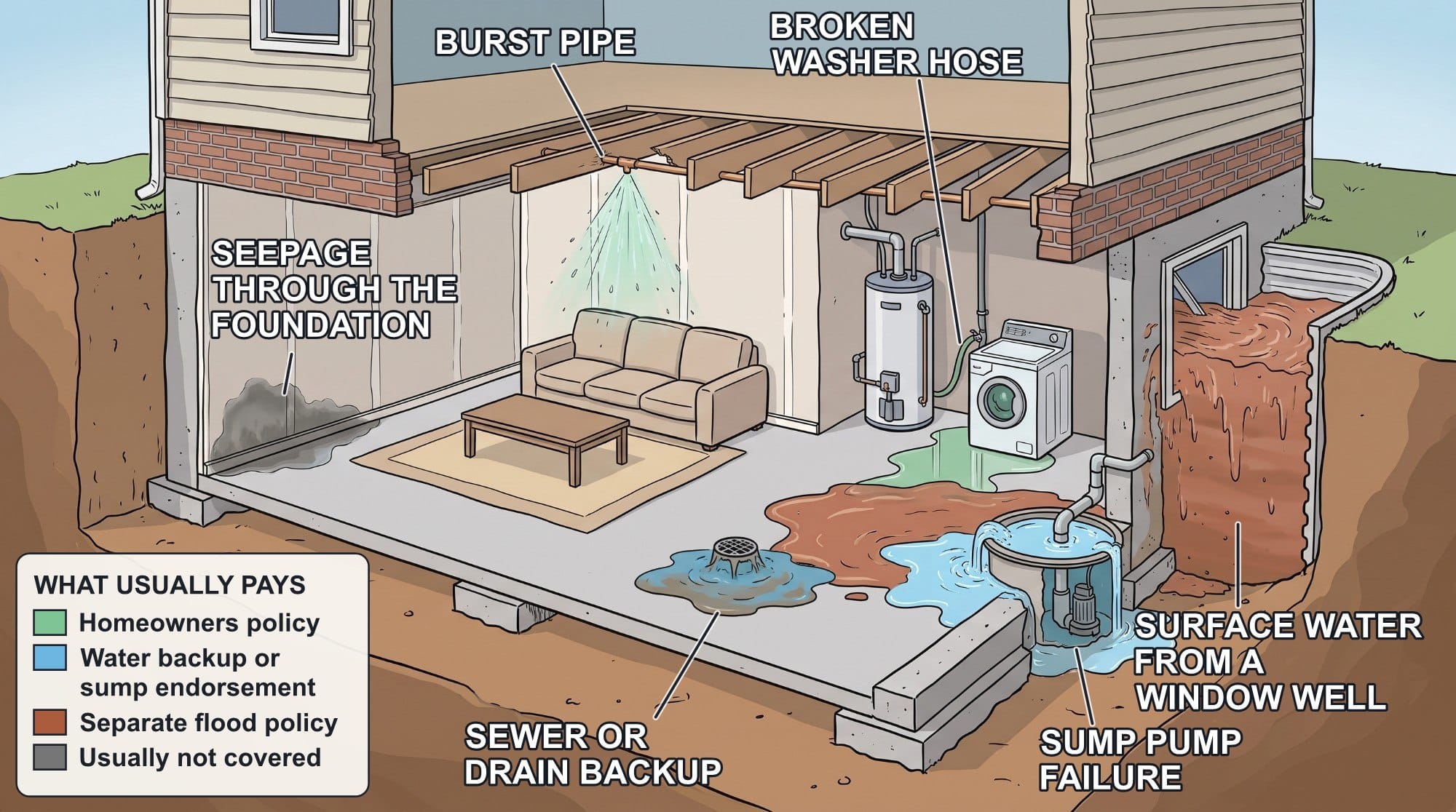
This exclusion applies regardless of the cause of the flooding. Here is how insurance typically treats common water damage scenarios.
Overland Flooding (Surface Water)
When rainwater flows across the ground and enters your home through doors, windows, or foundation cracks, that is a flood, and a standard homeowners policy does not cover it.
Sewer or Drain Backup
When municipal storm sewers become overloaded during heavy rain, water can back up through floor drains, toilets, and basement sinks. This is one of the most common causes of basement flooding in the northern suburbs, and it is also excluded from standard policies unless you have added a Sewer & Drain Backup endorsement, often called water backup coverage.
Sump Pump Failure
Many northern suburb homes rely on sump pumps to manage groundwater. If the pump fails (whether due to power outage, mechanical failure, or simply being overwhelmed) the resulting water damage is typically not covered unless you carry a Sump Pump Failure endorsement.
Coverage Options to Ask About
Coverage is available, but in most cases you must specifically request it. Here are the key options to discuss with your agent:
National Flood Insurance Program (NFIP). Backed by FEMA, NFIP policies provide up to $250,000 in structural coverage and $100,000 for contents. They are available to homeowners in participating communities regardless of flood zone designation. Note: there is typically a 30-day waiting period before coverage takes effect, so don’t wait until storm season is underway.
Private Flood Insurance. Private market flood policies have grown significantly in recent years and can offer higher coverage limits, broader definitions of flood, shorter waiting periods, and coverage for items (like finished basements) that NFIP may limit. They can be a strong alternative or supplement for higher-value homes.
Sewer & Drain Backup Endorsement. This is an add-on to your standard homeowners policy that specifically covers water damage from backed-up sewers, drains, and sometimes sump pumps. Given how frequently this happens in the northern suburbs, it is one of the most important endorsements a homeowner in this area can carry.
Sump Pump Failure Coverage. Often packaged with the sewer backup endorsement, this coverage protects you specifically when your sump pump fails or is overwhelmed. Given that a single sump pump failure can cause $20,000-$50,000 in basement damage, this is typically inexpensive coverage relative to its value.
Before the First Spring Storm
Spring arrives quickly in northern Illinois, and flood season is rarely far behind. Before the first major storm of the season, take these steps:
- Review your current homeowners policy and look for water and flood exclusions.
- Check whether you carry a sewer backup or sump pump failure endorsement.
- Look up your property on FEMA’s Flood Map Service Center (msc.fema.gov) to understand your designated flood zone.
- Talk to your insurance agent about flood insurance options: before the 30-day waiting period becomes a problem.
Add flood coverage well before storm season; with the waiting period, a policy bought after the forecast may not start in time. If you have questions about your current coverage or want to explore flood insurance options for your home in the northern Chicago suburbs, contact our office today for a complimentary policy review.
Related Coverage
- Personal Insurance Coverage
- Insurance for Northfield Homeowners
- Insurance for Glenview Properties
- Create a Home Inventory
- When to File a Claim vs. Pay Out of Pocket
A Practical Water-Coverage Checklist for Northern Chicago Suburbs
Before spring storms arrive, homeowners in Wilmette, Evanston, Glenview, Northbrook, Northfield, Winnetka, Glencoe, Kenilworth, Skokie, and Highland Park should review five separate issues: roof and gutter condition, sump pump reliability, sewer backup exposure, finished-basement values, and whether the home has any separate flood exposure.
The policy question is not just whether “water damage” is covered. Insurance policies draw lines between sudden interior water, backup through drains, water entering from outside, groundwater, flood, and maintenance-related leaks. Those lines can determine whether a claim is covered, limited, or excluded.
Finished Basements Need Special Attention
A finished basement can turn a small water event into a major loss. Flooring, drywall, built-ins, furniture, electronics, exercise equipment, stored clothing, and mechanical systems can exceed a small water backup limit quickly. Homeowners should compare the limit to what is actually downstairs, not just accept a default amount.
If the basement has a sump system, also review backup power, battery condition, pump age, and whether the policy’s water backup endorsement addresses sump overflow or failure. The best time to find the gap is before the next storm, not while the cleanup crew is on the way.
Questions to Ask Your Insurance Agent
Ask: What water losses are covered by my homeowners policy? What is my water backup limit? Does my deductible differ by type of loss? Is flood insurance separate? Are finished-basement improvements and contents fully reflected? Are there maintenance or seepage exclusions I should understand?
Longmeadow Insurance helps homeowners translate those questions into plain English so they know which risks are insured, which risks are self-insured, and which risks may need a separate policy or endorsement.
Related Insurance Guides
- Flood insurance on Chicago’s North Shore
- Ice dam prevention and insurance coverage
- When to file a homeowners insurance claim
- What to do when weather damage strikes
Coverage We Write
- Flood and water backup coverage
- Home insurance on the North Shore
- Condo insurance and HO-6 coverage
- Personal insurance overview
Call 847.242.1040 or request a quote online.