
Every year a number of North Shore households close up the house sometime between Thanksgiving and the new year and come back in March or April. Most of the planning goes into mail, plants, and the thermostat app. The insurance piece gets attention only if something goes wrong.
It is worth twenty minutes before you go, because a homeowners policy treats an empty house differently than an occupied one, and the specific provisions that change are the ones most likely to matter in a Chicago winter.
Tell the Insurer, and Get the Answer in Writing
Standard homeowners forms commonly suspend coverage for vandalism, malicious mischief, and glass breakage once a dwelling has been vacant for more than 60 consecutive days immediately before a loss.
There is an important distinction underneath it. Insurers and courts have long treated a vacant dwelling, meaning one empty of both occupants and contents, differently from one that is merely unoccupied while fully furnished. A North Shore house that still holds all the furniture while the owners are in Florida is usually the second rather than the first. That is the favorable reading, but the wording differs by form and it is not something to assume. Ask your carrier how your policy defines it and how long an absence they want to know about.
The conversation costs nothing. Discovering the answer during a claim is expensive.
The Freezing Exclusion Is the One That Costs Money
This is the provision that decides most winter-absence claims, and it is written as a conditional exclusion rather than a flat one.
Standard forms exclude loss caused by freezing of plumbing, heating, air conditioning, or automatic fire protective systems while the dwelling is vacant or unoccupied, unless you used reasonable care either to maintain heat in the building or to shut off the water supply and drain the systems and appliances of water.
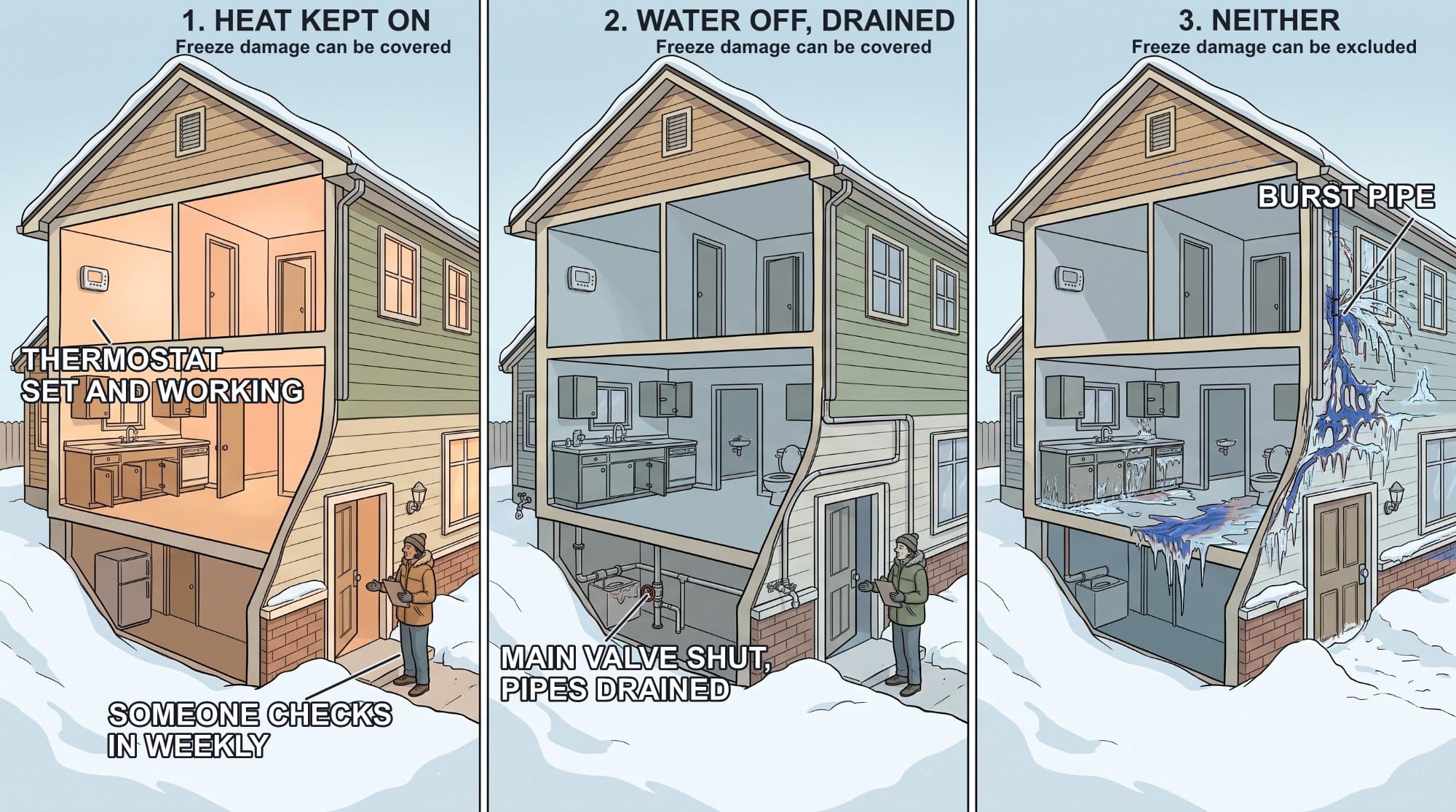
A burst supply line in an unheated second floor in January is a very large claim, and whether it is paid usually turns on whether you can show you did one of those two things.
If you keep the heat on:
- Set the thermostat to a real temperature rather than the minimum the system allows, and leave interior doors open so heat reaches exterior walls.
- Service the furnace or boiler before you leave. Heat that fails in February is the same outcome as heat that was never on.
- Use a thermostat or sensor that alerts you and someone local when the temperature drops, and confirm it still works after a power outage.
- Keep the gas and electric accounts active. A shutoff for nonpayment during a long absence leaves the house without heat.
- Open cabinet doors under sinks on exterior walls.
If you shut the water off instead: close the main, then actually drain the system rather than simply turning the valve. That includes supply lines, the water heater if appropriate, toilets, and outdoor spigots. A plumber can do this properly in an hour and will tell you what needs antifreeze in the traps.
Whichever route you choose, document it. Photographs of the thermostat setting, the service receipt, and a dated note of what was done cost nothing and are exactly what supports a claim later.
Water Gets In Other Ways Too
- The sump system. Test the pump before you leave, and check that the battery backup is not five years old. A February thaw over frozen ground produces exactly the conditions a sump handles, and nobody is home to notice it failed.
- The water backup limit. Confirm the endorsement is on the policy and that the limit reflects a finished lower level. Our guide to basement water coverage walks through how those claims are treated.
- Appliance connections. Washing machine hoses, ice maker lines, humidifier feeds, and water heaters are common failure points and they fail whether or not anyone is home.
- Automatic shutoff devices. A whole-house leak detection and shutoff valve is one of the few devices that reduces this exposure, and some carriers offer a credit. Ask before you buy, and ask what documentation they want.
Ice Dams, Roofs, and Snow
An empty house with the heat set low behaves differently on the roof than an occupied one, and ice dams remain the characteristic North Shore winter loss. That topic has its own article, and if you have not read it, the ice dam guide covers prevention, damage control, and how the coverage generally responds.
One point specific to being away: an unshoveled public walk is a liability exposure as well as a signal that nobody is home. If you hire a snow removal contractor, ask for a certificate of insurance before the first snowfall rather than after an incident. Our article on snow removal service risks explains what to look for on that certificate.
Make the House Look Lived In
- Hold the mail and suspend deliveries, or have someone collect them. A pile at the door advertises the absence.
- Keep the driveway and walks cleared on the normal schedule.
- Put interior lights on varied timers rather than one lamp burning continuously.
- Confirm the alarm is monitored and that the monitoring does not depend on a landline that has been disconnected. Cellular backup matters.
- Leave keys and alarm codes with one named person, and tell the local police department if your municipality offers a vacation watch.
- Do not announce the trip on social media while you are gone.
Who Is Checking the House, How Often, and Is It Written Down
Carriers frequently ask about this, and a clear answer is worth having. A weekly interior check by a named adult is a reasonable standard for a long absence. The point is not just discovering a problem but limiting how long it runs. A supply line that fails on day two and is found on day sixty is a different loss than one found on day four.
Ask whoever is checking to note the date, the thermostat reading, and anything unusual. A short log is both a maintenance tool and evidence of reasonable care.
Policy Changes Worth Making Before You Go
- Disclose the absence and confirm how the carrier treats it.
- Decide which house is the primary residence. If you now spend more of the year elsewhere, that affects how both properties should be written. Our second home insurance page covers how a seasonal property is handled.
- Do not strip the auto policy on a car left behind. Dropping liability to save a few dollars creates a gap in continuous coverage that affects future pricing, and it leaves nothing in place if someone moves the car.
- Check the umbrella. It should cover the liability at both properties, and a second location needs to be scheduled.
- If you plan to rent the house out while away, that is a different policy entirely and a standard homeowners form is generally not written for it. Raise it before listing, not after.
Longmeadow Insurance is an independent agency in Wilmette with offices across Chicago and the suburbs. If you are leaving for a few months, send the declarations pages for both properties and tell us the dates. We will tell you what your carrier needs to know and what should change. Start through the contact page or call 847.242.1040.
Frequently Asked Questions
Do I have to tell my insurance company I am leaving for the winter?
Tell them. Policies contain vacancy and occupancy conditions, and carriers differ on what length of absence they want disclosed and what precautions they expect. A short call before you leave also creates a record that you raised it, which is worth having if a claim follows.
Is my house considered vacant if we are away for four months?
Usually not, if it remains furnished and you intend to return. Insurers generally distinguish a vacant dwelling, empty of occupants and contents, from one that is unoccupied while furnished. The distinction matters because vandalism and glass breakage coverage is commonly suspended after 60 consecutive days of vacancy. Confirm the wording on your own policy.
Will frozen pipe damage be covered while we are away?
It depends on what you did before leaving. Standard forms exclude freezing losses while the dwelling is vacant or unoccupied unless you used reasonable care to maintain heat, or shut off the water supply and drained the systems. Doing one of those two things, and being able to show it, is what usually decides the claim.
How low can I set the thermostat?
Low enough to save money and high enough that pipes in exterior walls, unheated bathrooms, and crawl spaces stay well above freezing when the outside temperature drops hard. Your policy will not name a number. A temperature sensor that alerts you and someone local is worth more than any single setting.
Should someone check the house while we are gone?
Yes, and a weekly interior check by a named adult is a reasonable standard. Most carriers ask about this. Beyond satisfying the policy, it limits how long an undetected problem runs, which is usually the difference between a repair and a reconstruction.
Can I rent the house out while we are south for the winter?
Not under a standard homeowners policy without addressing it first. Renting the property, whether long term or through a short-term platform, changes the exposure and generally requires different coverage. Raise it with your agent before the listing goes up.
This article provides general educational information, not a coverage determination or legal advice. Vacancy and occupancy conditions, freezing exclusions, and carrier notification requirements vary by policy form and state. Coverage and claim payment depend on the applicable policy, endorsements, limits, exclusions, conditions, and the facts of the loss.
Coverage We Write
Call or text 847.242.1040 or request a quote online.