
Jewelry and Valuables Insurance in Illinois
Coverage at a Glance
Select an item in the room, a numbered marker, or a name below the picture to see how valuables insurance applies. Dashed markers are coverage-planning topics rather than separate policies.
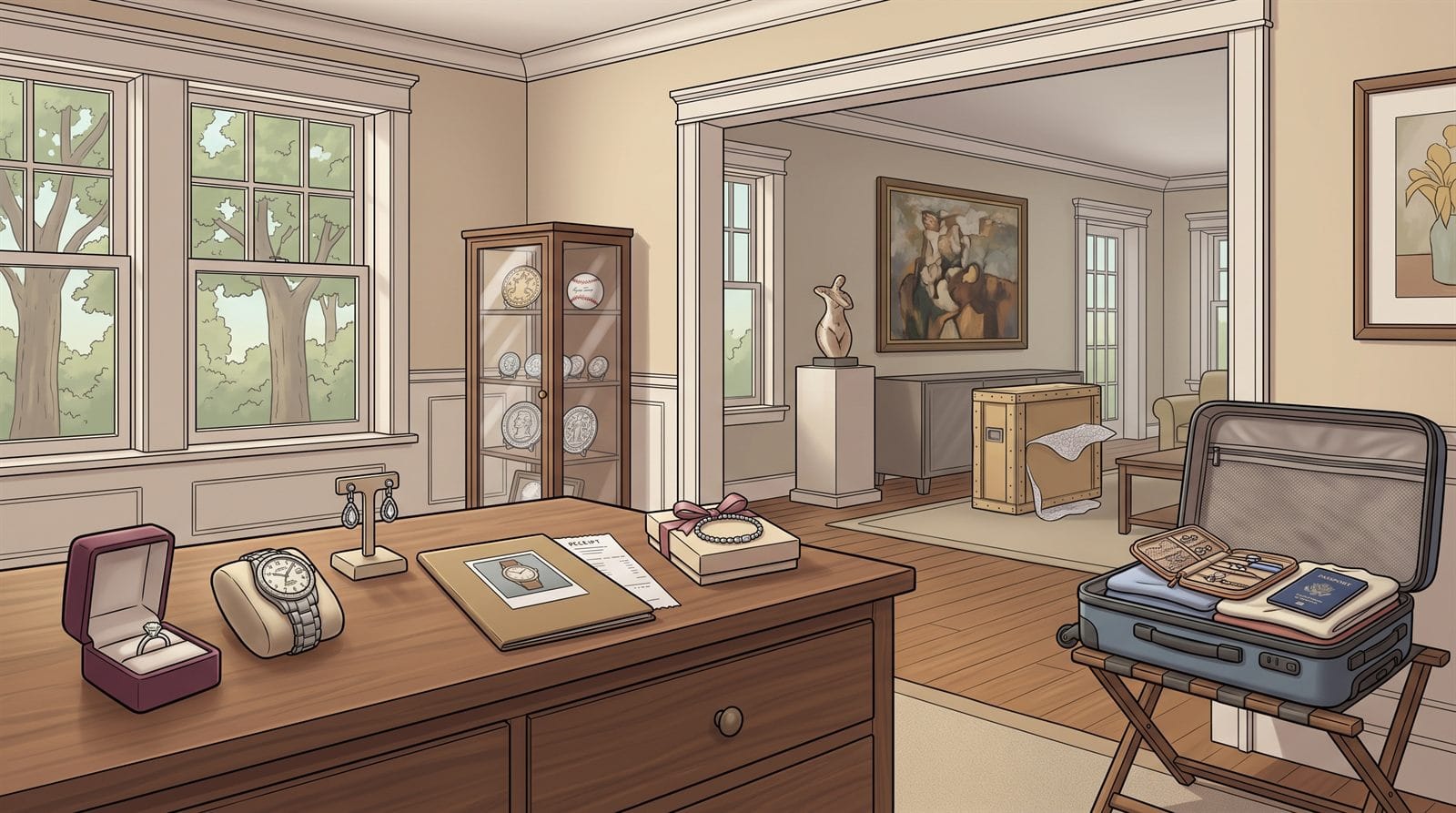
- Scheduled jewelry
Would your homeowners policy fully cover this ring?
Homeowners and renters policies often limit coverage for stolen jewelry. Scheduling your ring or purchasing separate jewelry insurance can provide a higher limit and broader protection. Review the insured value, deductible, and coverage for accidental loss or damage.
- Watch coverage
Insure the watch at its current value.
A valuable watch deserves a coverage review that reflects its model, condition, and current value. Specialized coverage can protect against covered theft, loss, and accidental damage. Ask how repairs and replacement are handled, and distinguish insured damage from routine servicing or wear.
- Coverage-planning topic: pairs and sets
What happens if you lose just one?
Losing one earring can affect the usefulness and value of the pair. Ask how your policy handles pairs and sets, including matching, replacement, and any requirement to surrender the remaining piece. Settlement provisions differ between policies.
- Coverage-planning topic: appraisals and values
Does your insured value still make sense?
An old appraisal may no longer reflect the cost of replacing an item. Keep photographs, receipts, and any required appraisals, and review values periodically. Ask whether claims are settled using an agreed value, replacement cost, or another valuation method.
- Coverage-planning topic: new purchases
Remember to insure new purchases and gifts.
A purchase, anniversary gift, or inherited piece can change your coverage needs. Some valuables policies provide limited automatic protection for newly acquired items, with reporting deadlines and conditions. Tell us promptly rather than assuming the item is fully covered.
- Worldwide coverage
Does your protection travel with you?
Specialized valuables insurance may protect covered items worldwide, including while traveling. Review territorial restrictions, storage conditions, and coverage for loss or theft away from home. Jewelry protection is separate from trip cancellation, travel medical, and baggage benefits.
- Fine art coverage
Repairing the painting may not restore its value.
Fine art coverage can address covered theft and accidental damage, including specialist restoration. Ask whether a covered repair that leaves the artwork worth less qualifies for loss-in-value protection. Keep artwork descriptions, ownership records, and valuations current.
- Accidental breakage
Accidental breakage needs its own coverage check.
A sculpture knocked from its pedestal may not be protected as broadly under ordinary contents coverage as you expect. Specialized fine art insurance can cover qualifying accidental damage. Review valuation, restoration options, and exclusions for fragile items.
- Collectibles coverage
A collection is more than ordinary household contents.
Coins, sports memorabilia, and other collectibles may need specialized coverage. Review whether individual items should be listed or protected under a blanket collection limit. Maintain an inventory and confirm how market value, authenticity documentation, and per-item limits affect coverage.
- Art in transit and storage
Protection matters while valuables are being moved.
Moving, shipping, storage, or lending artwork introduces different exposures. Ask whether your fine art policy covers the item throughout the journey and whether packing, handling, or transit conditions apply. Confirm protection before the artwork leaves your home.
Send us your appraisals or receipts and we will show you what scheduling each piece would cost.
Illustrative coverage options. Covered items, valuation methods, deductibles, reporting requirements, and exclusions vary by policy.
Your homeowners or condo policy already covers your belongings, but it treats certain categories differently, and jewelry is the sharpest example. A policy with a $200,000 personal property limit will commonly cap jewelry theft at $1,500 or $2,500. That cap applies no matter how much coverage you carry on everything else.
Scheduling an item, whether on your homeowners policy or a separate jewelry insurance policy, removes the cap. It also changes what causes of loss are covered, which is the part most people do not know until they lose something.
The Sublimits Already on Your Policy
Exact figures vary by carrier and form, and yours are in your policy wording or on your declarations page. The pattern is consistent enough to plan around.
| Category | What the sublimit usually restricts |
|---|---|
| Jewelry, watches, precious stones | Theft specifically, at a low dollar cap. Fire is usually covered to the full contents limit |
| Silverware and goldware | Theft, at its own separate cap |
| Firearms | Theft, and sometimes damage |
| Furs | Theft, at a per-item and aggregate cap |
| Cash and precious metals | A very low flat limit, often a few hundred dollars |
| Fine art, antiques, collectibles | Frequently no specific cap, but valuation after a loss is the problem rather than the limit |
Read the theft caps first. On most policies they are the binding constraint, and the number is smaller than the value of a single engagement ring.
What Scheduling Changes
- The item gets its own limit. A scheduled value replaces the relevant category sublimit for that item. Check whether a claim uses agreed value, replacement cost, or another settlement method.
- The deductible usually disappears for that item. A $2,500 policy deductible does not apply to a scheduled ring on most forms, which matters because many jewelry losses are smaller than a home deductible.
- Accidental loss can be included. Many scheduled-item forms cover losing an item as well as theft or damage. Confirm that protection for the item you are scheduling.
- Coverage travels. Worldwide, rather than tied to the residence.
Blanket or Itemized
There are two ways to write it and they suit different situations.
Itemized scheduling lists each piece with its own amount, supported by an appraisal or a receipt. It gives the clearest agreement about value up front, which is exactly what you want on a single significant piece.
Blanket coverage insures a category up to a total limit with a per-item maximum, usually without appraisals for items under that maximum. It suits a collection that changes, or a household that would rather not document twenty smaller pieces individually. The tradeoff is that value is established after a loss rather than before it.
Many households end up with both: the two or three pieces that matter most itemized, and a blanket amount over everything else. Which structures are available depends on the carrier, and it is one of the practical reasons to compare more than one.
Appraisals and Keeping Values Current
Carriers generally want a recent appraisal above a threshold amount, and a detailed receipt is often enough below it. The appraisal should describe the piece well enough to replace it: metal, weight, stone dimensions, cut, color, clarity, and any maker’s marks. A one-line valuation is not much use to an adjuster.
Refresh appraisals every three to five years. Precious metal and stone prices move, and an item scheduled at its 2015 value is underinsured in a way that only becomes visible at claim time. Some carriers offer an inflation provision that pays a percentage above the scheduled amount, which helps but does not substitute for an updated figure.
Photograph everything, keep the appraisals somewhere other than the house, and see our guide to documenting what you own.
Getting Items Scheduled
Send us your current homeowners or condo declarations page along with appraisals or receipts for anything you want covered. We will show you what your existing sublimits are, what scheduling each item would cost, and whether blanket coverage is the better structure for your situation.
Households with significant collections should look at high-value home insurance, where scheduling is part of a broader program rather than an endorsement. Call or text 847.242.1040 or start online.
Common Questions
Is my engagement ring covered by my homeowners policy?
Partly. It is covered for fire and most other named perils up to your contents limit, but theft is capped at a low sublimit, commonly $1,500 to $2,500. And simply losing the ring, with no theft involved, is generally not covered at all unless the ring is scheduled.
Do I need an appraisal to schedule jewelry?
Usually above a certain value, and a detailed purchase receipt often works below it. Requirements vary by carrier. The appraisal should describe the piece specifically enough that it could be replaced from the description alone.
How much does jewelry insurance cost?
It is priced as a rate per thousand dollars of value, and the rate depends on the item type and where you live. Jewelry costs more per thousand than fine art. For most households the annual cost of scheduling a ring is a small fraction of what replacing it would be, which is why we raise it on nearly every home policy we write.
Does scheduled coverage apply when I travel?
Generally yes, worldwide. That is one of the main advantages over relying on your contents limit, which is oriented around the residence. Confirm the specific wording if you travel with items frequently or store them abroad.
What happens if my item is worth more than the scheduled amount?
The scheduled amount is the item’s listed limit. The payment calculation depends on whether the coverage uses agreed value, replacement cost, or another method. Updated appraisals keep that limit aligned with replacement value; some policies also include an allowance for price increases.
Should I schedule or raise my overall contents limit?
A larger overall contents limit does not raise a separate jewelry-theft sublimit. Scheduling gives the item its own listed limit and can broaden the losses covered.