
Water claims are among the most frustrating insurance problems because homeowners often learn the definitions only after the basement is wet. Many people use the word flood to describe any water in the house. Insurance policies do not work that way. A sewer backup claim and a flood claim can look similar from the homeowner’s perspective. Both can put water in a basement. Both can damage flooring, drywall, mechanical systems, furniture, and stored property. But they are usually covered by different policies or endorsements. The distinction matters across Chicago, the North Shore, Lake County, DuPage County, and the western suburbs, where heavy rain, older sewer systems, and finished basements make water losses expensive.
What Sewer Backup Coverage Usually Means
Sewer backup coverage, often sold as water backup coverage, is typically added to a homeowners policy by endorsement. It is designed for water or sewage that backs up through a sewer, drain, sump, or similar system. Common examples include a floor drain backing up during heavy rain, a sump pump failing during a storm, or water entering through a drain in a finished basement. This coverage is not automatically unlimited. Policies often offer choices such as $5,000, $10,000, $25,000, $50,000, or higher limits depending on the insurer and the property. A finished basement with drywall, flooring, furniture, mechanical equipment, and electronics can exceed a small limit quickly. Homeowners should also check whether the endorsement covers both building damage and personal property, whether there is a separate deductible, and whether mechanical breakdown of a sump pump is treated differently from power failure or overwhelmed drainage.
What Flood Insurance Usually Means
Flood insurance generally applies when water comes from outside the home and affects normally dry land. Examples include overflowing rivers, storm surge, surface water runoff, and water that enters through windows, doors, window wells, or foundation openings because the surrounding ground is inundated. Standard homeowners policies exclude flood damage. That exclusion applies even if the homeowner is not in a lender-required flood zone. A property can be outside a mapped high-risk zone and still experience surface water flooding during a severe storm. Flood insurance may be available through the National Flood Insurance Program or through private flood markets. Each option has different limits, pricing, waiting periods, coverage terms, and claim handling characteristics.
Why Chicago Area Homeowners Confuse the Two
The confusion happens because the same storm can create multiple types of water damage. Heavy rain can overwhelm municipal systems, saturate soil around the foundation, push water toward window wells, and cause drains to back up. One basement loss may involve both surface water and sewer backup issues. From the homeowner’s point of view, it is all storm water. From the policy’s point of view, what matters is the path the water took into the home. Water through a drain may trigger one coverage. Water through a window well may require flood insurance. Water through a foundation crack may be treated differently again. This is why the coverage review needs to happen before the storm. Once water enters the basement, it is too late to restructure the policy. Water is only one of the ways a storm can leave a bill the policy does not cover; our guide to storm damage coverage gaps covers the others, from wind and hail deductibles to tree removal.
Finished Basements Need Higher Water Limits
Many Chicago and suburban homes have basements that are no longer storage space. They are family rooms, offices, gyms, guest suites, playrooms, and finished living areas. That increases the financial impact of a water claim. A small sewer backup limit may be reasonable for an unfinished utility area. It is usually not enough for a finished basement with flooring, trim, drywall, furniture, built-ins, and electronics. Homeowners should estimate the actual cost to remove damaged materials, dry the space, rebuild, replace contents, and address possible mold remediation. The right limit depends on the property. It should not be chosen casually from the default option on a quote.
Flood Zones Are Not the Whole Story
A mortgage lender may require flood insurance if a property is in a designated flood zone. That requirement is not the same as a complete risk analysis. Many homes outside those zones still have meaningful flood exposure from intense rainfall, poor drainage, nearby waterways, or grading that directs water toward the structure. Homeowners in Wilmette, Winnetka, Glencoe, Evanston, Oak Park, Elmhurst, Gurnee, and other communities should evaluate water risk based on the property, not only the map. Local drainage history, basement elevation, sump systems, neighborhood grading, and past water issues matter.
Common Water Claim Mistakes
The most common mistake is assuming every basement water claim is covered because the homeowner purchased insurance. Standard policies draw sharp distinctions between flood, sewer backup, seepage, groundwater, sump failure, and sudden plumbing discharge. Each category can be treated differently. A second mistake is choosing a low sewer backup limit because it reduces premium. That may be acceptable for an unfinished basement, but it is rarely enough for a finished lower level with flooring, drywall, furniture, and mechanical systems. A third mistake is waiting until after a neighborhood flood event to buy flood insurance. Flood policies often have waiting periods, and coverage cannot be added retroactively.
How to Think About the Right Limits
Start with the value of what is below grade. Include drywall, flooring, trim, furniture, mechanical equipment, appliances, electronics, storage, and cleanup costs. Then consider how much water remediation and rebuilding would cost if contractors are in high demand after a major storm. For flood insurance, consider the structure, basement limitations, personal property restrictions, and whether a private flood option offers broader terms than a standard federal policy.
Does Home Insurance Cover Sump Pump Failure?
Usually not on the base policy. Water that backs up through a sump, drain, or sewer is excluded from a standard homeowners form, and it is covered only if you carry the water backup and sump overflow endorsement. It is usually a separate purchase with its own limit, so look for it by name on your declarations page.
The endorsement generally responds when the pump fails mechanically, when it is overwhelmed by volume, or when it stops because the power went out, though power-outage wording varies by carrier and is worth confirming specifically. What it does not do is pay to replace the pump itself, which is maintenance.
Three Different Kinds of Water, Three Different Answers
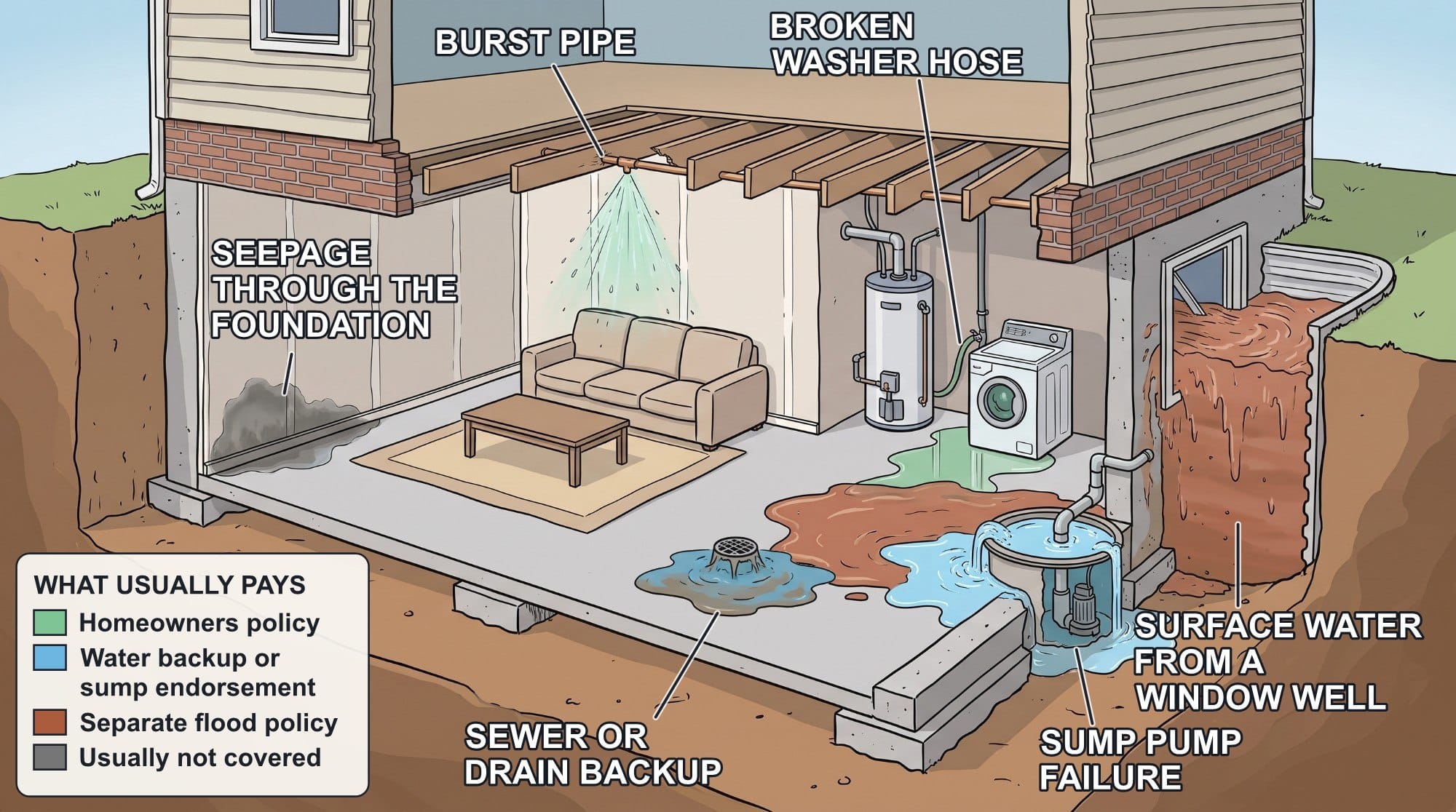
Most confusion here comes from treating basement water as one problem. Insurers treat it as three, and which one you had determines which policy responds.
| What happened | What it is called | What pays |
|---|---|---|
| Sewer line or municipal main backs up through a floor drain or toilet | Sewer backup | Water backup endorsement on your homeowners policy |
| Sump pump fails, jams, or cannot keep up and the pit overflows | Sump overflow | The same water backup endorsement, if the wording includes sump overflow |
| Power goes out during a storm and the pump stops | Sump overflow, usually | Depends on carrier wording. Some require a battery backup to have been in place |
| Surface water enters from outside, over the foundation or through window wells | Overland flood | A separate flood policy. Not the water backup endorsement |
| Groundwater seeps through the foundation or slab | Seepage | Generally excluded by everything. Treated as maintenance |
| A pipe inside the wall bursts | Sudden and accidental discharge | Covered by the base homeowners policy |
Two mistakes cause particular confusion: assuming a backup endorsement covers outside surface flooding, and assuming flood insurance pays for an isolated sump failure. A backup directly caused by a qualifying flood is a different situation. Have the cause and both policies reviewed when one storm creates several kinds of water damage.
Does Homeowners Insurance Cover Basement Flooding?
It depends on where the water came from. A homeowners policy usually pays for sudden water from inside the house, such as a pipe that freezes and bursts or a water heater or washing machine hose that gives way. Water that comes in from outside needs a flood policy, and water that comes up through a drain or sump needs a water backup endorsement.
Even when the water itself is covered, a few things usually are not: the broken pipe, pump, or sewer line itself, since the policy pays for the damage it caused rather than the failed part; mold, which many policies cap at a low limit or exclude; slow seepage through the foundation; and damage from maintenance that was put off.
Rain can cause more than one kind of loss at once. Surface water needs flood coverage, while a drain or sump backup during the same storm falls under the backup endorsement, so the cause of each part of the damage matters more than where the water came in. If you are weighing whether a claim is worth filing, our guide on when to file a claim and when to pay it yourself walks through the deductible and premium questions.
The Battery Backup Question
Storms in this region knock out power and drop several inches of rain at the same time, which is exactly when a sump pump is needed and exactly when it has no electricity. A battery backup or water-powered secondary pump is the single most useful thing most Chicago-area basements are missing.
It matters for insurance in two directions. Some carriers offer a credit for having one. More importantly, some water backup wording is narrower about power-related failure, and a functioning secondary pump removes the argument entirely.
Sump Pump and Backup Questions
Does homeowners insurance cover a failed sump pump?
Only if you carry the water backup and sump overflow endorsement. A standard homeowners policy excludes water that backs up through a sump or drain. The endorsement covers the resulting damage to your basement and belongings, not the cost of replacing the pump.
Is sump pump failure covered by flood insurance?
An isolated sump failure is usually a water-backup or sump-overflow claim. If a qualifying flood directly causes the backup, flood coverage can come into play. Many households need both coverages because the causes differ.
What if the power went out and the pump stopped?
Most water backup endorsements respond, but the wording varies and a few carriers are narrower about power-related failure. If you do not have a battery backup pump, this is the specific sentence in your policy worth reading before storm season rather than after.
How much water backup coverage should I carry?
Size it against what is actually in the basement. A finished lower level with a bathroom, flooring, drywall, mechanicals, and stored belongings costs far more to restore than the default endorsement limit most policies carry. Unfinished storage space needs much less.
Will one water claim affect my rate?
Water claims carry more weight with carriers than most homeowners expect, and repeat water claims at the same address affect both price and availability. That is an argument for sizing the limit correctly and for prevention, not for going without the coverage.
Prevention Still Matters
Insurance is not a substitute for maintenance. Sump pumps, battery backups, drain cleaning, grading, downspouts, backflow valves, water sensors, and regular inspections all reduce the chance and severity of a claim. Good risk control can also make coverage easier to place.
Coverage Review Checklist
- Confirm whether your policy includes sewer backup
- Review the sewer backup limit against your finished basement value
- Ask whether sump pump failure is included
- Evaluate private flood and NFIP options
- Do not rely only on lender flood-zone requirements
- Document basement improvements and contents
- Consider water sensors and backup power for sump pumps
Water Backup, Flood Insurance, or Both
Longmeadow Insurance can review your water-related coverage and help determine whether sewer backup, flood insurance, or both should be part of your plan.
How Longmeadow Insurance Can Help
Longmeadow Insurance is an independent agency based in Wilmette, Illinois. Send us your current declarations pages and we will tell you what they cover, and where the gaps are, before we quote anything. For a coverage review, call 847.242.1040 or request a consultation online.
Related Insurance Guides
Coverage We Write
- Flood and water backup coverage
- Home insurance on the North Shore
- Condo insurance and HO-6 coverage
- Personal insurance overview
Call 847.242.1040 or request a quote online.