
The Condo Insurance Gap Most Unit Owners Don’t Know About
If you own a condo in Illinois, you’re covered by two insurance policies: your association’s master policy and your personal HO-6 unit owner policy. The problem is that most unit owners have no idea where one policy ends and the other begins, and that gap is exactly where expensive surprises live.
What the Association’s Master Policy Covers
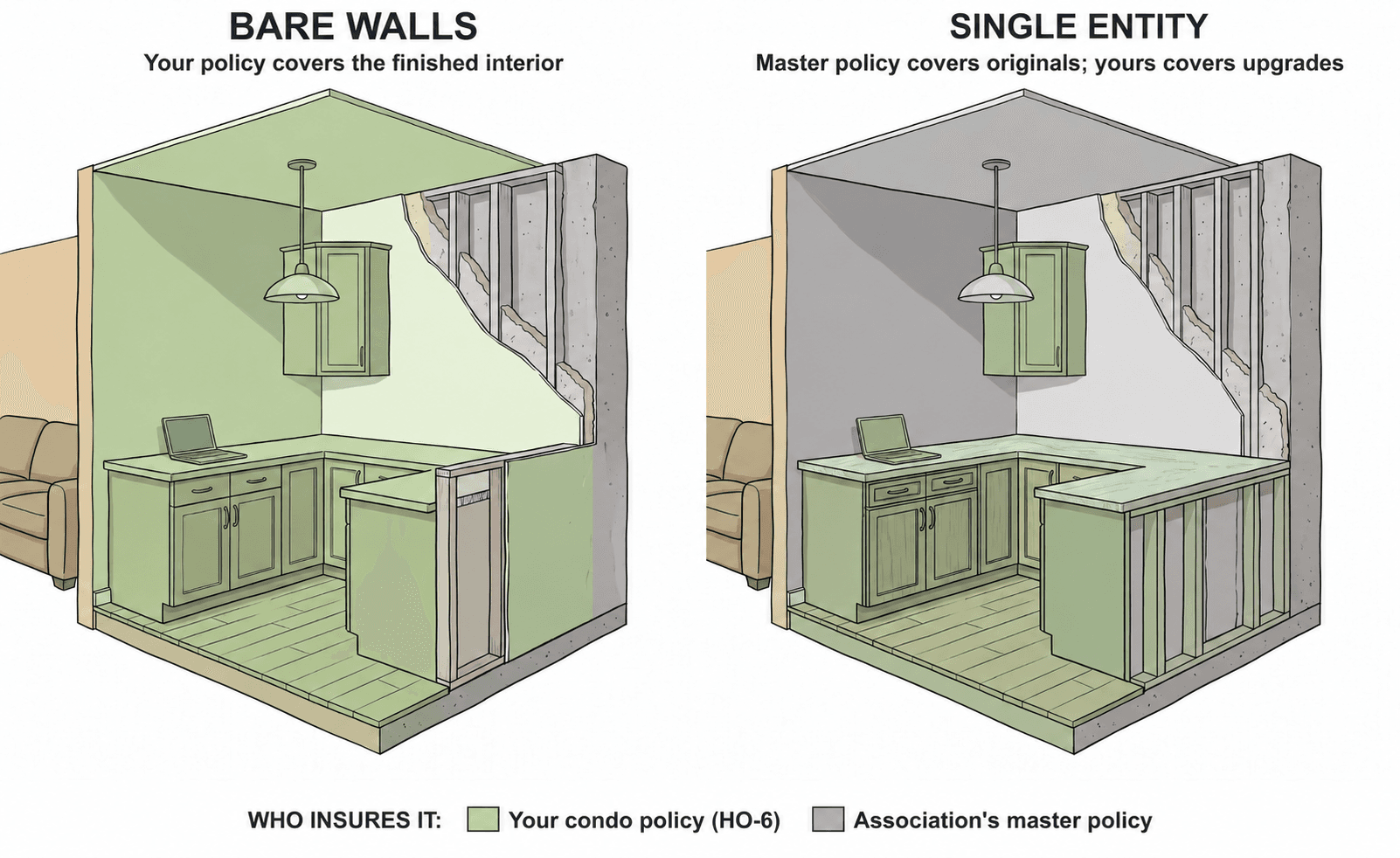
Your condo association carries a master policy for the building and common elements. Three common descriptions are bare walls, single entity, and all-in. The master policy, declaration, and Illinois insurance requirements set the actual division of responsibility.
Bare-Walls Coverage
A bare-walls description leaves more of the interior to the unit owner. The association still insures shared building property, such as:
- The building’s exterior structure (roof, walls, foundation)
- Common areas (lobbies, hallways, elevators, parking garages)
- Building systems and components identified in the master policy and governing documents
Do not assume the boundary is always the studs. For an Illinois condo, check who insures drywall, flooring, fixtures, and improvements against Section 12 of the Condominium Property Act, the declaration, and the master policy.
Single-Entity and All-In Coverage
Single-entity coverage generally includes the original fixtures and finishes installed by the builder; the owner insures later upgrades. All-in coverage also includes owner improvements covered by the master policy. Neither replaces the owner’s personal property or liability insurance.
What Your HO-6 Policy Needs to Cover
Your HO-6 covers your own insured property, belongings, liability, and qualifying assessments. It works alongside the master policy, with separate limits for each part of your protection:
Dwelling Coverage (Coverage A)
Dwelling coverage pays to repair the interior property you are responsible for insuring, such as cabinets, flooring, fixtures, and improvements. Set the limit from that responsibility and the cost of replacing those features.
The dwelling coverage amount should reflect the cost to rebuild your unit’s interior from scratch. For a renovated condo with custom finishes, this can easily be $100,000-300,000+.
Personal Property (Coverage C)
Your furniture, clothing, electronics, and other belongings. Replacement cost coverage pays what it costs to buy a new equivalent item, not the depreciated value.
Loss Assessment Coverage
Loss assessment coverage pays your share of qualifying assessments after a covered property or liability loss. Assessments involving the master policy’s deductible may have a separate limit. It does not pay routine maintenance, reserve contributions, or every shortfall in the association’s insurance.
Standard loss assessment coverage is often $1,000-2,000, nowhere near enough for a major building claim. Increasing this to $25,000-50,000 is inexpensive and strongly recommended.
Personal Liability
Personal liability addresses covered claims when you are responsible for injury or damage to someone else’s property. A leak affecting the unit below can involve several policies; the fact that water started in your unit does not by itself decide liability.
Additional Living Expenses
If your unit becomes uninhabitable due to a covered loss, this pays for temporary housing and increased living expenses.
The Most Common Condo Insurance Mistakes
1. Assuming the Master Policy Covers Your Interior
After a fire, the master policy and your HO-6 divide repairs according to the building’s documents and insurance. An adequate HO-6 dwelling limit should cover the interior property assigned to you, including any upgrades you must insure.
2. Underinsuring Dwelling Coverage
Many unit owners carry $20,000-50,000 in dwelling coverage when they actually need $150,000+. Think about what it would cost to install new flooring, cabinets, countertops, bathrooms, fixtures, and appliances throughout your entire unit.
3. Skipping Loss Assessment Coverage
One major building claim with an underinsured association can result in five- or six-figure special assessments to each unit owner.
4. Not Reading the Master Policy
Request the master policy’s declarations, relevant endorsements, and the declaration’s insurance provisions. Identify who insures original finishes, later improvements, and the master-policy deductible before setting your HO-6 limits.
How to Get Your Condo Insurance Right
- Get a copy of your association’s master policy declarations page
- Identify responsibility for original finishes, owner improvements, and deductible assessments
- Calculate the cost to rebuild your unit’s interior from scratch
- Set your HO-6 dwelling coverage to match that rebuild cost
- Increase loss assessment coverage to at least $25,000
- Add water backup coverage if your building has basement units
- Review annually, especially after renovations
Get a Free Condo Insurance Review
Longmeadow Insurance is an independent agency in Wilmette. We’ll review your association’s master policy alongside your HO-6 and show you where the gaps are. Request a free review or call (847) 242-1040.
Related Articles
Coverage We Write
- Condo insurance and HO-6 coverage
- Renters insurance
- Home insurance on the North Shore
- Personal insurance overview
Call 847.242.1040 or request a quote online.