Loss assessment coverage pays your share when a condo association bills every unit owner for a shortfall its master policy did not cover. Most HO-6 policies include a token amount by default. In a mid-sized Illinois building, the realistic exposure is often many times that.
It is often underfunded on Chicago and North Shore condo policies, and many owners first hear about it when the assessment letter arrives.
What a Special Assessment Actually Is
When an association faces a cost its reserves and insurance do not cover, the board can levy a special assessment: a one-time charge divided among unit owners, usually by percentage of ownership. It is not optional, and it is not negotiable once properly adopted under the Illinois Condominium Property Act and your declaration.
The most common triggers we see:
A large master policy deductible after a storm, fire, or water loss
Damage the master policy excluded entirely, such as flood or certain water backup
A liability claim in a common area that exceeds the association’s limit
Underinsured building coverage discovered at claim time
Uninsured repairs the reserve study did not anticipate
How Loss Assessment Coverage Responds
Loss assessment is a coverage part on your HO-6 policy. When the association levies an assessment arising from a covered cause of loss, your policy pays your share up to the limit you carry, subject to your deductible.
Two limits matter and they are not the same. There is the overall loss assessment limit, and there is frequently a separate, much lower sublimit for assessments arising from the master policy deductible itself. That second one is where policies quietly fail.
How to Size Your Limit
You can estimate your exposure in about five minutes with two numbers from the association.
Find the master policy deductible on the association’s certificate of insurance.
Divide it by the number of units, or multiply it by your percentage of ownership if the declaration allocates that way.
That figure is your share of a deductible-driven assessment before anything else goes wrong.
Add margin for the scenario the master policy does not cover at all, which is the larger risk.
Percentage-of-ownership allocation matters here. In a building where units vary in size, a larger unit carries a larger share, and dividing evenly understates the exposure for bigger owners.
The Deductible Assessment Trap
Master policy deductibles on Illinois condo buildings have climbed sharply, and wind and hail deductibles are increasingly written as a percentage of the building value rather than a flat dollar amount. A percentage deductible on a large building produces a number that dwarfs what most HO-6 policies carry for deductible assessments.
Ask two questions of your policy. Does it cover assessments arising from the master deductible at all? Some forms exclude exactly that. And if it does, is that sublimit anywhere near your calculated share?
What Loss Assessment Does Not Cover
Routine assessments. Regular dues increases, deferred maintenance catch-ups, and planned capital projects are not insurable losses.
Uncovered causes. If the underlying event would not be covered by your own policy, the assessment for it generally is not either. Flood is the usual example.
Amounts above your limit. The remainder is yours to pay.
Assessments charged before your policy started. Forms differ on whether the date of the loss or the date of the assessment controls, so check yours.
Illinois and Chicago Specifics
Older buildings. Vintage Chicago and North Shore buildings carry aging roofs, plumbing risers, and facades. Facade work in particular tends to arrive as an assessment.
Water is the dominant claim. Frozen pipes, ice dams, and sewer backup drive most building losses here, and backup is frequently excluded or sublimited on the master policy.
Small associations. Two flats, three flats, and small conversions often carry thin reserves, which raises the odds that a loss becomes an assessment rather than a reserve draw.
Reserve studies. A recent, funded reserve study is a genuine signal that assessments are less likely. It is worth asking for.
Common Questions
How much loss assessment coverage should an Illinois condo owner carry?
Start from your share of the association’s master policy deductible, then add margin for a loss the master policy does not cover at all. Default limits on many HO-6 policies are far below that figure, and raising the limit is usually one of the least expensive changes available on the policy.
Does loss assessment cover the master policy deductible?
Sometimes, and only up to a specific sublimit that is often much smaller than the main loss assessment limit. Some forms exclude deductible assessments entirely. This is the single most important thing to verify on the policy language rather than the declarations summary.
Is loss assessment coverage required in Illinois?
State law does not require it, but many association declarations require unit owners to carry an HO-6 policy, and some specify a minimum loss assessment limit. Lenders may also have requirements. Check the declaration before assuming the default limit is acceptable.
Can the association make me pay an assessment I disagree with?
If the board followed the procedure in the declaration and the Illinois Condominium Property Act, generally yes. This is a question for an association attorney rather than an insurance agent.
Does my loss assessment limit apply per assessment or per year?
That depends on the form. Some apply the limit per occurrence, others aggregate it across the policy period. If your building has had multiple losses, the difference is significant and worth confirming in writing.
Have Your Limit Checked
Send us your association’s certificate of insurance along with your current declarations page. We will calculate your share of the master deductible, compare it against your loss assessment limit and any deductible sublimit, and tell you plainly whether the gap is worth closing.
Consider a pipe break that damages several units and a hallway in a Chicago mid-rise. The association reports the claim under its master property policy, which has a $50,000 water deductible. The board then assesses ten owners $5,000 each. One owner has $25,000 of loss assessment coverage.
The owner cannot conclude that the $5,000 charge is covered merely because it is below $25,000. The insurer may ask whether the pipe break is a covered cause under the HO-6 form, what property the master policy covered, why this owner was assessed, whether the assessment was validly made, when the loss and assessment occurred, and what sublimit applies to a master deductible.
If repeated leakage, deterioration, faulty maintenance, or another exclusion caused the damage, the result could differ. If the assessment includes repairs, upgrades, and the deductible in one invoice, the components may need to be separated. This example illustrates questions, not a promise that coverage applies.
When Timing and Policy Dates Matter
An assessment may arrive months after the underlying incident. HO-6 policies can contain rules about when the occurrence took place, when the assessment was made, and which policy period applies. Buying a higher limit after the building loss is known may not make that new limit available for the earlier event.
Keep notices that identify the date and cause of loss. If you change carriers, save prior policies and declarations. Report a potential assessment promptly rather than waiting for a collection deadline. Late notice can complicate fact gathering and may affect rights under policy conditions.
The Condo Insurance Gap Most Unit Owners Don’t Know About
If you own a condo in Illinois, you’re covered by two insurance policies: your association’s master policy and your personal HO-6 unit owner policy. The problem is that most unit owners have no idea where one policy ends and the other begins, and that gap is exactly where expensive surprises live.
What the Association’s Master Policy Covers
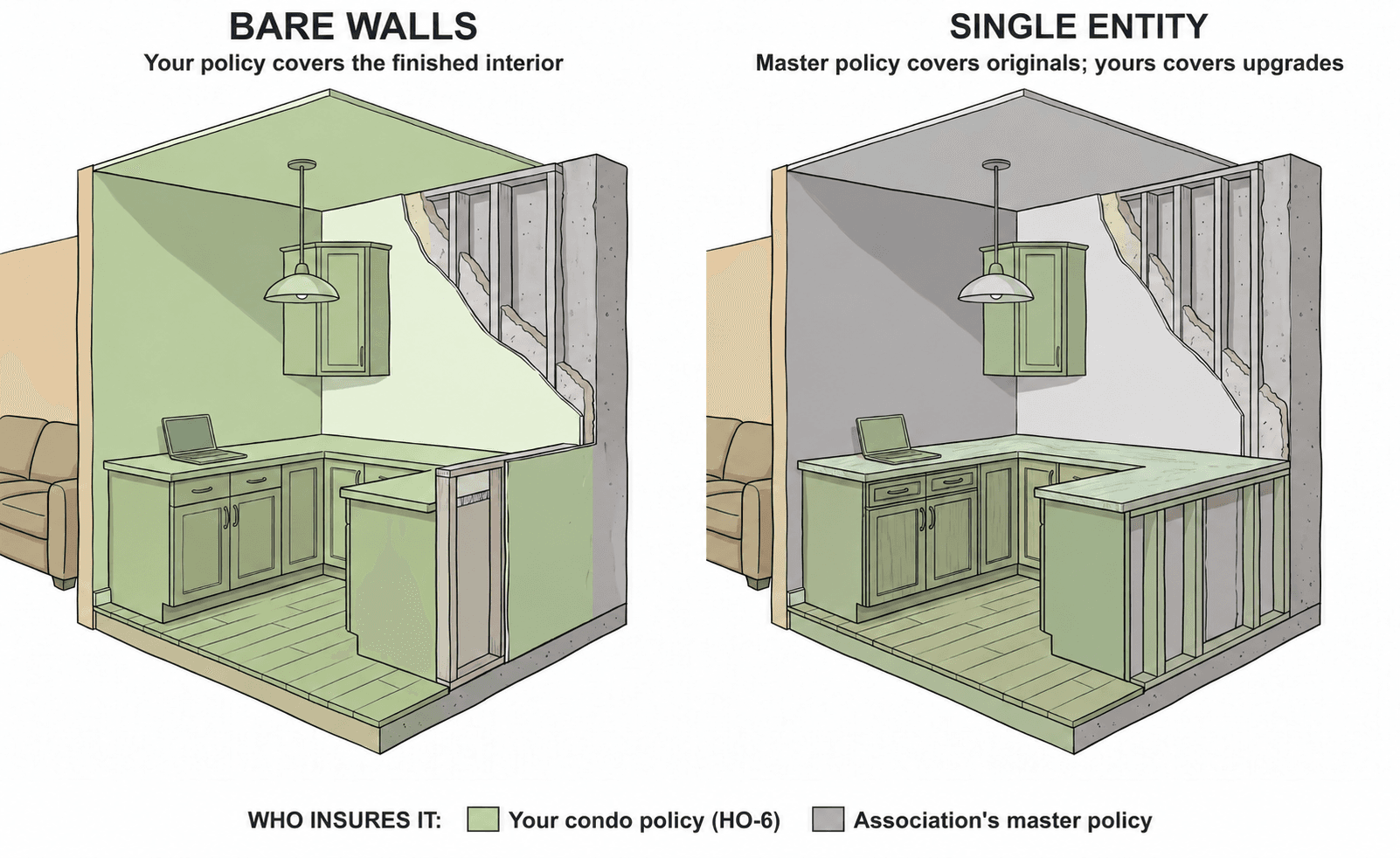
Your condo association carries a master policy for the building and common elements. Three common descriptions are bare walls, single entity, and all-in. The master policy, declaration, and Illinois insurance requirements set the actual division of responsibility.
Bare-Walls Coverage
A bare-walls description leaves more of the interior to the unit owner. The association still insures shared building property, such as:
The building’s exterior structure (roof, walls, foundation)
Common areas (lobbies, hallways, elevators, parking garages)
Building systems and components identified in the master policy and governing documents
Do not assume the boundary is always the studs. For an Illinois condo, check who insures drywall, flooring, fixtures, and improvements against Section 12 of the Condominium Property Act, the declaration, and the master policy.
Single-Entity and All-In Coverage
Single-entity coverage generally includes the original fixtures and finishes installed by the builder; the owner insures later upgrades. All-in coverage also includes owner improvements covered by the master policy. Neither replaces the owner’s personal property or liability insurance.
Master-policy descriptions should distinguish original finishes from owner improvements. Single-entity coverage generally includes the originals; all-in coverage also includes covered improvements. Your belongings remain yours to insure.
What Your HO-6 Policy Needs to Cover
Your HO-6 covers your own insured property, belongings, liability, and qualifying assessments. It works alongside the master policy, with separate limits for each part of your protection:
Dwelling Coverage (Coverage A)
Dwelling coverage pays to repair the interior property you are responsible for insuring, such as cabinets, flooring, fixtures, and improvements. Set the limit from that responsibility and the cost of replacing those features.
The dwelling coverage amount should reflect the cost to rebuild your unit’s interior from scratch. For a renovated condo with custom finishes, this can easily be $100,000-300,000+.
Personal Property (Coverage C)
Your furniture, clothing, electronics, and other belongings. Replacement cost coverage pays what it costs to buy a new equivalent item, not the depreciated value.
Loss Assessment Coverage
Loss assessment coverage pays your share of qualifying assessments after a covered property or liability loss. Assessments involving the master policy’s deductible may have a separate limit. It does not pay routine maintenance, reserve contributions, or every shortfall in the association’s insurance.
Standard loss assessment coverage is often $1,000-2,000, nowhere near enough for a major building claim. Increasing this to $25,000-50,000 is inexpensive and strongly recommended.
Personal Liability
Personal liability addresses covered claims when you are responsible for injury or damage to someone else’s property. A leak affecting the unit below can involve several policies; the fact that water started in your unit does not by itself decide liability.
Additional Living Expenses
If your unit becomes uninhabitable due to a covered loss, this pays for temporary housing and increased living expenses.
The Most Common Condo Insurance Mistakes
1. Assuming the Master Policy Covers Your Interior
After a fire, the master policy and your HO-6 divide repairs according to the building’s documents and insurance. An adequate HO-6 dwelling limit should cover the interior property assigned to you, including any upgrades you must insure.
2. Underinsuring Dwelling Coverage
Many unit owners carry $20,000-50,000 in dwelling coverage when they actually need $150,000+. Think about what it would cost to install new flooring, cabinets, countertops, bathrooms, fixtures, and appliances throughout your entire unit.
3. Skipping Loss Assessment Coverage
One major building claim with an underinsured association can result in five- or six-figure special assessments to each unit owner.
4. Not Reading the Master Policy
Request the master policy’s declarations, relevant endorsements, and the declaration’s insurance provisions. Identify who insures original finishes, later improvements, and the master-policy deductible before setting your HO-6 limits.
How to Get Your Condo Insurance Right
Get a copy of your association’s master policy declarations page
Identify responsibility for original finishes, owner improvements, and deductible assessments
Calculate the cost to rebuild your unit’s interior from scratch
Set your HO-6 dwelling coverage to match that rebuild cost
Increase loss assessment coverage to at least $25,000
Add water backup coverage if your building has basement units
Review annually, especially after renovations
Get a Free Condo Insurance Review
Longmeadow Insurance is an independent agency in Wilmette. We’ll review your association’s master policy alongside your HO-6 and show you where the gaps are. Request a free review or call (847) 242-1040.
Your condo association’s insurance and your own unit-owner policy need to be reviewed together. An HO-6 policy can cover belongings, certain interior property, personal liability, and additional living expenses after a covered loss. It does not automatically cover everything the association’s policy leaves unpaid.
Before comparing quotes, collect your declarations page, the association’s insurance information, and the documents describing unit-owner responsibilities. A certificate of insurance is a useful summary, but it does not replace the policy and endorsements.
Coverage at a Glance
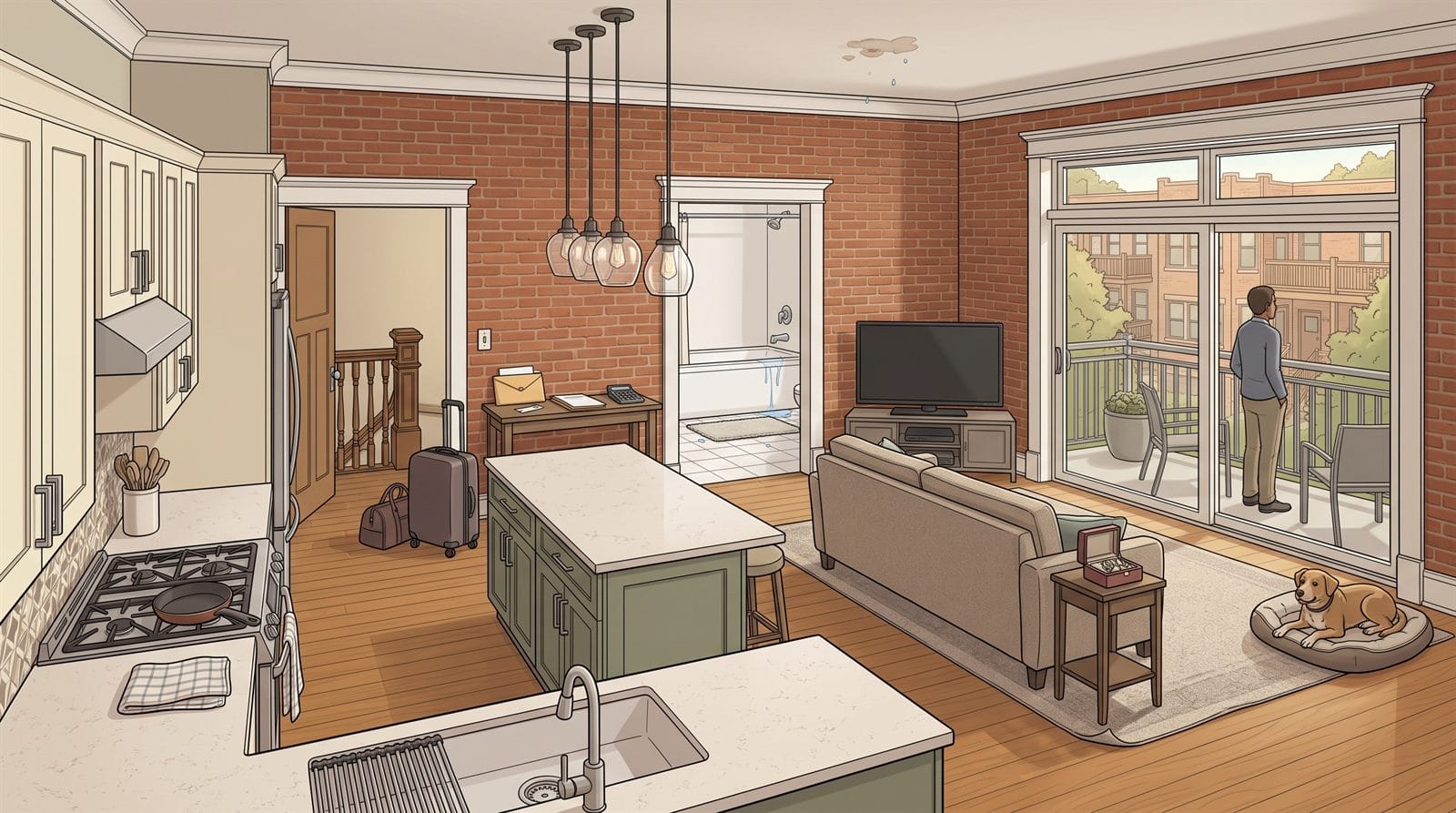
Select an item in the condo, a numbered marker, or a coverage name below the picture to see how condo insurance applies.
Dwelling coverage (interior)
Who pays to rebuild your kitchen?
Custom cabinets, countertops, flooring, and other improvements can be expensive to replace. Your condo policy can help cover interior property you’re responsible for after a covered loss. We’ll read your association’s insurance and governing documents and help you set a dwelling limit that matches the interior property assigned to you.
Master policy versus unit policy
What does the association’s insurance cover?
The association generally insures shared building property, but coverage inside individual units varies. Don’t assume everything inside your walls is your responsibility, or that the association covers it all. Your condo policy should fit the master policy and the association’s governing documents.
Loss assessment coverage
Could a building claim become your bill?
After certain shared property or liability losses, the association may assess unit owners for costs. Loss assessment coverage may help pay your share of a qualifying assessment. Routine maintenance and planned improvements aren’t covered. Assessments involving the master policy’s deductible may have special limits or exclusions.
Water damage you cause
Your overflowing tub can affect more than your bathroom.
A sudden, accidental overflow may damage your belongings, interior finishes, and the unit below. Different coverages can apply to each. Your liability protection may respond if you’re legally responsible for someone else’s damage; responsibility isn’t determined simply by where the water started.
Damage from another unit
What if the upstairs neighbor has a leak?
A leak from another unit can damage your ceiling, floors, and belongings. Your own policy may help with covered damage even when the water originated elsewhere. Notify your insurer and association promptly; which policy pays depends on the cause, damaged property, and applicable responsibilities.
Water backup endorsement
Water backup needs its own coverage check.
Water backing up through a sewer or drain is generally excluded from standard condo insurance. An optional endorsement may cover resulting damage to insured belongings and interior property. Ask about available limits and exclusions. Water backup coverage does not replace flood insurance.
Fire and smoke damage
A small cooking fire can cause a big loss.
Fire and smoke can damage belongings and interior finishes throughout your condo. Your policy can help pay for covered damage to property it insures. The association’s policy may also be involved when the building is damaged.
Personal property
What would it cost to replace everything you own?
Furniture, clothing, electronics, and household items are protected by personal property coverage against covered losses. Ask for replacement cost coverage so depreciation doesn’t reduce the value used to settle eligible claims. Choose a limit based on replacing all your belongings.
Loss of use
Where would you live during repairs?
If a covered loss makes your condo unlivable, loss of use coverage can help pay additional costs for a hotel or temporary rental, meals, and other eligible expenses. It covers increases above your normal living expenses, subject to policy limits and the covered repair period.
Personal liability
An accident could put your savings at risk.
If you accidentally knock a planter from the balcony and injure someone below, personal liability coverage can help with a covered claim and legal defense. Ask whether your liability limit is enough and whether an umbrella policy would provide useful additional protection.
Medical payments to others
A guest trips and needs treatment.
Medical payments to others coverage can help pay a guest’s medical expenses after a qualifying accident, regardless of fault. It has a separate limit and generally doesn’t cover you or household residents. Larger claims involving your legal responsibility fall under liability coverage.
Scheduled valuables
Some valuables need more than standard coverage.
Your policy may limit payment for stolen jewelry, watches, and other valuables. Scheduling individual items or buying separate jewelry and valuables insurance raises those limits and can add coverage for accidental loss. Let’s check your valuable items before a claim reveals a gap.
Pet liability
Your pet can create a liability claim.
If your dog bites someone or causes an injury, your personal liability coverage may help. Animal exclusions and eligibility rules differ by insurer, so tell us about your pets. This coverage protects against qualifying liability claims; it isn’t veterinary insurance.
Send us your association’s insurance documents and we’ll help identify gaps in your condo coverage.
Coverage varies by policy and association requirements. Limits, deductibles, exclusions, and optional endorsements apply.
How the two policies fit together
The association arranges insurance for shared property and other association exposures. Your unit-owner policy addresses your own insured property and liability. The details depend on the insurance contracts, governing documents, and applicable law.
Boards and property managers will find the association side in more depth on our condo association insurance page.
For Illinois condominiums, Section 12 of the Condominium Property Act addresses association insurance and unit-owner coverage. Do not rely only on a description such as “bare walls” or “all in” when deciding what to insure. Ask the association and your agent to identify the relevant provisions.
Questions to resolve before selecting HO-6 limits
Item
What to check
Building and common areas
Which property the association insures, the covered causes of loss, and the deductible.
Cabinets, flooring, fixtures, and renovations
Which interior property is your responsibility and whether improvements made by you or a prior owner are included.
Furniture and other belongings
Your personal property limit, settlement terms, and special limits for items such as jewelry.
Temporary housing
When additional living expense coverage applies and its dollar or time limits.
Injury or damage involving another person
The liability provisions, exclusions, and limits that apply to the circumstances.
Association assessments
Which assessments qualify under your policy and whether a separate deductible-assessment limit applies.
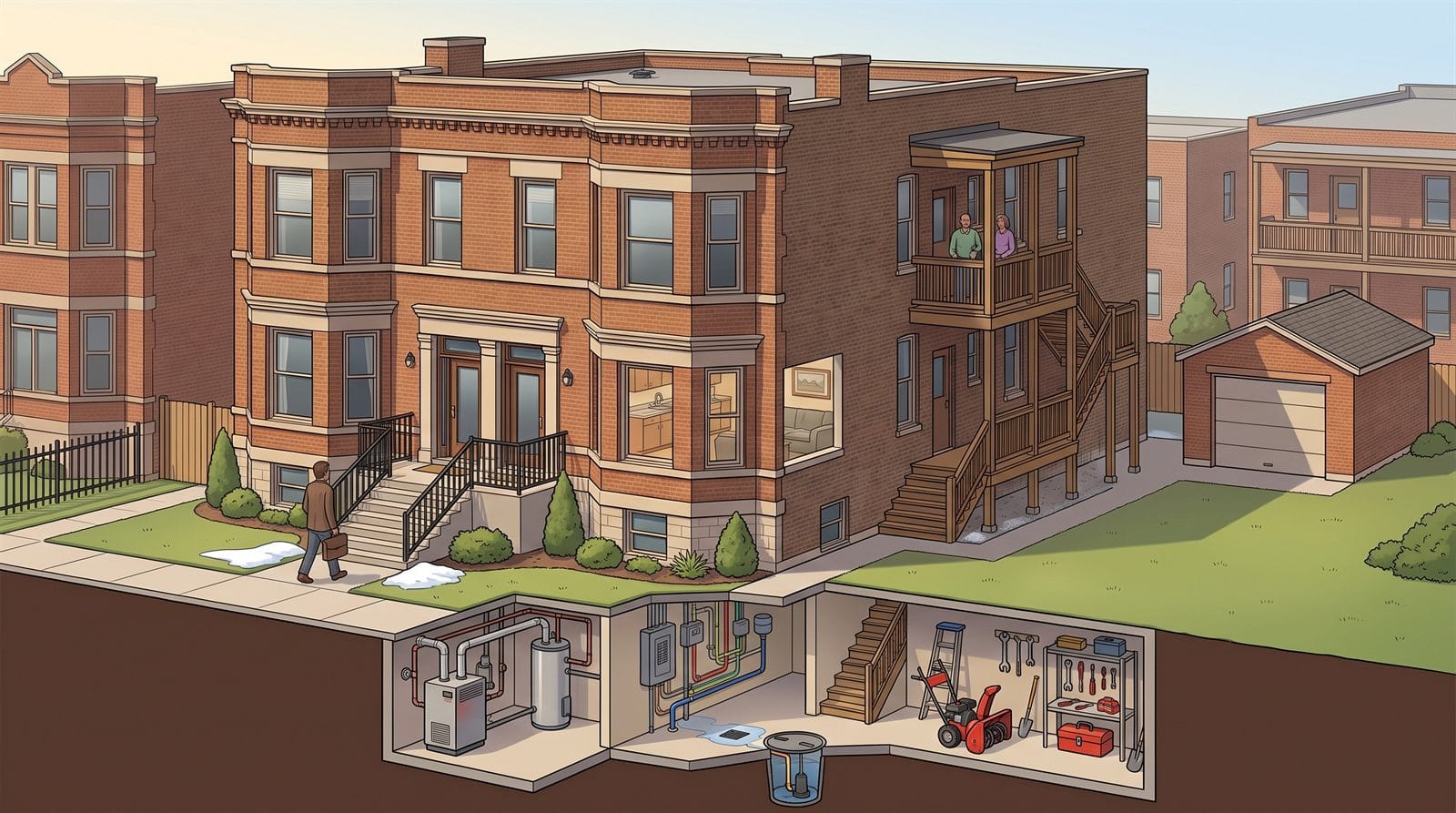
Select a part of the building, a numbered marker, or a coverage name below the picture to see where each coverage applies.
Building property coverage
Could your association afford to rebuild?
Building property coverage helps repair or replace insured property after a covered loss, such as fire. The insurance amount should reflect reconstruction costs, not the building’s sale price or owners’ combined equity. Ask how your policy handles replacement cost, coverage limits, and underinsurance.
Roof coverage and deductibles
A roof claim can come with a large deductible.
Wind or hail damage may be covered, but roof coverage can have separate deductibles, payment limitations, or exclusions. Aging roofing and routine maintenance generally aren’t insured losses. We’ll check the roof settlement terms before a storm reveals an expensive gap.
Ordinance or law coverage
Repairs may have to meet today’s building codes.
After a covered loss, required code upgrades can increase rebuilding costs. Ordinance or law coverage can help with qualifying upgrades, demolition, and loss to undamaged portions of the building. It isn’t a fund for correcting existing code violations or routine modernization.
Equipment breakdown
What happens when the building’s heat fails?
Equipment breakdown coverage can help with covered sudden mechanical or electrical breakdowns of insured building equipment. Ask about repair costs and related extra expenses. Ordinary wear, corrosion, and routine maintenance are generally excluded; an old boiler needing replacement isn’t automatically a covered claim.
Water damage from building plumbing
One broken pipe can affect several units.
Sudden, accidental water damage from building plumbing may be covered. The damaged property, cause of loss, and association responsibilities determine how the master policy and unit-owner policies respond. Ask about water-damage deductibles and restrictions on repeated leakage or seepage.
Sewer backup and sump overflow
Water coming up is a different coverage question.
Sewer backup and sump overflow can damage shared equipment and building interiors. Don’t assume they’re included in ordinary water-damage coverage. Ask for specific protection and adequate limits. Also review flood coverage separately. Surface flooding and drain backup can trigger different policy terms.
General liability
A visitor slips on the shared entrance.
General liability coverage can help defend the association and pay covered damages when it is legally responsible for someone’s injury or property damage. Shared stairs, walkways, and entrances deserve particular attention. Insurance works alongside regular inspections, repairs, and snow removal.
Commercial umbrella
Could a serious injury exceed your liability limit?
A major accident involving shared stairs or a porch could produce a substantial liability claim. Commercial umbrella or excess liability coverage can add protection above specified underlying policies. Check which policies it follows; coverage for board-related claims isn’t automatically included.
Directors & officers, crime, and social engineering
The board’s decisions and the association’s money
Volunteer board members can still be sued. Disputes over assessments, rule enforcement, or board decisions can lead to claims against the association and its directors. Directors and officers liability insurance can help with covered allegations of wrongful acts. Ask about defense costs, nonmonetary claims, and coverage for the property manager.
Protect the association’s operating and reserve funds. Crime or fidelity coverage can help protect association funds against covered theft or dishonesty. Make sure the policy addresses the people who handle your money, including board members and any management company. Review the limit against the funds the association holds.
What if a contractor’s payment instructions are fake? A convincing email can trick a board member into transferring association funds to a criminal. Ask specifically about social engineering and fraudulent payment coverage; ordinary crime or cyber insurance may leave gaps. Independently verify changes to payment instructions before sending money.
Business personal property
The association owns more than the building.
Shared maintenance equipment, tools, and other association-owned belongings also need protection. Business personal property coverage can help after a covered loss. Include their replacement value when reviewing insurance, and distinguish association property from residents’ belongings kept in the basement.
Other structures
Are all association structures included?
A detached garage or other shared structure can be overlooked when coverage is arranged. Confirm that the policy includes every structure the association is responsible for, with appropriate values. Building coverage does not automatically insure residents’ cars or everything they store inside.
Master policy versus unit-owner policies
Where does the association’s coverage end?
The master policy and each owner’s condo policy should work together. Interior building components, owner improvements, personal belongings, and liability can fall under different coverages. We’ll review the governing documents and insurance terms to help clarify responsibilities and identify gaps.
Send Longmeadow your master policy and condo declaration for an association coverage review.
Illustrative coverage examples. Coverage depends on policy terms, endorsements, deductibles, exclusions, and applicable association responsibilities.
Interior repairs and improvements
Make a room-by-room list of finishes and improvements. Include work completed before you bought the unit: a renovated kitchen, new flooring, built-in cabinetry, or a remodeled bathroom may affect the amount you need to insure.
Ask which policy would address damage to each item. Then compare your dwelling coverage limit (the building-property figure on your HO-6) with the cost of repairing the items assigned to you. That comparison tells you how much dwelling coverage your condo needs. The unit’s purchase price is not a substitute for that estimate.
For a vintage Chicago or North Shore unit, describe plaster, millwork, and other finishes accurately. Keep renovation invoices and photographs with your inventory. If you are planning work, discuss the project before construction begins.
Loss assessments and deductibles
An association may charge owners for costs following a loss. Loss assessment coverage can help with certain qualifying assessments, but it does not pay every special assessment. Maintenance projects, reserve contributions, and losses excluded by the policy need separate consideration.
Read the assessment coverage wording as well as the headline limit. Ask whether it covers an assessment arising from the association’s deductible, whether that protection has a smaller sublimit, and which date determines coverage.
Do not assume your exposure is the master-policy deductible divided by the number of units. Obtain the association’s allocation provisions and ask how they apply to a loss involving your unit. Ownership percentages and the circumstances of the damage may matter.
For example, a $50,000 loss assessment limit does not establish that a $20,000 charge to you will be paid. The reason for the assessment, covered cause of loss, policy conditions, and any deductible sublimit still need to be checked. Ask the agent to show you the relevant endorsement.
Water damage and liability
Describe how water entered the unit before deciding which coverage might apply. A leaking supply line, a sewer backup, and surface flooding raise different questions. Photographs and the plumber’s findings can help document the source.
Water from another unit: report damage to your insurer and the association promptly. Coverage and responsibility depend on the facts and the policy documents; the upstairs owner’s insurer does not automatically owe your deductible.
Water leaving your unit: give your insurer the details of any demand from a neighbor or the association. The location of the leak alone does not establish liability or coverage.
Sewer or drain backup: check whether the applicable endorsement is included and read its limits, deductible, and exclusions. See our sewer backup guide.
Surface flooding: review flood coverage separately. FEMA’s flood policy guidance explains that sewer backup is covered by the NFIP only when it directly results from flooding. Basement coverage has additional limitations.
For liability, compare the limits on your condo and auto policies before considering an umbrella policy. Confirm the umbrella’s underlying coverage requirements and that the people and properties you want covered qualify.
A renewal checklist
Obtain your HO-6 declarations and endorsements, the association’s insurance summary, and its current deductible information.
Ask for the provisions describing insurance responsibilities and assessment allocation. Request the relevant master-policy wording when the summary is unclear.
List interior improvements and update photographs of your belongings. Review special limits for valuables.
Compare building property, personal property, additional living expense, liability, and loss assessment limits individually.
Review water backup and flood options, especially for a garden unit or property stored below grade.
Disclose rental use, extended vacancy, renovations, or changes in occupancy before renewing.
Two more questions for the board or property manager: is the master policy written as walls-in, bare-walls, or single-entity coverage, and has the association made any loss assessments recently? Both answers change how much dwelling and loss assessment coverage your own policy should carry.
When requesting proposals, use the same limits and deductibles where possible. Ask for a written explanation of material differences so a lower price does not obscure a change in protection.
What condo insurance costs in Chicago
A comprehensive HO-6 policy on a modest Chicago unit currently runs about $500 to $700 a year. Expensive finishes push the price up, because the policy needs a larger dwelling coverage limit to pay for repairing them.
Your own choices move the price as well: the deductible, the personal property and liability limits, and whether you add loss assessment and water backup coverage. So does the master policy. When the association insures little of the unit’s interior, your policy has to cover more of it, and it costs more.
Common questions
Does an HO-6 cover everything inside my condo?
No. Covered property, causes of loss, exclusions, and limits are defined in the policy. Review interior property responsibilities alongside the association documents instead of assuming everything inside the front door is covered.
Is a certificate of insurance enough to choose my coverage?
No. It provides a summary. You may also need the master policy, endorsements, and governing documents to understand interior property responsibilities and deductible assessments.
Will loss assessment coverage pay an association deductible?
It depends on the policy and the assessment. Check the covered cause of loss, deductible-assessment provisions, sublimits, and other conditions before relying on the stated loss assessment limit.
How much does condo insurance cost in Chicago?
A comprehensive HO-6 policy on a modest Chicago unit currently runs about $500 to $700 a year. Expensive finishes, higher limits, and added coverage such as water backup push the price up.