
Short answer: Sewer and sump backup generally need an endorsement on your homeowners policy. Choose the limit from the cost of cleanup, repairs, and replacing basement belongings. Surface flooding and groundwater seepage are separate issues; a backup endorsement does not cover every basement water loss.
Water in a basement is one of the most common and most frustrating insurance problems. Homeowners often describe any basement water as flooding, but insurance policies make important distinctions. Sewer backup, sump overflow, seepage, burst pipes, roof leaks, and flood can all be treated differently.
Sewer backup coverage, often sold as water backup coverage, is usually added by endorsement. It can be extremely valuable, but it is not unlimited and it does not cover every type of water loss.
On this page
- Sewer backup coverage focuses on drains and systems
- It is different from flood insurance
- Limits can be too low for finished basements
- Maintenance and prevention still matter
- Review the deductible and property covered
Sewer backup coverage focuses on drains and systems
Sewer backup generally refers to water or sewage backing up through a sewer, drain, sump, or related system. Examples may include a floor drain backing up during heavy rain or a sump system overflowing.
The exact policy language matters, so homeowners should review how the endorsement defines covered water backup and what systems are included.
It is different from flood insurance
Flood insurance generally involves outside surface water affecting normally dry land and entering the home. A basement can have water from both sewer backup and flood-like conditions during the same storm, which can make claims complicated.
A homeowners policy with sewer backup coverage is not the same as a flood policy. If surface water enters through a window well, door, or foundation opening, sewer backup coverage may not solve the problem.
Limits can be too low for finished basements
Many policies offer choices such as $5,000, $10,000, $25,000, $50,000, or higher where available. A finished basement with drywall, flooring, furniture, mechanical systems, and electronics can exceed a low limit quickly.
Cleanup and mitigation alone can be expensive before repairs even begin.
Maintenance and prevention still matter
Backwater valves, sump pump maintenance, battery backups, generator planning, grading, gutters, downspouts, and sewer line maintenance can reduce risk. Insurance helps after a covered loss, but prevention can reduce the chance and severity of the claim.
Homeowners should also keep photos and documentation of basement finishes and major belongings.
Review the deductible and property covered
Some endorsements may have separate deductibles or special limits. Confirm whether both building damage and personal property are covered, and whether loss of use applies if the home becomes temporarily uninhabitable.
Do not assume every water-related cost is included.
How to Size the Limit
Most policies default to $5,000 or $10,000 of backup coverage, and most finished lower levels are worth several times that. Size it by adding up what is actually down there rather than accepting the default.
Count the finished flooring and the drywall up to the height water would reach. Add the mechanicals sitting on the floor (the furnace, water heater, and any laundry equipment) and the contents: furniture, a television, stored boxes, and anything in a closet at floor level. Then add cleanup and remediation, which on a sewage backup is a specialist job rather than a wet vacuum, and which frequently costs more than the drywall it dried out.
For most finished North Shore basements the honest number lands well above $10,000. Raising the limit is inexpensive relative to what it covers, which is why we ask about it on every home policy we write here.
Three Different Water Problems, Three Different Answers
The word people use is flooding. The policy distinguishes three separate causes and covers them three separate ways, which is where most claim disputes begin.
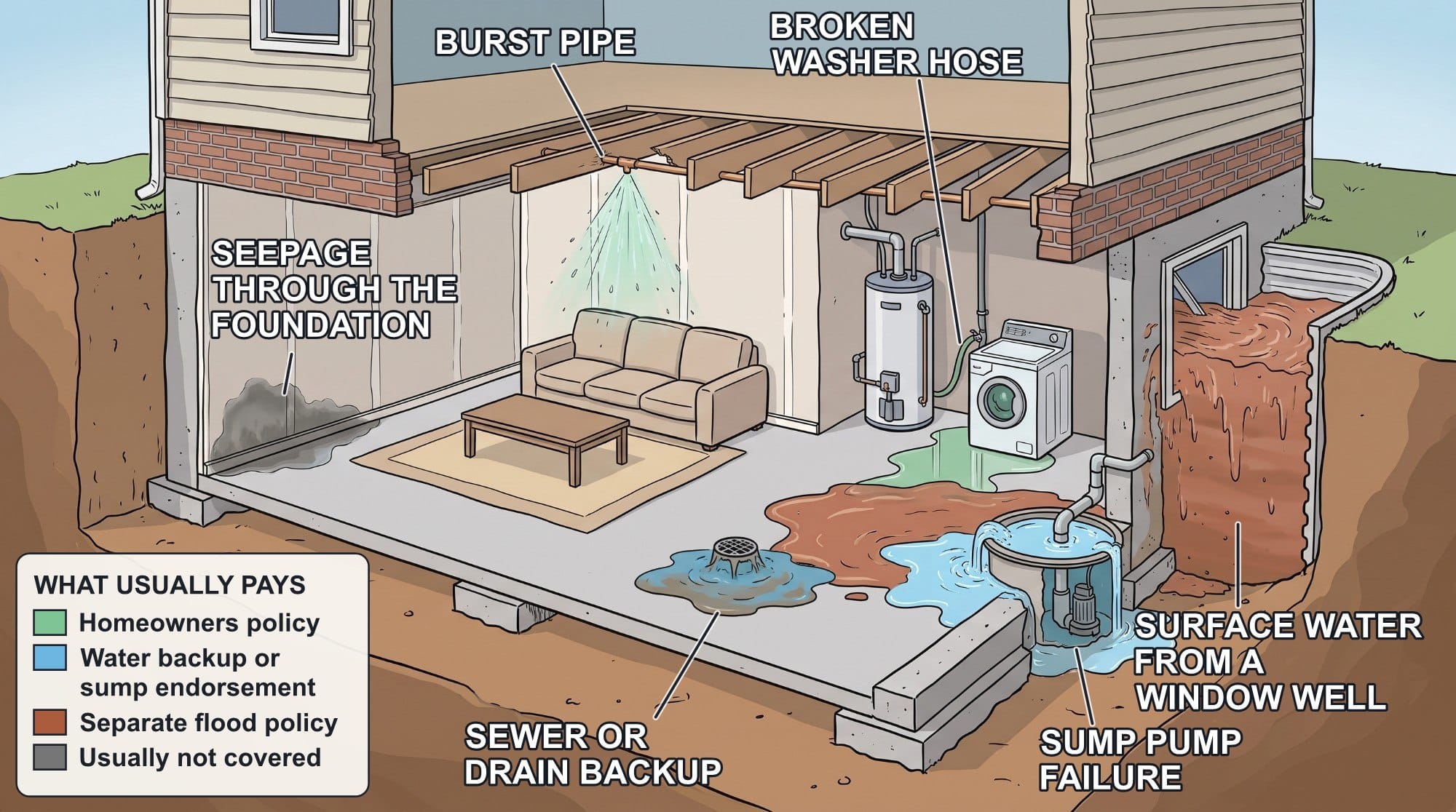
- Water backing up through a drain or sewer. The endorsement discussed on this page. Excluded without it.
- A sump pump that fails or is overwhelmed. Often included in the same endorsement, but not always, and some carriers price it separately. Confirm rather than assume.
- Surface water entering at grade. That is flood, excluded from the homeowners policy entirely, and it needs an NFIP or private flood policy.
A single heavy rain can produce all three at once in the same basement, and the adjuster will apportion the loss between them. Carrying only one of the three is how a homeowner ends up paying for most of a claim they believed was covered.
Frequently asked questions
Is sewer backup automatically included?
Not always. It is often optional or limited, so review your declarations page.
Does sewer backup cover flood?
No. Flood needs a separate NFIP or private flood policy.
How much sewer backup coverage do I need?
It depends on basement finish, contents, mechanical systems, and cleanup exposure.
Talk with a local independent insurance agency
Longmeadow Insurance can help Illinois homeowners review sewer backup coverage, flood insurance, water backup limits, and basement exposure before the next heavy rain. To start a review, use our get a quote form or call 847.242.1040.
Coverage We Write
- Flood and water backup coverage
- Home insurance on the North Shore
- Condo insurance and HO-6 coverage
- Personal insurance overview
Call 847.242.1040 or request a quote online.