
Lake House and Second Home Insurance
Coverage at a Glance
Select a part of the property, a numbered marker, or a coverage name below the picture to see how second-home insurance applies.
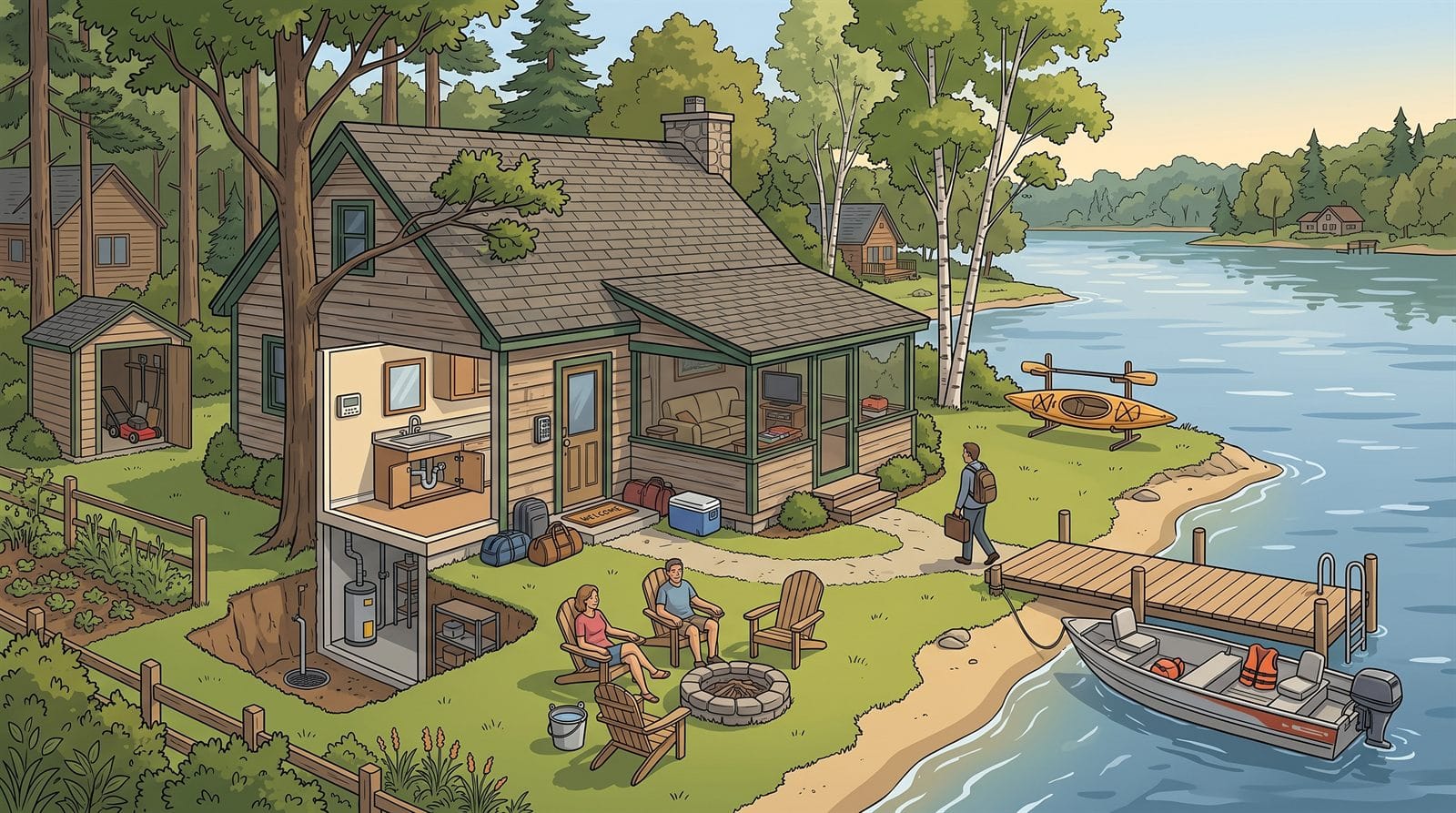
- Dwelling coverage
Could you rebuild your place at the lake?
Dwelling coverage helps repair or rebuild the cottage after a covered loss. Choose coverage based on reconstruction costs, not just the purchase price. Seasonal-home policies can differ in the losses they cover and whether claims are settled at replacement cost or depreciated value.
- Seasonal and unoccupied home provisions
Your cabin needs protection while you’re away.
A weekend or seasonal home has different risks from a house occupied every day. Tell us how often you visit and whether you close it for winter. Vacancy and unoccupancy provisions can affect coverage, and a leak or break-in may go unnoticed between visits.
- Frozen pipes and winterization
Frozen pipes can damage an empty cabin for days.
Water damage from a frozen, burst pipe may be covered, but policies commonly require reasonable care to maintain heat or shut off and drain water systems. Let’s check your policy’s requirements against how you winterize the cottage. Temperature and leak alerts can help catch problems sooner.
- Contents at the cottage
Don’t overlook everything you leave up north.
Furniture, kitchenware, electronics, and fishing equipment can add up. Review contents coverage for belongings kept at the cottage, including theft protection and replacement cost options. Don’t assume your primary home’s policy fully covers a second household’s possessions.
- Falling trees and tree removal
A falling tree can turn a weekend away into a claim.
Covered storm damage from a tree falling onto the cottage may be insured. Tree removal has conditions and limits, especially when nothing insured is damaged. Routine tree maintenance and removal of standing hazardous trees generally remain your responsibility.
- Other structures
The shed and its contents need a coverage check.
Other structures coverage can help protect a detached shed after a covered loss. The mower, tools, and equipment inside fall under separate property provisions. Review both limits, especially if you also have a detached garage or other outbuildings.
- Dock coverage
Your dock may have narrower protection than your cottage.
A dock may be covered under your property policy or need specialized coverage. Ice pressure, freezing, flooding, and certain collapse losses are commonly excluded. Ask specifically about your dock, any boat lift, and whether coverage changes when they’re removed for winter.
- Boat insurance
A small boat can still create a big claim.
Boat insurance can protect the vessel and motor and provide liability coverage for qualifying boating accidents. Homeowners protection for motorboats is often limited. Review operators, passengers, towing, salvage, and winter-storage conditions, and coordinate the boat with your umbrella policy.
- Kayaks and water equipment
Check the gear you use on the water.
Kayaks, canoes, and related equipment may have limited protection under a home policy. Ask about theft, accidental damage, and liability while using them. Lending equipment to guests or providing it to paying renters can change the coverage questions.
- Personal liability and medical payments
What if a guest gets hurt?
Personal liability coverage can help when you’re legally responsible for a covered injury. Medical payments coverage may help with smaller qualifying medical bills regardless of fault. Make sure the lake property is included in your liability protection and any umbrella policy.
- Firepit liability
A relaxing evening can create liability beyond your yard.
If a fire you’re legally responsible for damages a neighboring cabin or injures someone, personal liability coverage may help with a covered claim. A serious loss can exceed basic limits. Review your liability and umbrella protection alongside safe firepit use.
- Water backup coverage
Backup water needs its own coverage review.
Sewer or drain backup and sump overflow generally need specific coverage. Ask about protection for cleanup, building damage, and stored belongings. A backup endorsement does not automatically cover seepage, rising lake water, or every failure involving a septic system.
- Flood insurance
Lake flooding is different from a burst pipe.
Standard home insurance generally excludes flood damage. Separate flood insurance may help with qualifying rising-water losses, but basement coverage and shoreline property can have significant limitations. Review flood exposure even if your lender hasn’t required a policy.
- Short-term rental use
Do you ever rent the cottage to someone else?
Even occasional paid rentals deserve an insurance review. A seasonal-home policy may not cover rental-related damage or liability. Tell us how often you rent, how bookings are arranged, and whether guests can use the boat or equipment. Platform protection may leave gaps.
Enjoy your weekends. Let’s make sure the cottage, dock, and boat are properly protected.
Coverage varies by policy. Separate policies or endorsements may be needed. Limits, deductibles, exclusions, and seasonal-use conditions apply.
A second home is not a smaller version of your primary policy. It is usually empty, often further from a fire department, sometimes rented out, and frequently near water. Each of those changes how it is underwritten, and together they are why a lake house is rarely cheaper to insure per dollar of value than the house you live in.
We write second homes and lake property for North Shore families wherever the property sits: the Chain O’Lakes and the Fox River, southeastern Wisconsin from Lake Geneva to Door County, the Indiana shore from Michigan City to the dunes, and Michigan from Harbor Country up to Torch Lake. The primary home in Wilmette or Evanston and the cottage three hours north get reviewed together, because the mistakes almost always sit in the gap between them.
Where North Shore Families Own a Second Place
Most of the second homes we insure fall into four groups, and each brings its own underwriting questions.
- Illinois. The Chain O’Lakes, including Fox Lake, Grass Lake, Channel Lake and Antioch, where our Antioch office is. Older frame cottages on small lots, boat traffic all summer, and water tables that make sewer and sump exposure worth taking seriously.
- Wisconsin. Lake Geneva, Delavan, Powers Lake and Twin Lakes an hour north; Lake Koshkonong and Elkhart Lake beyond that; Door County, Green Lake and the Northwoods around Minocqua for the families who drive further. Wisconsin winters make heat maintenance and pipe protection the first thing a carrier asks about.
- Indiana. The Lake Michigan shore at Michigan City, Long Beach, Beverly Shores and Dune Acres, plus inland water at Lake Wawasee, Lake Maxinkuckee at Culver and Lake James near Angola. Dune-front homes carry wind and erosion exposure that a suburban policy never contemplated.
- Michigan. Harbor Country first, meaning New Buffalo, Union Pier, Lakeside and Sawyer, then South Haven, Saugatuck and Douglas, Grand Haven, and north to Torch Lake and Traverse City. Michigan’s shoreline has lost ground in recent high-water years, and that history shows up in how carriers look at bluff-top property.
Not every carrier writes property in all four states, and the one that insures your Wilmette house may decline a cottage in Michigan or price it badly. Part of what we do is place each property with the carrier that actually wants it, then make sure the two policies and the umbrella above them still fit together.
Occupancy Is the First Question
How the property is used decides which policy form applies, and getting this wrong is the most common reason a second-home claim is disputed.
| How you use it | What it needs |
|---|---|
| Family use only, occupied on weekends and holidays | A secondary or seasonal dwelling policy. Closest to a standard homeowners form |
| Family use, plus a few weeks of short-term rental a year | Secondary dwelling with a short-term rental endorsement, where the carrier permits it |
| Rented most of the season, family uses it occasionally | A landlord or dwelling fire form. See landlord insurance |
| Vacant for an extended period, or between owners | A vacant dwelling policy. Standard forms restrict coverage sharply once a property is vacant beyond a set number of days |
The third row catches people. Listing a lake house on a rental platform for the season converts it from a second home to a rental property in most carriers’ eyes, and doing that without telling the insurer is a coverage argument waiting for a claim.
The Problems That Come From Being Empty
Most second-home losses are not dramatic. They are the result of nobody being there when something small started.
- Frozen pipes. The signature Midwest second-home claim. Many policies require reasonable care to maintain heat or to shut off and drain the system, and a burst line in an unheated house can be excluded on exactly that basis. If you winterize, document it. If you leave the heat on, a low-temperature sensor that texts you is cheap insurance in the literal sense.
- Slow leaks. A supply line that fails in an occupied house is a bad afternoon. In a house nobody visits for six weeks it is a rebuild, and the continuous-leakage exclusion may apply to the portion that occurred over time.
- Water shutoff and monitoring devices. Increasingly the thing that makes a property insurable rather than just cheaper, and several carriers now offer credits for them.
- Distance to response. Rural properties are rated on distance to a responding fire department and to a hydrant or draft source, and that single factor can move the premium more than the construction does. A Northwoods cabin twelve miles from a volunteer station is a different risk from a Lake Geneva house on a municipal line.
Docks, Seawalls, Ice and Wind
Lake property brings exposures a suburban policy never contemplated. Docks, piers, boat lifts, seawalls and shoreline improvements are frequently excluded or limited to a token amount on a standard dwelling form, and they are expensive to replace. They usually need to be scheduled specifically, and not every carrier will do it.
Ice is the reason. On inland lakes in Wisconsin and Indiana, ice shove in March pushes a sheet of ice up the shoreline and takes pilings, seawalls and anything left in the water with it. Most forms treat that the way they treat any other damage to a shoreline structure, which is to say poorly. A lift and dock that come out every fall are cheaper to cover than ones that stay in.
On the Lake Michigan shore in Indiana and Michigan the questions are wind and erosion. Wind is a covered peril, but shoreline territories often carry a separate wind or hail deductible, sometimes stated as a percentage of the dwelling limit rather than a flat dollar amount, and it is worth reading that line before a storm rather than after. Erosion and bluff loss are excluded outright as earth movement on standard forms. A house that has lost yard to the lake is not an insurance claim, and a carrier will look closely at how much bluff is left.
Flood Is Its Own Policy
Flood is excluded from every dwelling policy, so the question is whether the exposure justifies a separate policy rather than whether the homeowners form covers it. On waterfront property it usually does, and a lender will often require it. The flood map determines what a lender demands, not what the water will do. Many inland lake lots sit outside a mapped high-risk zone and still take water when a spring thaw and a week of rain arrive together.
Coverage is available through the National Flood Insurance Program or a private flood carrier, and the two are priced very differently on lake property. See our flood insurance page for how the cause-of-loss distinctions work, because sump failure, sewer backup and surface water are three different claims with three different answers.
Renting It Out
Tell us before you list it. A homeowners or secondary dwelling form excludes business use, and a paying guest is business use. Some carriers permit occasional short-term rental by endorsement, typically capped at a number of nights a year. Some require a landlord form the moment the property earns income. Some will not write the risk at all, and a property that has been quietly rented for two summers can find that out at claim time.
Rental changes the liability picture as much as the property picture. A guest who is hurt on your dock is a different claim from a family member who is, and the platform’s own coverage is thin and secondary. If the lake house earns real money, it is a rental property with a house on it, and it is insured that way. See landlord and rental property insurance.
Liability Has to Reach Both Properties
This is the gap we find most often. A household carries a good umbrella above the primary home and auto, then buys the lake house policy separately from a different carrier and never tells the umbrella carrier it exists.
An umbrella covers the properties and vehicles scheduled beneath it. A second home has to be added, the underlying liability limit on that property has to meet the umbrella’s requirement, and the same applies to any watercraft. Guests, a dock, a fire pit and a lake are a meaningful liability picture, and it is worth confirming the umbrella actually reaches it. See umbrella insurance.
What Gets Left Off
The dwelling limit is the number everyone checks. These are the ones that get missed.
- Replacement cost in a remote area. Rebuilding on a Northwoods lake or a Michigan bluff costs more than the same square footage in a suburb, because contractors, materials and permits are all further away. The limit should reflect where the house is, not what a Cook County calculator says.
- Detached structures. A bunkhouse, a boathouse, a detached garage or a pole barn is covered under the other-structures limit, usually ten percent of the dwelling. A boathouse alone can exceed that.
- Older cottages and ordinance or law. A 1950s lake cottage rebuilt after a fire has to meet current code, including setbacks from the water that may not allow the same footprint. Ordinance or law coverage pays for the difference; the base policy does not.
- Wood stoves, wells and septic. A wood stove is an underwriting question and sometimes an inspection. A well pump sits under equipment breakdown if you have it. A septic backup needs the same water backup endorsement a suburban sump does.
- Everything with a motor. A boat, a personal watercraft, an ATV or a golf cart each needs its own coverage, and none of them are reliably picked up by the dwelling policy. Our boat and watercraft page covers agreed value, navigational territory and winter lay-up.
- Who owns it. A lake house held in a trust or an LLC needs that entity named correctly on the policy, or a claim can be paid to the wrong party or denied. Our guide to insurance for trusts and LLCs covers how to set it up.
Get a Second Home Policy Reviewed
Send the declarations pages for the second home, your primary home, and your umbrella, plus a description of how the property is used through the year and what is stored there. We will tell you whether the occupancy is correctly stated, whether the umbrella reaches it, what the shoreline structures are actually covered for, and whether the carrier holding it is the right one for that state. We compare across the carriers we hold appointments with rather than quoting a single company.
Call or text 847.242.1040, email hello@longmeadow.agency, or start a quote online.
Common Questions
Can I add a second home to my existing policy?
It is written as its own policy rather than added to the primary one, though the same carrier will often write both and apply a multi-policy discount. What can and should be shared is the umbrella, which needs the second home scheduled beneath it.
Can the carrier that insures my Illinois house write a lake house in Wisconsin or Michigan?
Sometimes. Carrier appetite is set state by state, and a company that is happy to insure a North Shore home may decline a Michigan bluff or price a Wisconsin cottage above the market. When that happens the second home goes to a different carrier, and the job becomes keeping the two policies and the umbrella consistent with each other.
Why does a second home cost more to insure than my main house?
Because nobody is there. Unoccupied periods mean small problems become large ones before anyone notices, and rural properties often sit further from fire protection. Distance to a responding department, heat maintenance in winter, and whether the property is ever rented all move the price.
Does my policy cover the dock and boat lift?
Usually not adequately. Shoreline structures are commonly excluded or limited to a token amount on a standard dwelling form, and they are expensive to replace after ice damage. They generally need to be scheduled, and not every carrier will write them.
What if I rent it out a few weeks a year?
Tell us before you list it. Some carriers permit occasional short-term rental by endorsement, some require a landlord form, and some will not write the risk at all. Renting without disclosing it is the most reliable way to have a claim disputed.
Do I need flood insurance on a lake property?
Flood is excluded from every dwelling policy, so the question is whether the exposure justifies a separate policy rather than whether the homeowners form covers it. On waterfront property it usually does, and a lender will often require it. The flood map determines requirement, not risk.
Does my umbrella cover guests at the lake house?
Only if the lake house is scheduled on it and the underlying policy carries the liability limit the umbrella requires. An umbrella bought for the Wilmette house does not automatically follow you to a cottage insured by someone else. Confirm both, because a guest injury on a dock is exactly the claim an umbrella exists for.
What happens if the house sits vacant for months?
Standard forms restrict coverage once a property is vacant beyond a set number of days, commonly 30 or 60, with vandalism and water damage among the first things curtailed. A seasonal property occupied part of the year is different from a vacant one, and the distinction is worth confirming with your carrier rather than assuming.