
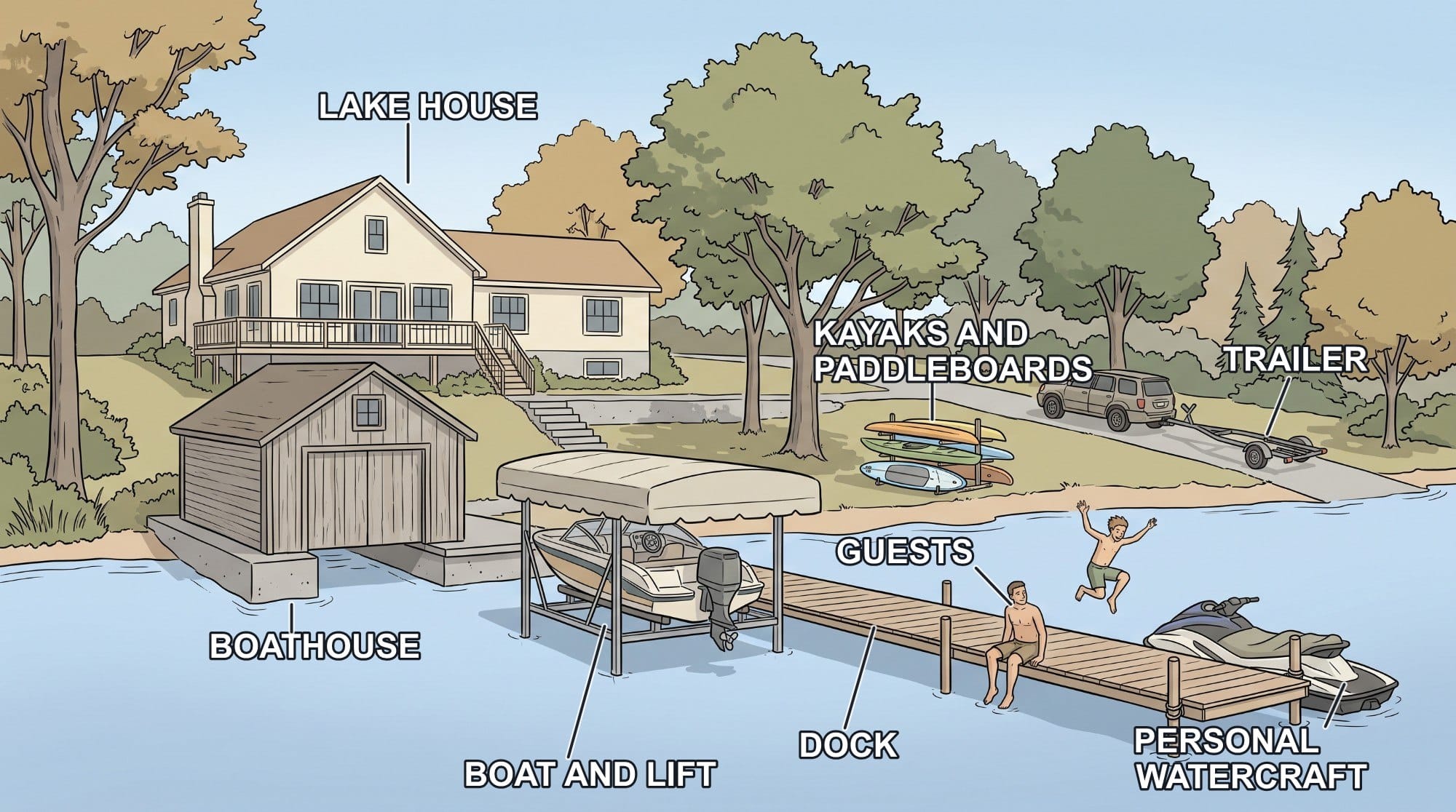
A lake house often comes with boats, docks, lifts, trailers, kayaks, paddleboards, jet skis, guests, and family members who all want to get on the water. That creates a coverage problem if the insurance program treats the home and boat as separate, unrelated risks. Some small watercraft may receive limited coverage under a homeowners policy, but larger boats, faster boats, jet skis, valuable boats, and liability-heavy usage usually require a separate boat or personal watercraft policy. The details matter before someone is injured or the boat is damaged. A good lake house review should connect the homeowners policy, boat policy, umbrella policy, auto policy, trailer exposure, dock coverage, and any rental or guest-use issues.
Do Not Assume the Homeowners Policy Covers the Boat
Homeowners policies may provide very limited coverage for small boats, canoes, kayaks, or low-horsepower watercraft. That does not mean a meaningful boat exposure is protected. Length, horsepower, speed, value, ownership, storage, and use can all determine whether coverage exists. A separate boat policy is usually the safer route for motorboats, personal watercraft, higher-value boats, or boats used frequently by guests and family. The policy can address physical damage, liability, medical payments, uninsured boaters, wreck removal, fuel spill liability, and equipment. Start with what the boat is, how it is used, who operates it, where it is stored, and what could go wrong.
Physical Damage Needs to Include More Than the Hull
Boat owners often focus on the hull value, but claims can involve motors, electronics, fishing gear, covers, anchors, batteries, safety equipment, trailers, lifts, and accessories. Some items may have sublimits or require scheduling. Ask whether the policy provides agreed value, stated value, or actual cash value. The difference matters after a total loss. Also ask how the policy treats depreciation on motors, lower units, canvas, electronics, and older boats. Storage location matters too. A boat kept on a lift, in a boathouse, at a marina, in a driveway, or on a trailer may face different risks and underwriting questions.
Liability Is the Bigger Risk
The most serious boat claim is often not the boat itself. It is an injury. Boat liability claims can involve swimmers, passengers, skiers, tubers, other boaters, dock collisions, alcohol allegations, inexperienced operators, children, or guests operating equipment they do not understand. A lake house owner should confirm boat liability limits and coordinate them with umbrella insurance. Some umbrellas require underlying boat limits. Some umbrellas exclude certain watercraft unless listed. If the umbrella does not know about the boat, the extra liability layer may not work as expected. Operator rules also matter. Policies may restrict young operators, unlicensed operators, paid operators, or anyone using the boat without permission.
Docks, Lifts, and Trailers Create Separate Questions
Docks and boat lifts are not automatically handled the same way by every policy. A permanent dock, seasonal pier, floating dock, lift, canopy, or boathouse may fall under homeowners coverage, other structures, scheduled property, inland marine, or a separate endorsement depending on the policy. Trailers create another layer. Physical damage to the trailer may be part of the boat policy, but liability while towing may involve the auto policy. Theft of the trailer, roadside incidents, and storage away from the residence should all be reviewed. If the boat moves between a primary home, lake house, marina, and repair shop, the policy territory and storage terms should match that reality.
Guest Use and Family Use Should Be Discussed Honestly
Lake houses invite informal use. A neighbor borrows the pontoon. A cousin drives the jet ski. A teenager pulls a tube. Friends visit for the weekend. Those are normal lake-house scenarios, but they can create serious coverage questions. Boat policies can treat permissive operators differently. Some may require operators to meet age, licensing, or experience requirements. Some may limit coverage if the boat is rented, loaned regularly, used for paid rides, or involved in business activity. The policy should be built around how the boat is actually used, not the clean version that appears on a quote form.
Coverage Review Checklist
- List every boat, jet ski, kayak, paddleboard, trailer, lift, and dock exposure
- Confirm whether each watercraft needs its own policy or endorsement
- Review agreed value, stated value, or actual cash value settlement terms
- Check liability limits and umbrella compatibility
- Ask how young operators, guests, and permissive users are handled
- Confirm trailer coverage while stored and while being towed
- Review dock, lift, canopy, and boathouse coverage separately
Coordinate the Boat, Home, and Umbrella Policies
Longmeadow Insurance can review the home, boat, dock, trailer, and umbrella coverage together so a lake-house boating claim does not fall between policies.
How Longmeadow Insurance Can Help
Longmeadow Insurance is an independent agency based in Wilmette, Illinois. Send us the home, boat, and umbrella declarations pages and we will show you any gaps between them. For a coverage review, call 847.242.1040 or request a consultation online.
For the full picture, see our boat and watercraft insurance guide for Illinois and Wisconsin, covering agreed value, navigational territory, lay-up periods, trailers, and charter exclusions.
Coverage We Write
Call 847.242.1040 or request a quote online.