
Short answer: For most North Shore households the starting point is a $1 million umbrella, and families with teen drivers, a pool, rental property, or assets well past $1 million usually land at $2 million to $5 million. The higher limit is rarely the expensive part; our guide to what umbrella insurance costs covers pricing at each limit. Size the limit to what you own plus what you will earn, because a judgment can reach both.
How much umbrella insurance you need starts with the liability coverage you already carry and the risks it needs to sit above. Review your home, vehicles, rental properties, and other insured activities together before comparing higher limits.
What Umbrella Insurance Does
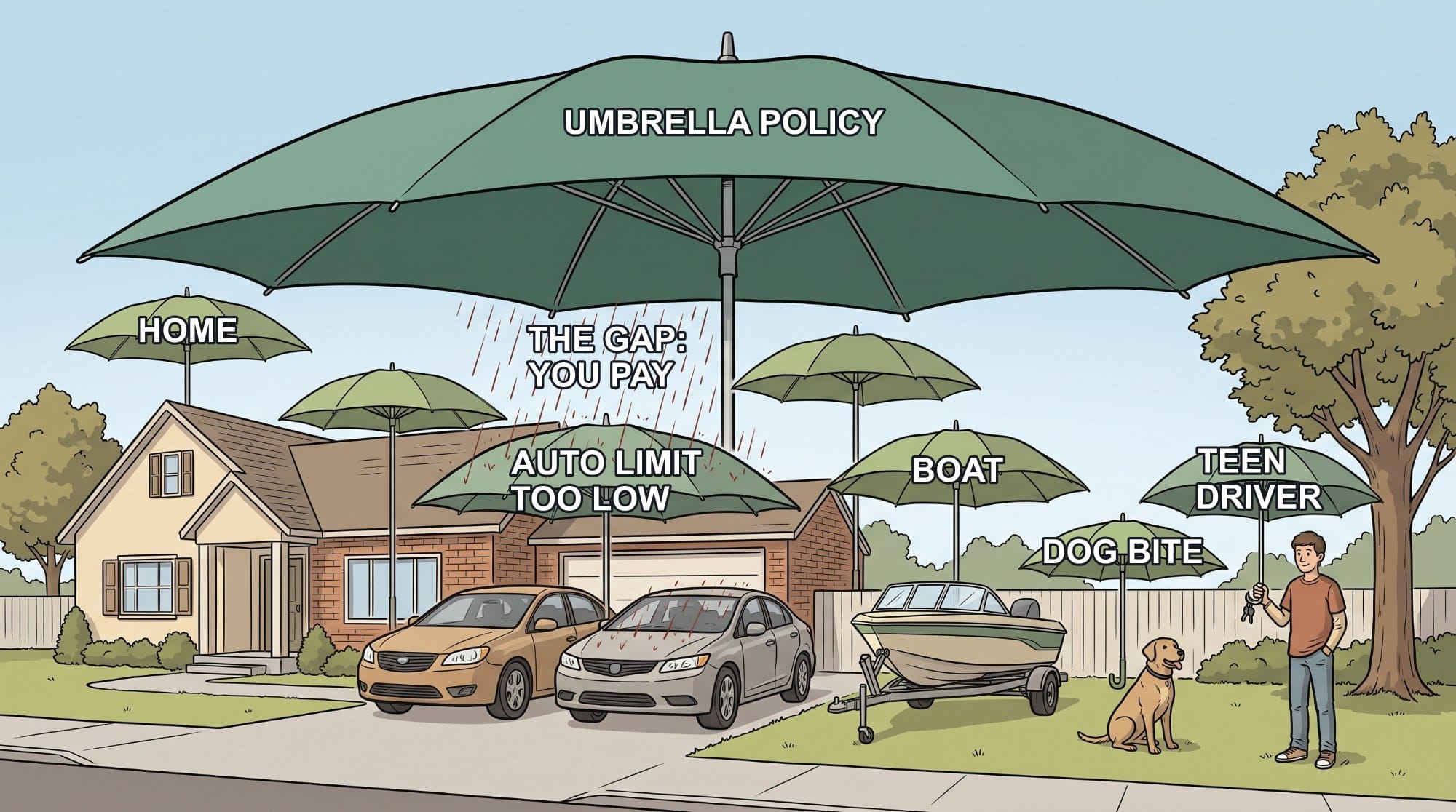
Umbrella insurance kicks in when you’ve exhausted the liability limits on your home, auto, boat or other primary insurance policies. If someone sues you for $2 million after a serious car accident and your auto policy covers $500,000, a $2 million umbrella covers the remaining $1.5 million. Without it, you’d be personally responsible for that difference, meaning your savings, investments, and future earnings could be at risk. Beyond just higher limits, umbrella policies often cover situations your base policies don’t, like certain defamation claims or false arrest accusations.
The Traditional Approach: Net Worth Plus Future Earnings
Net worth is a useful starting point, but it is not the entire calculation. Consider home equity, savings, taxable investments, income exposure, and the household’s activities. Retirement accounts and other assets can have legal protections, so do not automatically treat every dollar on a balance sheet as equally exposed.
Risk Factors That Call for Higher Limits
Certain situations raise your liability exposure and should push you toward higher coverage amounts:
- You have significant assets to protect. The wealthier you are, the more attractive you become as a lawsuit target. If you have a net worth over $1 million, consider $2-5 million in umbrella coverage.
- You own rental properties. Landlords face liability from tenant injuries, slip-and-falls, and various premises liability claims. Each rental property increases your exposure.
- You have teenage drivers. Auto accidents involving young, inexperienced drivers can result in catastrophic injuries and multi-million dollar lawsuits. This is one of the most common triggers for umbrella claims.
- You employ household workers. Nannies, housekeepers, or gardeners who get injured on your property could sue. Many homeowners policies have limited or no coverage for household employees.
- You have a pool, trampoline, or dog. Dog bites are a common source of liability claims, and a pool adds the risk of a drowning or serious injury.
- You’re active on social media or serve on boards. These activities increase your exposure to defamation or libel claims, which umbrella policies typically cover but standard policies don’t.
- You have a high public profile. Business owners, executives, and professionals are more likely to be sued simply because they’re perceived as having deep pockets.
Choosing a Limit Step by Step
Start with the assets and income you want to protect, then review the household’s drivers, homes, rental property, boats, and activities. Compare several umbrella limits and the premium difference between them. There is no reliable rule that adds a fixed million dollars for every exposure. Check which assets are protected from judgments and make sure the underlying policies meet the umbrella’s requirements.
Common Coverage Amounts and Who They Suit
- $1 million: Appropriate for younger professionals or families with modest assets (under $500,000 net worth), no high-risk exposures, and stable employment income.
- $2-3 million: Better for established professionals with $500,000-$2 million in assets, families with teen drivers, or anyone with one or two significant risk factors.
- $5 million or more: Often chosen by high-net-worth individuals, those with multiple rental properties, business owners, or anyone with several compounding risk factors.
Underlying Limits Come First
You can’t buy umbrella insurance on its own; you need minimum liability limits on your underlying policies first. Most insurers require at least $250,000/$500,000 in auto liability coverage and $300,000 in homeowners liability before they’ll sell you an umbrella policy. Increasing these base coverages will add to your total cost.
When to Reassess Your Coverage
Your umbrella insurance needs aren’t static. Review your coverage every few years or whenever you experience major life changes: significant increases in net worth, buying rental property, children getting driver’s licenses, starting a business, or receiving an inheritance.
When in Doubt, Price the Higher Limit
Higher limits cost relatively little, and a judgment above your limits comes out of your savings and future income. If you are deciding between two limits, price both before you choose.
Frequently asked questions
Is $1 million enough umbrella insurance?
It may be a starting point, but the right limit depends on assets, income, drivers, and property exposures.
Do teen drivers make umbrella insurance more important?
Yes. Teen drivers can increase auto liability exposure, which is one of the most common reasons families review umbrella limits.
Does an umbrella cover every lawsuit?
No. Umbrella policies have exclusions and conditions. Review the policy language and underlying requirements.
Coverage We Write
Call 847.242.1040 or request a quote online.