
Category: Umbrella and Liability

Personal liability and umbrella coverage.

  • How Much Does Umbrella Insurance Cost? A Complete Guide to Pricing for 1M, 2M, and 5M Policies

    What Does Umbrella Insurance Actually Cost?

    Umbrella insurance is one of the most affordable ways to protect your family’s financial future, yet most people overestimate the price. A $1 million umbrella policy typically costs between $150 and $350 per year. That’s roughly $15 to $30 per month for an additional million dollars in liability protection above your existing home and auto insurance limits.

    For families on Chicago’s North Shore, where home values regularly exceed $500,000 and household net worth often reaches into the millions, umbrella insurance is not optional. It’s essential. Here’s a detailed breakdown of what you can expect to pay and what factors affect your premium.

    Cost of a $1 Million Umbrella Policy

    A $1 million umbrella policy is the most common starting point. For most families, the annual premium falls between $150 and $350, depending on the number of underlying policies (home, auto, boat), driving records, and the number of properties owned.

    This is the minimum recommended coverage for any homeowner. If you have a car, a house, and any assets worth protecting, a $1 million umbrella policy is likely the best insurance dollar you can spend.

    Cost of a $2 Million Umbrella Policy

    Stepping up to $2 million in coverage typically adds $50 to $100 per year to the cost of a $1 million policy, bringing the annual total to roughly $200 to $450. The incremental cost of each additional million is significantly less than the first million.

    A $2 million policy is appropriate for families with a net worth between $1 million and $2 million, those with rental properties, or households with teenage drivers, one of the most common triggers for large liability claims.

    Cost of a $5 Million Umbrella Policy

    A $5 million umbrella policy typically costs between $400 and $900 per year, depending on your risk profile. For many North Shore families with significant home equity, investment portfolios, and professional incomes, this level of protection is worth serious consideration.

    At $5 million, you’re protecting your current assets and your future earnings as well. Courts can garnish wages to satisfy judgments, so a 40-year-old earning $200,000 annually has millions in future income at stake.

    Average Cost of Umbrella Insurance: Quick Reference

    Here’s a general pricing guide for umbrella insurance policies:

    • $1 million: $150–$350/year
    • $2 million: $200–$450/year
    • $3 million: $275–$575/year
    • $5 million: $400–$900/year
    • $10 million: $750–$1,500/year

    These are national averages. Your actual premium depends on factors specific to your household, which we cover below.

    What Factors Affect Umbrella Insurance Pricing?

    Insurance companies evaluate several factors when pricing your umbrella policy:

    Number of Underlying Policies

    The more policies you bundle underneath your umbrella (home, auto, boat, rental property), the higher your premium. Each policy represents additional exposure the umbrella must cover.

    Driving Record

    A clean driving record keeps premiums low. DUIs, at-fault accidents, or multiple moving violations can significantly increase your umbrella cost, or even make you ineligible with certain carriers.

    Number of Vehicles and Drivers

    Households with multiple vehicles and drivers, especially teenage drivers, pay more. Auto accidents are the most common source of large liability claims.

    Property Features

    Swimming pools, trampolines, dogs (especially certain breeds), and waterfront property all increase liability exposure and premiums.

    Rental Properties

    Each rental property you own adds to your liability risk. Landlords face exposure from tenant injuries, maintenance claims, and premises liability.

    Underlying Policy Limits

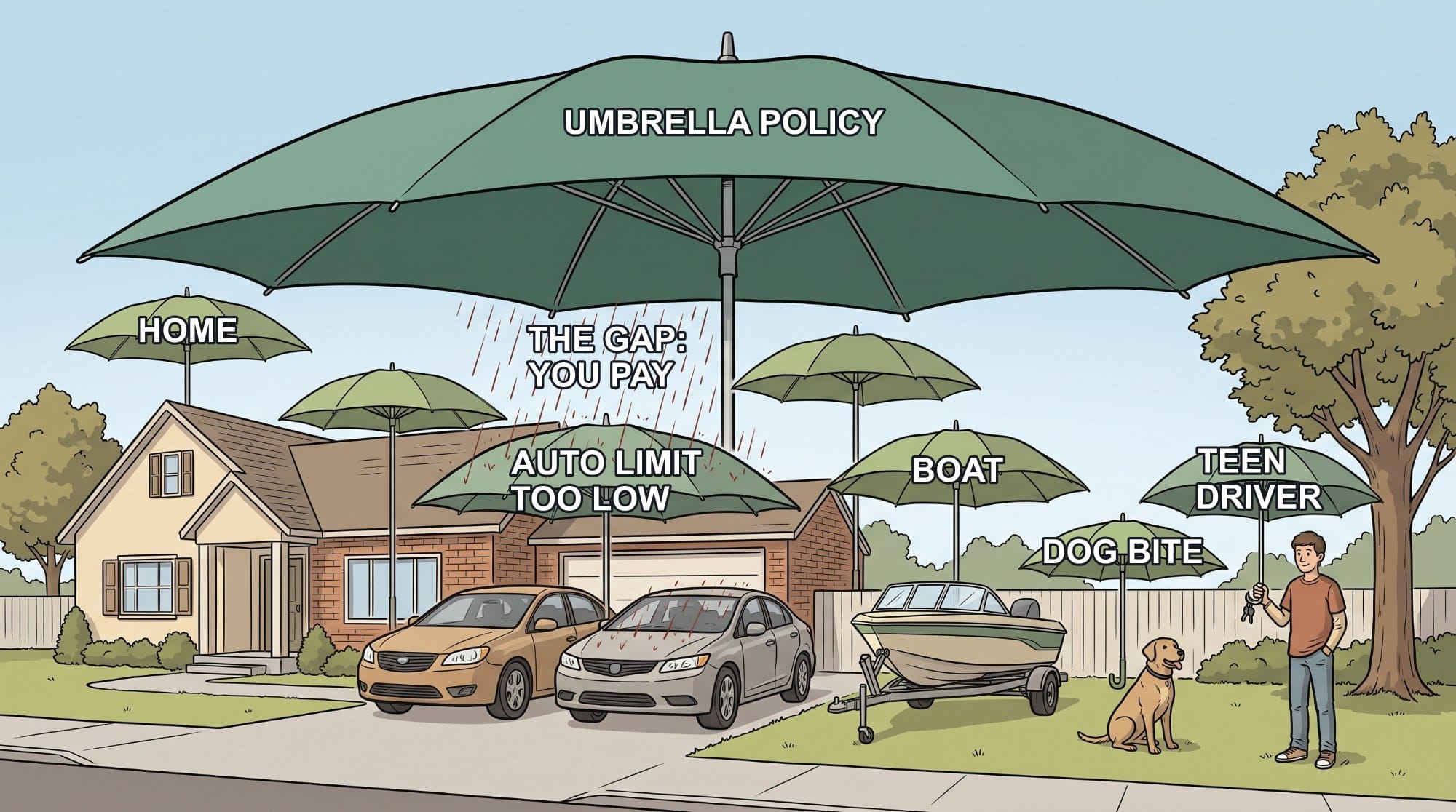
    Most umbrella policies require minimum underlying limits on your home and auto policies, typically $300,000/$300,000 on auto liability and $300,000 on homeowners liability. If your current limits are lower, you’ll need to increase them before adding an umbrella, which adds to the total cost but also improves your base coverage.
    Why Umbrella Insurance Is Especially Important on the North Shore

    Families in Wilmette, Winnetka, Glencoe, Kenilworth, and the surrounding North Shore communities face above-average liability exposure for several reasons:

    • Higher home values mean more equity to protect and higher-value premises liability claims
    • Higher household incomes make you a more attractive target in lawsuits, attorneys know there’s more to collect
    • Older homes with complex rooflines, mature trees, and aging infrastructure create more maintenance-related liability
    • Active lifestyles: boating, skiing, entertaining. All increase the chance of an accident involving a third party
    • Household employees like nannies, housekeepers, and landscapers create employer liability exposure

    What Does Umbrella Insurance Cover?

    An umbrella policy extends your liability protection beyond the limits of your home and auto insurance. It covers:

    • Bodily injury claims (car accidents, slip-and-falls on your property)
    • Property damage you cause to others
    • Personal liability (defamation, libel, slander)
    • Legal defense costs (even if the lawsuit is frivolous)
    • Landlord liability for rental properties
    • Some claims not covered by underlying policies

    It does not cover your own injuries, your own property damage, business liability (you need a separate commercial policy), or intentional acts.

    How to Get the Best Price on Umbrella Insurance

    The most effective way to get competitive umbrella pricing is to work with an independent insurance agency that can shop multiple carriers. Bundling your home, auto, and umbrella with the same carrier almost always produces the lowest combined cost.

    Other ways to reduce your premium:

    • Maintain clean driving records for all household members
    • Increase your underlying policy limits (this can actually lower the umbrella cost)
    • Address known hazards (fence your pool, train your dog)
    • Review your coverage annually as your risk profile changes

    Frequently Asked Questions

    How much does a 1 million dollar umbrella policy cost?

    A $1 million umbrella policy typically costs between $150 and $350 per year for most households. Your exact premium depends on driving records, number of properties, and risk factors like pools or teenage drivers.

    How much does a 2 million dollar umbrella policy cost?

    A $2 million umbrella policy generally costs between $200 and $450 per year. The second million of coverage usually only adds $50 to $100 to the cost of a $1 million policy.

    How much does a 5 million dollar umbrella policy cost?

    A $5 million umbrella policy typically costs between $400 and $900 per year, depending on your risk profile. Each additional million of coverage costs less than the one before it.

    Is umbrella insurance worth it?

    For most homeowners with assets to protect, absolutely. At roughly $15–$30 per month for $1 million in coverage, it is one of the most cost-effective insurance products available. A single serious auto accident or injury lawsuit can easily exceed your standard policy limits.

    Do I need umbrella insurance if I have a high deductible?

    Yes. Your deductible affects how much you pay before your primary insurance kicks in. An umbrella policy protects you when your primary policy’s limits are exceeded, a completely different situation. A high deductible strategy and umbrella insurance actually complement each other well.

    Can I get umbrella insurance without bundling my home and auto?

    Some carriers offer stand-alone umbrella policies, but most require you to carry your underlying home and auto policies with them or meet minimum underlying limit requirements. An independent agent can help you find the best structure.

    Get a Free Umbrella Insurance Quote

    Longmeadow Insurance is an independent agency in Wilmette serving Chicago’s North Shore. We work with multiple carriers to find the right umbrella coverage at the best price for your family. Request a free quote or call us at (847) 242-1040.

    Related Articles

    North Shore Insurance Resources

    Coverage We Write

    Longmeadow Insurance is an independent agency in Wilmette with offices across Chicago and the suburbs. If any of this applies to your situation, we can review your current policy and tell you what it actually covers.

    Call 847.242.1040 or request a quote online.
  • Dog Bite Liability in Illinois: What Homeowners Need to Know About Coverage and Risk

    Illinois Is a Strict Liability State for Dog Bites

    If your dog bites someone in Illinois, you’re liable, period. Under the Illinois Animal Control Act (510 ILCS 5/16), the owner of a dog that attacks or injures a person is liable for the full amount of damages, as long as the person was peacefully conducting themselves and had a legal right to be where they were.

    There’s no “one free bite” rule in Illinois. You don’t need to have known your dog was aggressive. The first bite creates full liability.

    What Dog Bite Claims Actually Cost

    According to the Insurance Information Institute, the average dog bite claim in the United States exceeds $50,000. Severe attacks involving children or facial injuries can result in claims of $200,000 to $500,000 or more.

    Illinois consistently ranks among the top states for dog bite claims by volume. For North Shore families with significant assets, the financial exposure from a single incident can be devastating.

    How Homeowners Insurance Covers Dog Bites

    Most standard homeowners policies cover dog bite liability under the personal liability section (typically $100,000-$300,000). This means if your dog bites a neighbor, guest, or delivery person, your homeowners insurance pays for their medical bills, lost wages, and pain and suffering. Up to your policy limit.

    However, there are important exceptions and limitations.

    Breed Restrictions

    Some insurance carriers exclude certain breeds entirely or charge higher premiums. Commonly restricted breeds include pit bulls, Rottweilers, German Shepherds, Dobermans, Akitas, and wolf hybrids. If your carrier excludes your dog’s breed, you have zero liability coverage for a bite.

    Not all carriers have breed restrictions. An independent agent can find carriers that will cover your specific breed without exclusions.

    Prior Bite History

    If your dog has bitten someone before, your insurer may exclude future dog-related claims from your policy, refuse to renew your coverage, or significantly increase your premium. Full disclosure of bite history is essential, a claim denied due to non-disclosure is worse than a higher premium.

    Coverage Limits

    Standard homeowners liability of $100,000-$300,000 may not be enough for a serious dog bite claim, especially one involving a child or requiring reconstructive surgery. This is where umbrella insurance becomes critical.

    Reducing Your Risk

    • Socialize and train your dog: Professional training reduces bite risk significantly
    • Secure your property: Proper fencing and gates prevent unsupervised interactions
    • Supervise interactions: Especially with children and unfamiliar people
    • Carry adequate liability insurance: At minimum, $300,000 homeowners liability plus a $1 million umbrella
    • Disclose your dog to your insurer: Non-disclosure can void your coverage entirely

    What to Do If Your Dog Bites Someone

    1. Secure the dog and provide first aid to the victim
    2. Exchange contact information with the victim
    3. Document the incident (photos, witnesses, circumstances)
    4. Report the bite to local animal control as required by Illinois law
    5. Contact your insurance agent immediately
    6. Do not admit fault or make statements about the incident beyond basic facts

    Get Your Coverage Reviewed

    If you own a dog, any breed, make sure your homeowners insurance covers dog-related liability without exclusions. Longmeadow Insurance will review your policy and make sure you’re protected. Request a review or call (847) 242-1040.

    Coverage We Write

    Longmeadow Insurance is an independent agency in Wilmette with offices across Chicago and the suburbs. If any of this applies to your situation, we can review your current policy and tell you what it actually covers.

    Call 847.242.1040 or request a quote online.
  • How Much Umbrella Insurance Do Chicago-Area Families Need?

    Umbrella insurance is one of the most misunderstood personal insurance policies. Many families assume it is only for the wealthy. In reality, umbrella coverage is often relevant for households with home equity, savings, income, teen drivers, rental property, pets, pools, boats, or simply the desire to protect future earnings from a severe liability claim.

    The right umbrella limit is not the same for everyone. It should reflect what you want to protect and the types of liability exposure in your household.

    Coverage highlights

    • Umbrella coverage sits above underlying policies
    • Start with assets, income, and future earnings
    • Teen drivers increase the need for a review
    • Rental property and second homes add complexity
    • Umbrella insurance is often affordable for the protection provided

    Umbrella coverage sits above underlying policies

    A personal umbrella generally provides additional liability protection above home, auto, condo, renters, landlord, or recreational policies. The underlying policies must usually carry required liability limits before the umbrella applies.

    This means the umbrella review should happen alongside your home and auto review, not separately.

    Start with assets, income, and future earnings

    Think about savings, home equity, taxable investments, income, future earnings, and other assets that could be threatened by a lawsuit. A $1 million umbrella may be a starting point, but some households need $2 million, $3 million, $5 million, or more.

    The purpose is not to match net worth perfectly. The purpose is to create a reasonable layer of protection against catastrophic liability.

    Teen drivers increase the need for a review

    Auto accidents can produce severe liability claims. When a household adds a teen driver, the umbrella conversation becomes more important because one serious accident can exceed standard auto limits.

    Review driver assignments, vehicles, liability limits, college drivers, and whether any vehicles are titled outside the household.

    Rental property and second homes add complexity

    Landlord exposure, vacation homes, lake houses, docks, boats, pools, and short-term rental activity can change umbrella eligibility and coverage needs. The umbrella carrier needs to know what properties and exposures exist.

    Do not assume every property is automatically covered. Schedule and underlying policy requirements matter.

    Umbrella insurance is often affordable for the protection provided

    Compared with the amount of liability protection, umbrella coverage is often relatively inexpensive. The final cost depends on drivers, vehicles, homes, properties, limits, and underwriting factors.

    The key is making sure the coverage is coordinated correctly rather than simply adding the cheapest umbrella available.

    How to use this article

    Use this as a review guide rather than a substitute for reading the policy. Insurance policies depend on definitions, exclusions, endorsements, limits, deductibles, underwriting rules, and state-specific forms. The same general topic can produce a different answer depending on the carrier and the exact policy language.

    A good review should end with a clear decision: keep the current policy, adjust limits or endorsements, compare other carriers, gather more documentation, or ask a more specific underwriting question. If the answer is vague, the review is not finished.

    Coverage details that deserve a second look

    • Replacement cost versus actual cash value.
    • Whether roof damage is settled differently because of age or material.
    • Whether water backup, flood, seepage, and sump overflow are separate issues.
    • Whether liability limits match household assets and income.
    • Whether special property, jewelry, collections, bicycles, business property, or equipment need separate treatment.
    • Whether policy language changes at renewal created new restrictions.

    Why working with a local agency can help

    Local insurance work is partly about knowing which questions to ask. A national quote form may produce a price, but it may not pause to ask about a vintage Chicago condo association deductible, an older Evanston home with plaster and custom millwork, a finished basement in the suburbs, a teen driver, a two-flat, or a property that changed from owner-occupied to rented.

    A local independent agency can compare multiple carriers, explain the tradeoffs, and help keep the policy aligned with the real risk. That does not mean the most expensive option is always best. It means the choice should be made with the coverage consequences clearly understood.

    A practical example

    Consider a household that focuses only on lowering the annual premium. The new quote may look attractive at first because the payment is smaller, but the difference often comes from somewhere: a higher deductible, a lower limit, a narrower endorsement, a different roof settlement method, or a missing coverage option. That tradeoff may be reasonable, but it should be intentional rather than accidental.

    The better approach is to compare the real claim scenarios. What happens after a wind or hail loss? What happens after water enters the basement? What happens if someone is injured and the claim exceeds the basic liability limit? What happens if repairs require code upgrades? Those questions usually reveal more than the premium alone.

    Common mistakes to avoid

    • Comparing only the annual premium instead of the coverage details.
    • Assuming every quote uses the same deductible, roof terms, water limits, and liability limits.
    • Reducing important coverage without estimating the possible out-of-pocket cost after a claim.
    • Waiting until the renewal date, closing date, or claim deadline to ask coverage questions.
    • Forgetting to update the policy after renovations, household changes, new drivers, rental exposure, or property-use changes.

    Local Chicago-area considerations

    Insurance decisions in Chicago, the North Shore, and the surrounding suburbs often involve local details that generic national advice can miss. Older homes, vintage condo buildings, two-flats, finished basements, sewer systems, lake-effect weather, mature trees, hail exposure, dense parking, and high reconstruction costs can all affect the right policy structure.

    Location also matters because the same coverage issue can look different in different communities. A Wilmette or Evanston older home, a Lakeview condo, an Elmhurst newer construction home, an Elk Grove Village business property, and a Chicago landlord exposure may all need different questions answered before the policy is truly comparable.

    Documents and details worth gathering

    • Current declarations page and renewal offer.
    • Roof age, roof material, and any recent roof invoices or inspection notes.
    • Recent renovation permits, contractor invoices, or photos of major updates.
    • Mortgagee information, closing documents, or association documents when relevant.
    • Photos or inventory notes for finished basements, valuables, or special property.
    • Prior claim information and any repair documentation.

    Questions to ask before you make a change

    • What changed since last year?
    • What coverage would I lose if I choose a cheaper option?
    • Are the deductible, water, roof, and liability terms still appropriate?
    • Does this policy match the way the property or household is actually used?
    • Would this policy still look good after a large claim, not just before one?

    Frequently asked questions

    Is $1 million enough umbrella insurance?

    It may be a starting point, but the right limit depends on assets, income, drivers, and property exposures.

    Do teen drivers make umbrella insurance more important?

    Yes. Teen drivers can increase auto liability exposure, which is one of the most common reasons families review umbrella limits.

    Does an umbrella cover every lawsuit?

    No. Umbrella policies have exclusions and conditions. Review the policy language and underlying requirements.

    Talk with a local independent insurance agency

    Longmeadow Insurance can help Chicago, North Shore, and suburban families review umbrella insurance limits alongside home, auto, condo, landlord, and recreational exposures. If you want help reviewing your options, you can start with Longmeadow’s get a quote form.

    Coverage We Write

    Longmeadow Insurance is an independent agency in Wilmette with offices across Chicago and the suburbs. If any of this applies to your situation, we can review your current policy and tell you what it actually covers.

    Call 847.242.1040 or request a quote online.

  • Do You Need Umbrella Insurance If You Have Teen Drivers?

    Do You Need Umbrella Insurance If You Have Teen Drivers?

    Adding a teen driver is one of the clearest moments to review umbrella insurance. The issue is not that every teen is careless. The issue is that inexperience increases the chance of a serious accident, and a serious accident can become a liability claim that exceeds standard auto limits.

    Families often focus on the premium increase when a teen is added to the policy. That is understandable. But the bigger question is whether the family’s liability protection still fits the risk. A major injury accident can involve medical bills, lost wages, legal defense, pain and suffering, and long-term care costs.

    Umbrella insurance is designed to add an extra layer of liability protection over auto, home, renters, condo, and certain other policies.

    Auto Liability Limits Can Be Exhausted Quickly

    An auto policy includes bodily injury and property damage liability limits. If an insured driver causes an accident and the damages exceed those limits, the family may be personally exposed for the difference. In a severe accident involving multiple vehicles, pedestrians, cyclists, or long-term injuries, damages can climb quickly.

    Higher auto liability limits are the first step. Umbrella coverage is the next layer. It can provide additional protection once the underlying auto limits are exhausted, subject to policy terms.

    Teen Drivers Add More Than Premium

    Teen drivers are new to judgment under pressure. Night driving, passengers, weather, phones, parking lots, school traffic, and unfamiliar roads all increase risk. Even responsible teens can make mistakes.

    Parents should use the insurance change as a broader risk review. That includes driver training, household rules, vehicle selection, telematics options, good student discounts, and liability limits.

    Umbrella Coverage Is Usually Cost-Effective

    Umbrella policies often provide $1 million or more of additional liability coverage for a relatively modest premium compared with the protection provided. Pricing depends on vehicles, drivers, homes, underlying limits, claims history, and household characteristics.

    The policy usually requires certain minimum underlying limits on auto and home policies. That means umbrella planning should be coordinated with the rest of the insurance program rather than added in isolation.

    Families With Assets or Income Should Pay Attention

    Umbrella insurance is especially important for households with savings, home equity, investment accounts, business ownership, professional income, rental properties, or future earnings to protect. A lawsuit does not only threaten current cash in the bank. It can threaten long-term financial plans.

    Families sometimes underestimate their exposure because they do not consider home equity, retirement contributions, college savings, or future income. Liability planning should reflect the household’s overall financial picture.

    Umbrella Insurance Also Covers More Than Auto Claims

    Although teen drivers are a strong reason to consider umbrella coverage, the policy can also respond to certain claims involving injuries at the home, dog bites, rental property liability, defamation, or other covered personal liability events. Coverage varies by policy, so the details matter.

    For many families, the umbrella becomes a central part of the protection plan, not just a teen-driver add-on.

    Common Family Liability Mistakes

    Families often raise deductibles to save money but leave liability limits unchanged. Deductibles address small property claims. Liability limits address catastrophic lawsuits. They are different decisions.

    Another mistake is buying umbrella coverage for one policy period and never revisiting the limit. Assets, income, home equity, vehicles, drivers, and risk factors change over time.

    A third mistake is forgetting that college, borrowed vehicles, part-time jobs, and different garaging situations can affect coverage for young drivers.

    How Much Umbrella Coverage Is Enough

    There is no universal answer. A practical review considers home equity, savings, investments, income, future earnings, rental properties, business ownership, vehicles, drivers, and lifestyle exposures. Many families start with $1 million, but higher limits may be appropriate.

    The key is to choose a limit intentionally rather than accepting whatever default was quoted years ago.

    Risk Management for Teen Drivers

    Household driving rules matter. Limit passengers, restrict late-night driving, prohibit phone use, set weather rules, monitor grades, and choose vehicles with strong safety features. Insurance protects finances after a loss, but prevention protects people first.

    A Practical Teen Driver Example

    Consider a teen driver who causes a multi-car accident with serious injuries. The family’s auto liability limit may respond first, but medical bills and legal demands can exceed that limit. Without umbrella insurance, the family may have personal exposure. With coordinated auto and umbrella coverage, the household has an additional layer of protection for the kind of claim that can alter long-term financial plans.

    When comparing quotes, ask whether the policy solves this real-world problem or only produces a lower premium. Strong insurance planning begins with the claim scenario, then works backward to the coverage, deductible, limit, and endorsement choices that would matter when money is actually at stake.

    It is also worth reviewing coverage before the renewal deadline rather than after the invoice arrives. A thoughtful review gives enough time to compare markets, correct rating details, gather documentation, adjust deductibles, and decide which coverage improvements are worth the cost. Rushed insurance decisions tend to focus only on premium, while better decisions compare premium, coverage quality, claim scenarios, and the financial consequences of being wrong.

    Coverage Review Checklist

    • Increase auto liability limits before adding umbrella coverage

    • Review all household drivers and vehicles

    • Ask about good student and driver training discounts

    • Consider telematics if appropriate

    • Set household driving rules in writing

    • Match umbrella limits to assets and income

    • Review coverage again when the teen leaves for college

    Bottom Line

    Longmeadow Insurance can help families compare auto and umbrella options when adding a teen driver.

    How Longmeadow Insurance Can Help

    Longmeadow Insurance is an independent agency based in Wilmette, Illinois. We help homeowners, condo owners, landlords, families, and businesses compare coverage options and understand the tradeoffs before a claim occurs.

    If you would like a coverage review, call 847.242.1040 or request a consultation through Longmeadow Insurance.

    Teen drivers make liability limits more important

    Adding a teen driver is not just a pricing event. It changes the household’s liability exposure. A serious accident can involve injuries, multiple vehicles, passengers, pedestrians, bicycles, property damage, lawsuits, and claims that exceed the underlying auto policy limits.

    Umbrella insurance can provide additional liability protection above the auto and homeowners policies, but it usually requires minimum underlying limits. Families should review those requirements before assuming the umbrella will respond.

    College, borrowed cars, and household drivers

    Teen and college-age drivers can create coverage questions when they take a car to school, drive a roommate’s vehicle, live away from home, remain household members, or return during breaks. Vehicle ownership, garaging address, driver listing, and liability limits should all be reviewed together.

    Longmeadow Insurance can help families compare premium, liability limits, umbrella coverage, and student/driver discounts without losing sight of the bigger risk.

    Related insurance guides

    Coverage We Write

    Longmeadow Insurance is an independent agency in Wilmette with offices across Chicago and the suburbs. If any of this applies to your situation, we can review your current policy and tell you what it actually covers.

    Call 847.242.1040 or request a quote online.

  • How Much Umbrella Insurance Do You Really Need?

    Most people don’t think about umbrella insurance until they need it, and by then, it’s too late. This extra layer of liability protection can shield your assets from devastating lawsuits, but determining how much coverage to buy isn’t always straightforward.

    What Umbrella Insurance Actually Does

    Umbrella insurance kicks in when you’ve exhausted the liability limits on your home, auto, boat or other primary insurance policies. If someone sues you for $2 million after a serious car accident and your auto policy only covers $500,000, umbrella insurance covers the remaining $1.5 million. Without it, you’d be personally responsible for that difference, meaning your savings, investments, and future earnings could be at risk.
    Beyond just higher limits, umbrella policies often cover situations your base policies don’t, like certain defamation claims or false arrest accusations. The coverage is remarkably affordable, typically $150-300 annually for $1 million in protection.

    The Traditional Approach: Net Worth Plus Future Earnings

    The most common advice is to carry umbrella coverage equal to your total net worth. Add up your home equity, retirement accounts, investment portfolios, and other assets. If that totals $800,000, you’d want at least $1 million in umbrella coverage.

    But this formula misses an important piece: your future earning potential. Courts can garnish future wages to satisfy judgments. If you’re 40 years old earning $100,000 annually, you might earn $2-3 million more before retirement. A young doctor or software engineer could have $5-10 million in future earnings at stake.

    Risk Factors That Should Increase Your Coverage


    Certain situations elevate your liability exposure and should push you toward higher coverage amounts:

    You have significant assets to protect. The wealthier you are, the more attractive you become as a lawsuit target. If you have a net worth over $1 million, consider $2-5 million in umbrella coverage.

    You own rental properties. Landlords face liability from tenant injuries, slip-and-falls, and various premises liability claims. Each rental property increases your exposure.

    You have teenage drivers. Auto accidents involving young, inexperienced drivers can result in catastrophic injuries and multi-million dollar lawsuits. This is one of the most common triggers for umbrella claims.
    You employ household workers. Nannies, housekeepers, or gardeners who get injured on your property could sue. Many homeowners policies have limited or no coverage for household employees.

    You have a pool, trampoline, or dog. These are liability magnets. Dog bites alone account for billions in insurance claims annually, and pools create ongoing drowning risks that could lead to devastating lawsuits.
    You’re active on social media or serve on boards. These activities increase your exposure to defamation or libel claims, which umbrella policies typically cover but standard policies don’t.

    You have a high public profile
    . Business owners, executives, and professionals are more likely to be sued simply because they’re perceived as having deep pockets.

    A Practical Framework for Choosing Coverage


    Here’s a step-by-step approach to determining your coverage amount:

    Start by calculating your baseline need: current net worth plus 10-20 years of future earning potential. This gives you a floor, the minimum you should consider.

    Next, assess your risk multipliers. Add $1 million for each significant risk factor you have (teen drivers, rental properties, pool, etc.). Someone with a $1.5 million net worth, two teenage drivers, and a rental property might consider $4-5 million in coverage.

    Finally, consider the cost-to-benefit ratio. The first $1 million in coverage might cost $200 per year. Jumping from $1 million to $2 million often adds only $50-75 annually. The marginal cost of higher coverage is remarkably low relative to the protection it provides.

    Common Coverage Amounts and Who They Suit

    $1 million: Appropriate for younger professionals or families with modest assets (under $500,000 net worth), no high-risk exposures, and stable employment income.

    $2-3 million: Better for established professionals with $500,000-$2 million in assets, families with teen drivers, or anyone with one or two significant risk factors.

    $5 million or more: Often chosen by high-net-worth individuals, those with multiple rental properties, business owners, or anyone with several compounding risk factors.

    Don’t Forget the Prerequisites


    You can’t simply buy umbrella insurance, you need to maintain minimum liability limits on your underlying policies first. Most insurers require at least $250,000/$500,000 in auto liability coverage and $300,000 in homeowners liability before they’ll sell you an umbrella policy. Increasing these base coverages will add to your total cost.

    When to Reassess Your Coverage

    Your umbrella insurance needs aren’t static. Review your coverage every few years or whenever you experience major life changes: significant increases in net worth, buying rental property, children getting driver’s licenses, starting a business, or receiving an inheritance.

    The Bottom Line

    Given the relatively low cost and potentially catastrophic consequences of being underinsured, most financial advisors suggest erring on the side of more coverage rather than less. A lawsuit that exceeds your coverage by even $500,000 could derail your financial future entirely.

    A common question we get is: how much does umbrella insurance actually cost? The good news is that it is incredibly affordable. A standard $1 million personal umbrella policy typically costs between $150 and $300 per year.

    Coverage Options

    Coverage We Write

    Longmeadow Insurance is an independent agency in Wilmette with offices across Chicago and the suburbs. If any of this applies to your situation, we can review your current policy and tell you what it actually covers.

    Call 847.242.1040 or request a quote online.