Category: Home Insurance

Homeowners coverage guidance for Chicago and the North Shore.

  • Roof Insurance in Illinois: Replacement Cost vs. Actual Cash Value

    Roof Insurance in Illinois: Replacement Cost vs. Actual Cash Value

    Roof coverage has become one of the most important homeowners insurance issues in Illinois. Wind and hail losses, rising roofing costs, contractor disputes, and carrier underwriting changes have made roof settlement terms more complicated than many homeowners realize.

    The key question is simple: if your roof is damaged by a covered wind or hail event, will the policy pay replacement cost or actual cash value? The financial difference can be thousands or tens of thousands of dollars.

    Homeowners should understand the answer before the storm, not after the adjuster arrives.

    Replacement Cost Coverage Explained

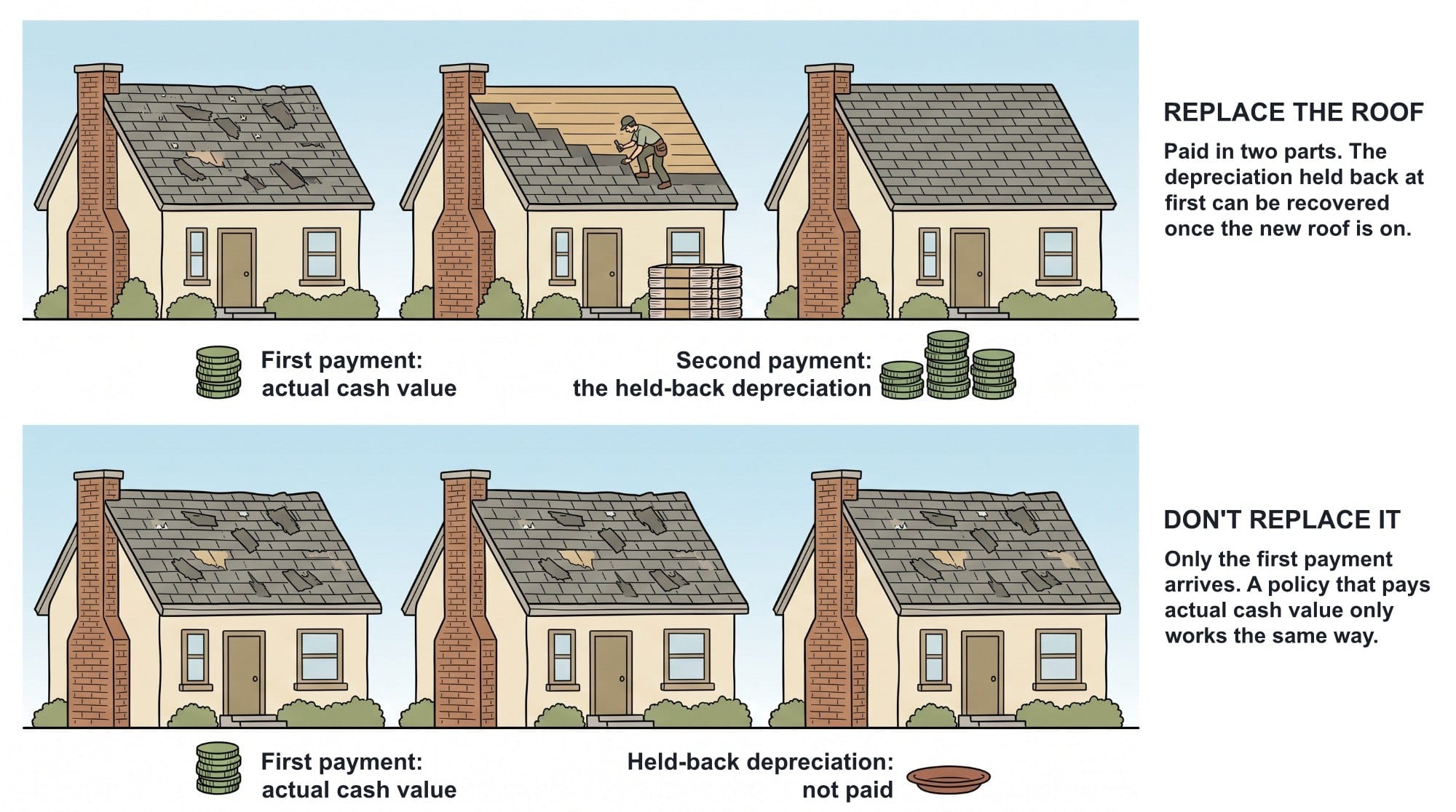
    Replacement cost coverage generally means the policy can pay the cost to replace damaged covered property with new materials of like kind and quality, subject to the policy deductible, limits, and conditions. For a roof claim, that can mean less out-of-pocket exposure after recoverable depreciation is paid.

    Some policies pay roof claims in stages. The insurer may initially pay actual cash value, then release recoverable depreciation after the work is completed and documentation is submitted. Homeowners should understand that process so they are not surprised by the first claim payment.

    Actual Cash Value Coverage Explained

    Actual cash value, often called ACV, generally means replacement cost minus depreciation. The older the roof, the more depreciation may be applied. If a roof is near the end of its expected life, the claim payment under ACV can be far lower than the cost to replace it.

    ACV roof coverage is not automatically bad in every situation, but homeowners need to know they have it. A lower premium may come with significantly more risk retained by the homeowner.

    Roof Age Can Change the Coverage

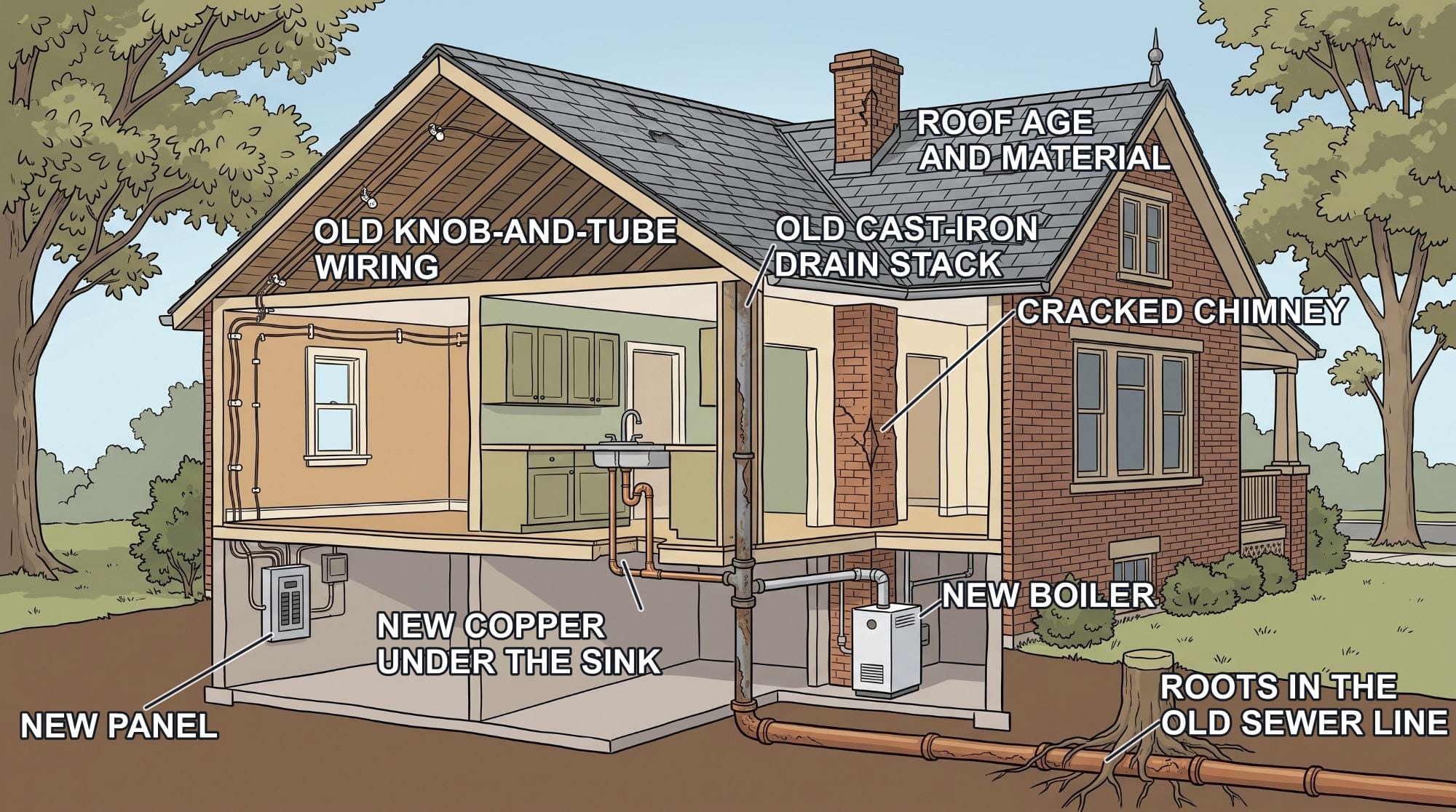
    Some insurers offer replacement cost for newer roofs but shift to ACV at a certain age. Others apply different deductibles or endorsements based on roof age, material, or condition. A renewal may include changes that are easy to miss if the policy is not reviewed carefully.

    Homeowners should keep records of roof installation, repairs, inspections, materials, and warranties. Documentation can help with underwriting, discounts, and claims.

    Wind and Hail Deductibles Need Review

    Some policies have a separate wind and hail deductible. It may be a flat dollar amount or a percentage of the dwelling limit. Percentage deductibles can be much larger than homeowners expect.

    For example, a one percent deductible on a high-value home can create a meaningful out-of-pocket cost. The deductible should be reviewed in dollars, not just as a percentage.

    Do Not Wait Until the Roof Is Old

    Once a roof is older or in poor condition, coverage options may become more limited. Some insurers may require repairs, exclude certain damage, offer only ACV, or decline the home. Proactive maintenance and documentation can preserve options.

    If a roof replacement is planned, homeowners should notify their agent after completion. A new roof may improve underwriting and pricing, and the policy should reflect the updated roof year.

    Common Roof Claim Mistakes

    One mistake is signing contractor paperwork before understanding the insurance claim process. Homeowners should be careful with assignments, contingency agreements, and promises that sound too easy.

    Another mistake is assuming matching issues, code upgrades, decking, gutters, and interior damage are handled the same way by every policy. They are not. Policy language matters.

    A third mistake is waiting years to document roof condition. Photos, inspections, maintenance, and replacement records can make a difference.

    Questions to Ask at Renewal

    Is the roof covered at replacement cost or actual cash value? Is there a separate wind and hail deductible? Does the deductible apply as a flat amount or percentage? Are cosmetic losses excluded? Does roof age change settlement terms?

    These questions should be answered before storm season. If the answers are unclear, the policy needs review.

    Maintenance and Documentation

    Clean gutters, trim overhanging limbs, repair minor damage promptly, document roof age, save invoices, and take photos after major work. Good documentation cannot guarantee a claim outcome, but it can reduce uncertainty.

    A Practical Roof Claim Example

    Consider a homeowner with a fifteen-year-old roof damaged by hail. If the policy provides replacement cost, the homeowner may recover depreciation after the roof is replaced, subject to policy terms. If the policy provides actual cash value only, depreciation may leave a much larger out-of-pocket cost. Two policies with similar premiums can produce very different claim results.

    When comparing quotes, ask whether the policy solves this real-world problem or only produces a lower premium. Strong insurance planning begins with the claim scenario, then works backward to the coverage, deductible, limit, and endorsement choices that would matter when money is actually at stake.

    It is also worth reviewing coverage before the renewal deadline rather than after the invoice arrives. A thoughtful review gives enough time to compare markets, correct rating details, gather documentation, adjust deductibles, and decide which coverage improvements are worth the cost. Rushed insurance decisions tend to focus only on premium, while better decisions compare premium, coverage quality, claim scenarios, and the financial consequences of being wrong.

    Coverage Review Checklist

    • Confirm whether roof claims settle at replacement cost or ACV

    • Check for separate wind and hail deductibles

    • Review roof age shown on the policy

    • Keep installation and repair documentation

    • Tell your agent after replacing the roof

    • Avoid choosing a policy based only on premium

    • Ask how recoverable depreciation works before a claim

    Bottom Line

    Longmeadow Insurance can review your homeowners policy and explain how your roof is covered before the next Illinois storm season.

    How Longmeadow Insurance Can Help

    Longmeadow Insurance is an independent agency based in Wilmette, Illinois. We help homeowners, condo owners, landlords, families, and businesses compare coverage options and understand the tradeoffs before a claim occurs.

    If you would like a coverage review, call 847.242.1040 or request a consultation through Longmeadow Insurance.

    Coverage We Write

    Longmeadow Insurance is an independent agency in Wilmette with offices across Chicago and the suburbs. If any of this applies to your situation, we can review your current policy and tell you what it actually covers.

    Call 847.242.1040 or request a quote online.
  • Insurance Checklist Before Renovating a Chicago or North Shore Home

    Insurance Checklist Before Renovating a Chicago or North Shore Home

    Renovation changes the insurance risk. A home that was properly insured yesterday may need different coverage once walls are opened, contractors are on site, materials are delivered, utilities are modified, or the family moves out temporarily.

    This is especially important in Chicago, Oak Park, Evanston, Wilmette, Winnetka, Glencoe, Kenilworth, Northbrook, Elmhurst, and other communities with older homes, high replacement costs, strict permits, and expensive finishes.

    Before the first contractor starts work, homeowners should review insurance. The goal is to prevent a renovation problem from becoming an uncovered claim.

    Tell Your Insurance Agent Before Work Begins

    The most important step is simple: notify your agent before the project starts. A small cosmetic update may not require major policy changes. A large addition, structural work, roof replacement, kitchen expansion, basement build-out, or whole-home renovation may require underwriting review or a different policy structure.

    Insurance companies care about construction because it increases fire, theft, water, liability, and vacancy exposure. If the insurer learns about a major renovation only after a claim, the situation becomes much harder.

    Verify Contractor Insurance

    Homeowners should request certificates of insurance from the general contractor and key subcontractors. The certificate should show general liability, workers compensation, and commercial auto where appropriate. For larger projects, homeowners may also request additional insured status.

    A contractor without proper insurance can create risk for the homeowner. If a worker is injured, a neighbor’s property is damaged, or faulty work causes a loss, the contractor’s insurance position matters.

    Builder’s Risk or Renovation Coverage May Be Needed


    A standard homeowners policy may not adequately cover a major renovation. Builder’s risk or renovation coverage can protect the structure, materials, and work in progress during construction, depending on the policy terms.

    This is especially important when the project involves structural changes, significant materials stored on site, a vacant home, or a large increase in property value. The homeowner should confirm who is responsible for insuring materials before and after installation.

    Vacancy and Temporary Relocation Change the Risk


    If the home will be vacant or unoccupied during renovation, coverage may change. Vacant homes are more vulnerable to theft, vandalism, frozen pipes, unnoticed leaks, and fire. Some policies restrict coverage after a certain vacancy period.

    Homeowners should disclose whether they are moving out, how long the project will take, who will monitor the home, and whether utilities will remain active.

    Update Replacement Cost After the Project

    Renovations often increase the replacement cost of the home. A new kitchen, addition, finished basement, custom built-ins, upgraded mechanical systems, new roof, or exterior improvements should be reflected in the dwelling limit after completion.

    Homeowners should keep contracts, plans, invoices, photos, permits, and completion records. These documents help update coverage and can be valuable during a future claim.

    Common Renovation Insurance Mistakes

    The most common mistake is assuming the contractor’s insurance protects the homeowner completely. Contractor coverage is important, but it does not replace the homeowner’s property and liability program.

    Another mistake is starting work before insurance review. Once demolition begins, materials arrive, or the home becomes vacant, the risk has already changed.

    A third mistake is failing to update coverage after the project. A successful renovation can increase replacement cost substantially.

    Contract Review Issues

    Construction contracts should address insurance, indemnity, responsibility for materials, change orders, site security, permits, and cleanup. Homeowners should not rely only on verbal assurances.

    For larger projects, it may be appropriate to have an attorney review the contract and to ask the insurance agent what documentation is needed from the contractor.

    After the Project Is Complete

    Send completion details to your agent, including total project cost, updated square footage, major systems, roof work, finished basement space, new detached structures, and high-value finishes. The policy should reflect the improved home, not the pre-renovation version.

    A Practical Renovation Example

    Consider a homeowner who moves out for a six-month renovation. Contractors open walls, materials are stored in the garage, plumbing is disconnected, and the home is unoccupied most nights. That is not the same risk as an occupied finished home. If theft, fire, or water damage occurs, the insurance company will ask about the construction and occupancy status. The answers should already be reflected in the coverage.

    When comparing quotes, ask whether the policy solves this real-world problem or only produces a lower premium. Strong insurance planning begins with the claim scenario, then works backward to the coverage, deductible, limit, and endorsement choices that would matter when money is actually at stake.

    It is also worth reviewing coverage before the renewal deadline rather than after the invoice arrives. A thoughtful review gives enough time to compare markets, correct rating details, gather documentation, adjust deductibles, and decide which coverage improvements are worth the cost. Rushed insurance decisions tend to focus only on premium, while better decisions compare premium, coverage quality, claim scenarios, and the financial consequences of being wrong.

    Coverage Review Checklist
    Notify your agent before signing major construction contracts
    Collect contractor certificates of insurance
    Ask whether builder’s risk or renovation coverage is needed
    Disclose vacancy or temporary relocation
    Confirm who insures materials on site
    Review liability limits and umbrella coverage
    Update replacement cost after completion

    Bottom Line

    Longmeadow Insurance can review your renovation plans and insurance coverage before work begins on a Chicago, North Shore, or suburban home.

    How Longmeadow Insurance Can Help

    Longmeadow Insurance is an independent agency based in Wilmette, Illinois. We help homeowners, condo owners, landlords, families, and businesses compare coverage options and understand the tradeoffs before a claim occurs.

    If you would like a coverage review, call 847.242.1040 or request a consultation through Longmeadow Insurance.

    Coverage We Write

    Longmeadow Insurance is an independent agency in Wilmette with offices across Chicago and the suburbs. If any of this applies to your situation, we can review your current policy and tell you what it actually covers.

    Call 847.242.1040 or request a quote online.
  • Eyes in the Sky: How Satellite Data Is Changing Home Insurance Renewals and What You Can Do About It

    If you have received a non-renewal notice from your home insurance carrier in the past year or two, there is a good chance a satellite played a role in that decision. What used to require a physical drive-by inspection or an in-person visit from an adjuster can now happen from orbit, and the shift is reshaping how carriers underwrite, price, and renew homeowners policies across the country.

    For homeowners on the North Shore and throughout the Chicago suburbs, understanding this trend is no longer optional. It is the new reality of property insurance, and being proactive about it can make a real difference in what you pay and whether your policy gets renewed at all.

    The Shift from Clipboards to Satellites

    Insurance underwriting has always involved assessing the physical condition of a home. For decades, that meant sending someone out to look at the property, take a few photos, and file a report. It was slow, expensive, and inconsistent. Two different inspectors looking at the same house might come to very different conclusions.

    Starting around 2018, carriers began experimenting with aerial and satellite imagery as a supplement to traditional inspections. By 2023, the practice had become mainstream. Today, most major carriers and many regional ones use some combination of satellite photos, drone imagery, and AI-driven image analysis to evaluate properties during the underwriting and renewal process.

    The technology behind this shift is surprisingly sophisticated. High-resolution optical satellites capture detailed images of rooftops, yards, and surrounding areas. Multispectral sensors can detect things invisible to the naked eye, like the moisture content of roofing materials or the health of surrounding vegetation. Synthetic Aperture Radar (SAR) technology works through cloud cover and at night, providing continuous monitoring capability regardless of weather conditions. When you layer AI and machine learning on top of all that imagery, carriers can analyze thousands of properties in the time it once took to inspect a single home.

    What Exactly Are Insurers Looking For?

    When a satellite or drone captures an image of your home, the AI systems reviewing that image are trained to flag a specific set of risk indicators. Understanding what they look for is the first step toward staying ahead of the process.

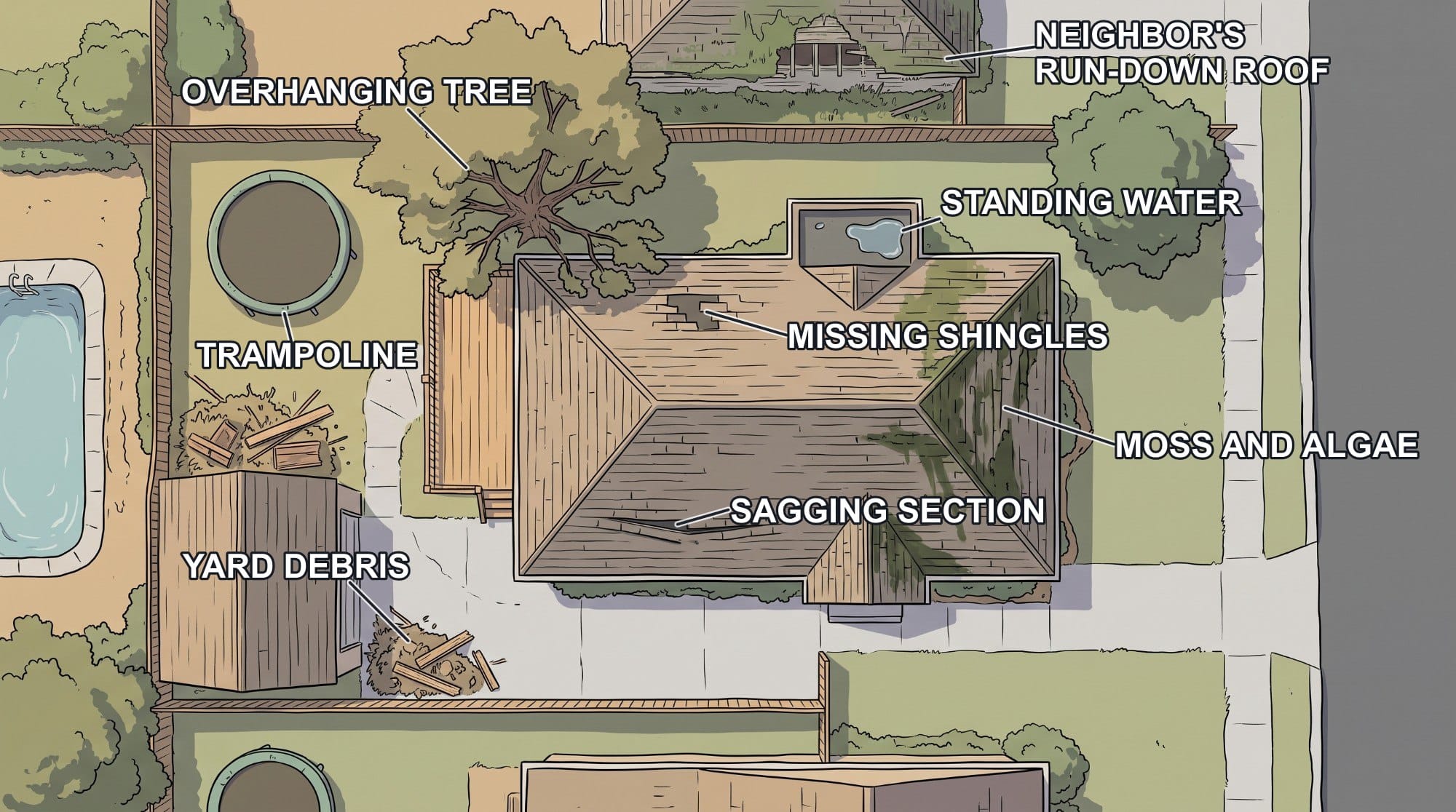
    Roof condition is far and away the biggest factor. Carriers are scanning for missing or damaged shingles, moss or algae growth, sagging sections, ponding water, and visible wear patterns that suggest a roof is nearing the end of its useful life. According to industry data, U.S. roof claims costs reached nearly $31 billion in 2024, roughly a 30% increase since 2022. That kind of loss trend makes carriers very motivated to identify roofs that are likely to generate claims before the next hailstorm or windstorm rolls through.

    Beyond the roof, satellite and aerial imagery can pick up on tree proximity and overhanging branches, yard debris and clutter, the presence of trampolines, pools, or large decks that increase liability exposure, structural issues visible from above like foundation cracks or leaning walls, and even the condition of neighboring properties that might increase your risk profile.

    In wildfire-prone regions, carriers are also evaluating defensible space, which refers to how much cleared area surrounds a structure. While this is less of a concern on the North Shore than it is in California or Colorado, the underlying principle applies everywhere: insurers want to see that a homeowner is actively managing risk around the property.

    How This Affects Your Renewal

    Here is where things get personal. The growing use of satellite data means that your carrier may be evaluating your property condition between renewal cycles without you knowing about it. In most states, including Illinois, insurers can legally use aerial imagery visible from public airspace without providing advance notice to the homeowner.

    The consequences can be significant. If the imagery flags a concern, you might receive a non-renewal notice 30 to 60 days before your policy expires. You might see a substantial premium increase at renewal. You might receive a letter requesting that you make specific repairs within a set timeframe, or risk cancellation. In some cases, you might simply find that your carrier is no longer willing to quote you at all when you go to shop for a new policy.

    The frustrating part for many homeowners is that these decisions can be based on outdated or inaccurate imagery. Satellite photos may have been taken months before the review, and a roof you replaced last spring might still show up as damaged in the insurer’s system. Trees you trimmed in the fall might still appear as overhanging hazards. This gap between reality and the data is one of the biggest sources of complaints from homeowners who feel they have been treated unfairly.

    Since 2023, homeowners in states like Texas have increasingly filed complaints with their state departments of insurance over decisions made on the basis of aerial imagery. Consumer advocates have raised concerns about the loss of human judgment in the process, with some arguing that the technology creates a system where algorithms make coverage decisions about homes that no human has actually visited.

    The Roof Factor: Why It Matters More Than Ever

    If there is one takeaway from the satellite data trend, it is this: your roof matters more to your insurance cost and availability than almost anything else about your home.

    Industry data shows that the premium gap between newer roofs and aging ones has widened dramatically in recent years. In 2022, the premium difference between a home with a roof less than five years old and one with a roof in the 11 to 15 year range was roughly $49 per year. By 2025, that same gap had grown to $155 per year. And that gap continues to grow as carriers lean more heavily into property-specific underwriting driven by aerial imagery.

    Many carriers have also moved away from offering full replacement cost coverage on older roofs, instead shifting to actual cash value schedules that factor in depreciation. The practical effect is that even if your older roof is in good shape, you may be paying more for less coverage than your neighbor with a newer roof.

    For homeowners approaching a roof that is 15 to 20 years old, the math on a proactive replacement increasingly favors action. The combination of lower premiums, better coverage terms, improved insurability, and avoiding a potential non-renewal makes a compelling financial case, above and beyond the obvious benefit of not having to worry about leaks and storm damage.

    Best Practices for Homeowners: How to Get the Best Rate

    The good news in all of this is that the satellite data trend actually gives homeowners more agency over their insurance outcomes than the old system did. When decisions are made based on visible, physical characteristics of your property, you can take concrete steps to influence those decisions. Here is what the smartest homeowners are doing.
    Keep Your Roof in Top Shape

    This is the single most impactful thing you can do. Have your roof inspected by a qualified contractor at least once a year, ideally in the spring after winter weather has had its way with things. Address minor issues like missing shingles, flashing problems, or moss growth immediately. Keep a file of dated photos and contractor invoices showing work that has been done. If your roof is approaching the 15-year mark and showing signs of wear, start planning and budgeting for a replacement rather than waiting for a problem.

    Manage Your Trees and Landscaping

    Overhanging branches are a major red flag in aerial imagery analysis. Carriers see them as a direct threat to your roof and siding, and they are right. Keep branches trimmed back at least six feet from the roof line, and consider removing dead or dying trees entirely. Beyond reducing your insurance risk, this also reduces the chance of actual storm damage, which is a win on both sides of the equation.

    Clean Up Your Yard

    It might seem trivial, but visible clutter, debris, and deferred maintenance in your yard can and do affect underwriting decisions. Satellite and aerial images capture everything that is visible from above. A clean, well-maintained property signals to the algorithm (and to any human reviewer) that the homeowner is actively caring for the property. Remove old tarps, broken equipment, unused structures, and anything else that suggests neglect.

    Document Your Improvements


    This is critical and often overlooked. If you have made improvements to your home, particularly a new roof, updated siding, tree removal, or other work that changes the exterior appearance of the property, keep thorough documentation. Save contractor invoices, before-and-after photos with dates, permit records, and any inspection reports. If a carrier flags your property based on outdated imagery, this documentation is your best tool for getting the decision reversed.

    Share Your Documentation Proactively


    Do not wait for a non-renewal notice to share proof of improvements with your carrier. If you have replaced your roof or made other significant upgrades, let your agent know. A good independent agent can make sure that updated information gets into the underwriting file before the renewal review happens. This is one of the major advantages of working with an independent agency rather than buying direct. You have someone in your corner who can advocate on your behalf and make sure the right information reaches the right people at the right time.

    Review Your Policy Well Before Renewal

    At least 60 to 90 days before your policy renewal date, take a hard look at your coverage and start gathering competitive quotes. If your current carrier is planning a non-renewal or a significant rate increase, you want to know about it with enough lead time to find alternatives. The homeowners who get caught off guard are the ones who wait until 30 days out and then scramble.

    Consider a Pre-Renewal Inspection


    Some homeowners are now hiring independent inspectors to do a roof and property assessment before their renewal date, specifically to identify anything that might show up as a concern in aerial imagery. Think of it like getting a home inspection before selling. You want to know what the buyer (in this case, the insurance company) is going to see, and you want to fix anything fixable before they see it.

    Invest in Impact-Resistant Materials

    When you do replace a roof or make other exterior upgrades, choose materials that carry impact resistance ratings. Many carriers offer discounts for Class 4 impact-resistant shingles, and some will not even write a policy on a home without them in hail-prone areas. On the North Shore, where severe convective storms are an increasing concern, this is an investment that pays dividends on both the insurance side and the damage prevention side.

    Work with an Independent Agent

    This point deserves emphasis. When your insurance decisions are being made by algorithms analyzing satellite photos, having a knowledgeable human advocate working on your behalf is more important than ever. An independent agent who understands how different carriers use aerial imagery, which carriers are more flexible on older roofs, and how to present your property in the best possible light can save you hundreds of dollars a year and potentially prevent a non-renewal altogether.

    The Regulatory Picture

    State regulators are paying attention to this trend, though the regulatory response has been uneven. Some states have begun introducing legislation that would require carriers to notify homeowners before taking aerial images of their property or to disclose when automated imaging data is used in underwriting decisions. California introduced a bill in 2025 that would require 30 days advance notice before aerial imaging of a property.

    In Illinois, the regulatory framework is still evolving. The Illinois Department of Insurance has the authority to investigate complaints related to unfair underwriting practices, and homeowners who believe they have been treated unfairly based on inaccurate aerial imagery should absolutely file a complaint. The more complaints regulators receive, the more attention the issue gets, and the more likely we are to see meaningful consumer protections put in place.

    Looking Ahead

    The use of satellite and aerial data in home insurance is not going away. If anything, it is accelerating. The satellite constellation orbiting Earth is expected to grow from roughly 10,000 satellites to as many as 70,000 in the coming years, and the cost of satellite manufacturing and launch has dropped to roughly one-third of what it was in the 1990s. That means more frequent imagery, higher resolution, and even more data feeding into carrier underwriting models.

    For homeowners, the practical implication is clear: the physical condition and appearance of your property is now continuously visible to your insurance carrier in a way it never was before. That can feel intrusive, and the privacy concerns are legitimate. But it also means that the homeowners who take the best care of their properties are increasingly being rewarded with better rates, better coverage terms, and better access to the most competitive carriers.

    The old model of insurance underwriting relied heavily on broad averages and zip-code-level risk assessments. The new model is far more granular and property-specific. If your home is well maintained and your roof is in good shape, that specificity works in your favor. If it is not, the gap between what you are paying and what your well-maintained neighbor is paying is only going to get wider.

    The Bottom Line

    Satellite data and aerial imagery have fundamentally changed the home insurance renewal and underwriting process. Carriers can now evaluate your property remotely, in detail, and at any time. The decisions that come out of that process affect your premiums, your coverage availability, and your options.

    The homeowners who come out ahead in this new environment are the ones who treat property maintenance as an ongoing insurance strategy, not just a home improvement project. Keep your roof in excellent condition. Manage your trees. Clean up your yard. Document everything. And work with an independent agent who understands how the system works and can make sure your property is presented accurately to the carriers who are looking at it from above.

    If you have questions about how satellite data might be affecting your home insurance, or if you have received a non-renewal notice and want to understand your options, we are here to help. At Longmeadow Insurance, we work with multiple carriers across the North Shore and can help you work through the increasingly data-driven world of homeowners insurance with confidence. Longmeadow Insurance is an independent insurance agency based in Wilmette, Illinois, serving homeowners across the Chicago North Shore. Contact us today to review your coverage and make sure your home is positioned for the best possible rate at renewal.

    Related insurance guides

    These related resources go deeper on connected coverage questions.

    Coverage We Write

    Longmeadow Insurance is an independent agency in Wilmette with offices across Chicago and the suburbs. If any of this applies to your situation, we can review your current policy and tell you what it actually covers.

    Call 847.242.1040 or request a quote online.
  • Safeco Insurance Is Gone: What the Liberty Mutual Rebrand Means for Homeowners in Glenview, Northbrook, Wilmette, and Chicago’s North Shore

    If you have a Safeco homeowners policy in the northern suburbs of Chicago, here is the key coverage issues right now about the biggest insurance brand change in decades and why working with a local, independent insurance agent has never mattered more.

    The End of Safeco: What Happened and Why

    After more than 100 years as a recognized name in American insurance, the Safeco Insurance brand is officially being retired. In March 2025, Liberty Mutual Insurance announced that starting in 2026, all of its personal lines products will be sold and marketed exclusively under the Liberty Mutual name. That means homeowners insurance, auto insurance, umbrella policies, renters insurance, condo insurance, and specialty coverage that were previously branded as Safeco will now carry the Liberty Mutual name.

    Liberty Mutual acquired Safeco back in 2008 for approximately $2.7 billion. At the time, Safeco was the go-to brand Liberty Mutual used to distribute personal insurance through independent agents. Over the following 17 years, Safeco grew into a powerhouse, generating more than $13 billion in annual written premium and operating through a nationwide network of more than 22,000 independent insurance agencies.

    Now, that century-old name is being phased out, and if you are a homeowner in Glenview, Northbrook, Wilmette, Winnetka, Kenilworth, Glencoe, Highland Park, Deerfield, Libertyville, Lake Forest, Buffalo Grove, or anywhere else in Chicago’s northern suburbs, you may be wondering what this means for your coverage, your premiums, and your relationship with your insurance agent.

    The short answer: your policy is not going anywhere. But the longer answer is more nuanced, and understanding the full picture will help you make smarter decisions about your homeowners insurance in Illinois.

    A Brief History of Safeco Insurance: 100 Years of Independent Agent Trust

    To understand why this rebrand matters, it helps to understand where Safeco came from. Safeco was founded in 1923 in Seattle, Washington by Hawthorne K. Dent as the General Insurance Company of America. In 1953, a new subsidiary was created specifically to serve independent insurance agents, named SAFECO, which stood for Selective Auto and Fire Insurance Company of America. The brand was so successful that by 1968, the parent company changed its name entirely to Safeco.
    For decades, Safeco was synonymous with the independent agent channel. While companies like State Farm and Allstate built captive agent networks where agents sold only one company’s products, Safeco built its entire identity around independent agents: local insurance professionals who could shop multiple carriers and find the best coverage and price for each individual client.

    That independent agent philosophy is part of why so many homeowners in the Chicago area came to trust the Safeco name. When your local independent insurance agent in Glenview or Northbrook placed your home or auto policy with Safeco, it was because they believed it was the right fit for you, not because they were required to sell it.
    After Liberty Mutual’s 2008 acquisition, Safeco continued to operate as a semi-autonomous brand. Liberty Mutual itself sold directly to consumers online and through call centers, while Safeco served the independent agent channel with its own product offerings, its own underwriting guidelines, and its own brand identity.
    That dual-track approach is now coming to an end.

    What the Safeco to Liberty Mutual Transition Actually Means
    According to Liberty Mutual’s official announcement, here is what is changing and what is not:

    What is changing:
    -The Safeco brand name and logo will be retired in 2026
    Safeco.com and the Safeco mobile app will eventually transition to Liberty Mutual platforms
    -Your bank statement or insurance documents will show “Liberty Mutual” instead of “Safeco”
    -The familiar Safeco branding you have seen in your agent’s office will be replaced with Liberty Mutual branding

    What is NOT changing:
    -Your existing homeowners insurance policy will remain in force
    -Your coverage limits, deductibles, and policy terms stay the same
    -Your relationship with your independent insurance agent continues unchanged
    -Your payment schedule, billing method, and claims process are unaffected
    -No new paperwork is required from policyholders
    -Your current Safeco login credentials will transfer to Liberty Mutual’s platform

    As Liberty Mutual put it directly in their announcement, the goal is to “fully harness the Liberty Mutual brand value for all customers, agents, and partners, across all distribution channels.” The company also emphasized that independent agent channel products will remain differentiated from the direct-to-consumer channel, meaning that what your independent agent can offer you through Liberty Mutual will still be different from what someone might buy online at libertymutual.com.

    Why Did Liberty Mutual Decide to Retire the Safeco Brand?

    Corporate rebrands of this scale rarely happen overnight, and Liberty Mutual’s decision to sunset Safeco is rooted in several strategic business factors.

    Brand consolidation and marketing efficiency. Running two parallel consumer brands is expensive. Liberty Mutual spends hundreds of millions of dollars annually on advertising, including its widely recognized Limu Emu and Doug marketing campaign. Maintaining a separate brand identity for Safeco meant splitting marketing resources, technology investments, and operational infrastructure across two names. Consolidating under one brand allows Liberty Mutual to concentrate its marketing power in a single direction.

    Technology and digital experience alignment. Modern insurance consumers expect seamless digital tools: easy online policy management, mobile apps, instant ID cards, and frictionless claims filing. Building and maintaining separate digital platforms for Safeco and Liberty Mutual created redundancy. The consolidation allows Liberty Mutual to build one unified technology experience for all customers, regardless of whether they came through an independent agent or directly.
    Financial strength following a difficult period. Liberty Mutual closed 2024 with what company CEO Timothy Sweeney described as the strongest balance sheet in company history and the lowest combined ratio in 20 years. After several years of elevated losses from catastrophic weather events, including wildfires and severe storms, Liberty Mutual has stabilized its underwriting results and is now focused on growing market share aggressively.

    Competitive positioning. With companies like Nationwide, Travelers, and Progressive all competing hard for independent agent business, Liberty Mutual is betting that a single, nationally recognized brand with massive marketing reach will give its independent agent partners an edge when presenting options to homeowners and auto insurance shoppers.

    What This Means for Homeowners Insurance in Chicago’s Northern Suburbs

    If you own a home in Cook County, Lake County, or the northern collar counties of Illinois, your homeowners insurance needs are unique. Chicago’s north shore and northern suburban communities present specific insurance considerations that a local independent agent understands far better than a call center or a website.

    Weather and storm risk in Glenview, Northbrook, and surrounding communities. Northern Illinois is no stranger to severe weather. Hail damage to roofs and siding, basement flooding from heavy rain and snowmelt, ice dam damage in winter, and wind damage from derecho events all create real exposure for homeowners in communities like Buffalo Grove, Libertyville, Vernon Hills, Lake Forest, and Highland Park. The right homeowners insurance policy in this area needs to address:

    -Dwelling replacement cost coverage that keeps pace with rising Illinois construction costs
    -Sewer backup and water backup coverage, which is typically not included in a standard homeowners policy but is critical for any home with a basement in the Chicago suburbs
    -Extended replacement cost or guaranteed replacement cost to protect against catastrophic loss scenarios
    -Scheduled personal property coverage for high-value items like jewelry, fine art, or musical instruments
    -Flood insurance options, particularly for homeowners near the North Branch of the Chicago River, the Des Plaines River watershed, or low-lying areas in Lake County

    Home values in Chicago’s northern suburbs. The communities along Chicago’s north shore rank among the most expensive residential real estate markets in Illinois and in the Midwest. Median home values in Winnetka, Kenilworth, Glencoe, and Wilmette regularly exceed $700,000 to well over $1 million. Homes of this value require homeowners insurance policies with dwelling coverage limits that genuinely reflect what it would cost to rebuild today, not what the home was worth when the policy was first written years ago.

    One of the most common and costly mistakes homeowners in Glenview and Northbrook make is carrying insurance at outdated replacement cost values. Construction costs in the Chicago area have risen dramatically since 2020, driven by labor shortages and material price inflation. A home that could have been rebuilt for $350 per square foot four years ago may now require $450 to $500 per square foot. If your homeowners policy is not keeping pace, you may find yourself significantly underinsured when a major loss occurs.

    This is exactly the kind of review a local independent insurance agent in the northern suburbs performs annually, and it is a conversation you should be having with your agent regardless of whether your policy says Safeco or Liberty Mutual on the cover.

    Umbrella insurance for high-net-worth homeowners. Many families in Chicago’s northern suburbs own significant assets including investment portfolios, second homes, vacation properties, rental properties, and valuable personal property. A standard homeowners policy with $300,000 in liability coverage may not provide adequate protection. A personal umbrella policy provides an additional layer of liability coverage, typically in increments of $1 million, and is one of the most cost-effective ways to protect wealth in high-net-worth households. Local independent agents who specialize in North Shore insurance regularly pair homeowners and auto policies with umbrella coverage as a core component of a complete personal insurance program.

    The Independent Agent Advantage: Why It Matters More Than Ever in 2026

    The Safeco to Liberty Mutual transition is happening at a moment when the value of working with a local independent insurance agent has never been clearer.

    When you buy homeowners insurance directly from a carrier online, you are essentially shopping a single company’s products. You have no way to benchmark whether that price is competitive, whether that coverage is appropriate for your specific home, or whether better options exist elsewhere.

    When you work with an independent insurance agency in the northern suburbs of Chicago, you gain access to a licensed professional who represents multiple insurance carriers and can shop the market on your behalf. That agent knows the underwriting guidelines, pricing trends, and claims histories of the carriers they represent. They can match your specific risk profile to the company most likely to offer the best combination of price, coverage, and claims service.

    The Safeco brand change does not alter this dynamic. Your independent agent will still have access to Liberty Mutual’s products. The independent agent channel remains distinct from Liberty Mutual’s direct channel, meaning independent agents will continue to offer differentiated products that are not simply identical to what is available online.
    What the transition does underscore is the importance of conducting a comprehensive insurance review with your local agent. This is an ideal time to ask your agent:

    -Is my dwelling replacement cost value up to date with current construction costs in Illinois?
    -Do I have sewer backup and water backup coverage on my homeowners policy?
    -Is my liability coverage adequate, or should I be considering a personal umbrella policy?
    -Am I properly covered for home office equipment, business property, or professional liability if I work from home?
    -Are there any coverage gaps between my homeowners policy and my auto policy that could leave me exposed?
    -How does Liberty Mutual’s pricing compare to other carriers your agency represents, and am I still getting the best value?

    A thorough insurance review takes 30 to 45 minutes and could save you thousands of dollars or prevent a significant coverage gap that might not become apparent until after a major loss.

    Homeowners Insurance in Illinois: Key Coverage Concepts to Understand

    Whether your policy is transitioning from Safeco to Liberty Mutual or you are shopping for homeowners insurance in the north suburbs for the first time, understanding these core coverage concepts will help you make better decisions.

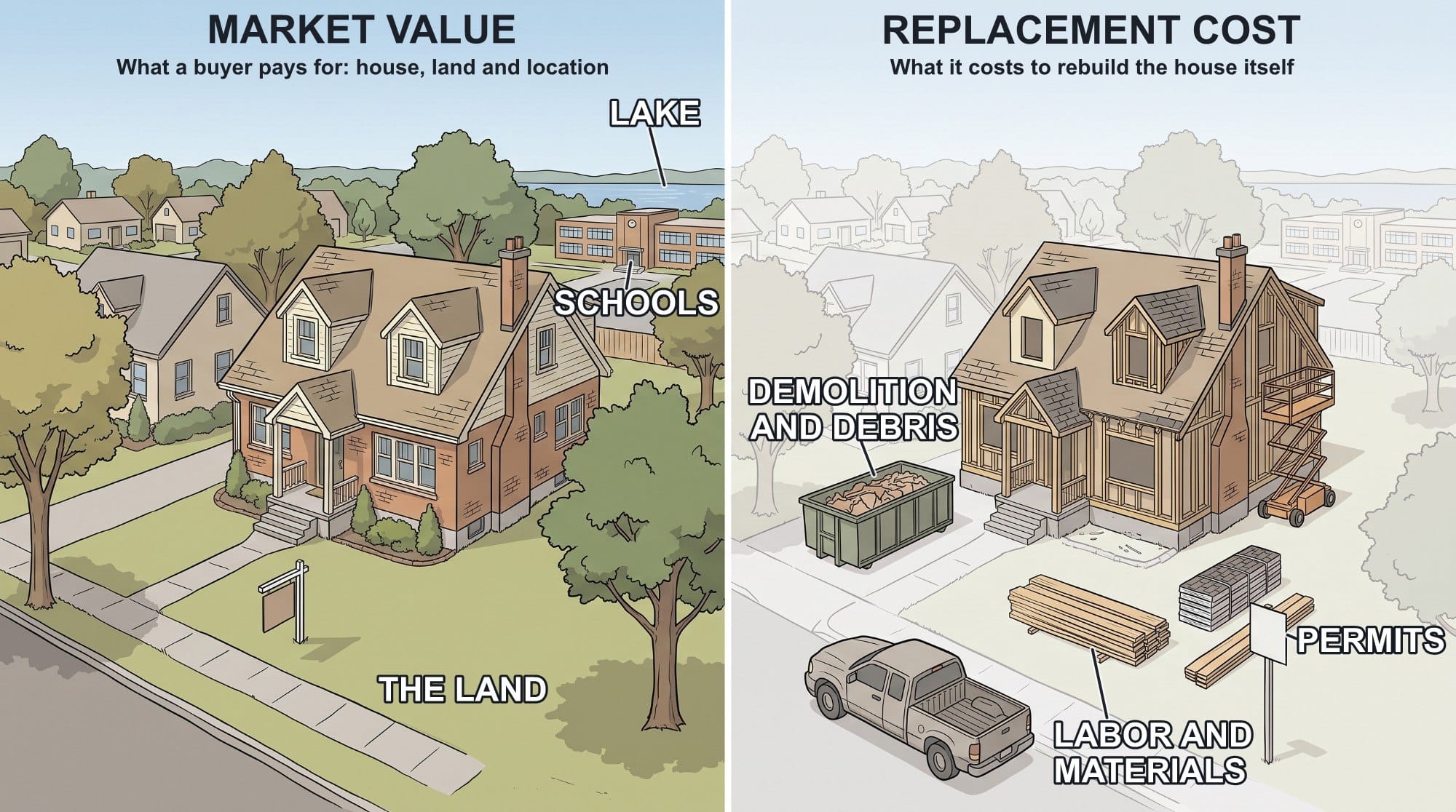
    Dwelling coverage (Coverage A). This pays to repair or rebuild the physical structure of your home after a covered loss such as fire, wind, hail, lightning, or certain water damage. The coverage limit should reflect the full estimated replacement cost of your home, not its market value or purchase price.

    Other structures coverage (Coverage B). This covers detached garages, fences, sheds, and similar structures on your property. It is typically set at 10% of your dwelling coverage, but can be adjusted if you have significant outbuildings.

    Personal property coverage (Coverage C). This covers your belongings, including furniture, electronics, clothing, and household goods. Most standard homeowners policies cover personal property on an actual cash value basis, which accounts for depreciation. Upgrading to replacement cost coverage for personal property can significantly improve your recovery after a loss.

    Loss of use coverage (Coverage D). If your home becomes uninhabitable after a covered loss, this pays for temporary housing and additional living expenses. For homeowners in Northbrook or Glenview, where rental market rates are high, having adequate loss of use coverage is important.
    Personal liability coverage (Coverage E). This protects you if someone is injured on your property or if you are held responsible for damage to someone else’s property. Most standard policies include $100,000 to $300,000 in liability coverage, but many insurance professionals recommend higher limits, particularly when combined with a personal umbrella policy.

    Medical payments coverage (Coverage F). This pays for minor medical expenses for guests who are injured on your property, regardless of who is at fault. This coverage helps resolve small injury claims without triggering a liability lawsuit.

    What to Do Right Now If You Have a Safeco Policy in the Chicago North Suburbs

    If you are a Safeco policyholder in communities like Glenview, Northbrook, Wilmette, Winnetka, Kenilworth, Glencoe, Highland Park, Deerfield, Libertyville, Lake Forest, Buffalo Grove, Vernon Hills, Mundelein, or anywhere else in Cook County or Lake County, here is a practical action plan:

    Step one: Contact your local independent insurance agent. Your agent should proactively be reaching out to Safeco policyholders about the transition, but do not wait if you have questions. Call your agent, ask for an explanation of what the transition means for your specific policy, and request a comprehensive coverage review.

    Step two: Verify your replacement cost coverage. Ask your agent to run a current replacement cost estimator for your home. Given the rise in construction costs in the Chicago area, many homeowners are carrying dwelling coverage that has not been updated in several years. This is one of the most common and consequential insurance gaps in the northern suburbs.

    Step three: Ask about water backup and sewer backup coverage. This endorsement is not included in a standard homeowners policy and must be added separately. Given the frequency of heavy rain events in northeastern Illinois and the prevalence of older infrastructure in many north shore communities, this is a critical endorsement for nearly every homeowner in the region.

    Step four: Consider whether Liberty Mutual is still the best carrier for your needs. The rebrand is a natural moment to ask your independent agent to shop your homeowners and auto insurance across all the carriers they represent. Independent agents in the northern suburbs typically have access to dozens of carriers including Erie, Travelers, Chubb, Cincinnati Insurance, Nationwide, Auto-Owners, Hanover, and many others. You may find that Liberty Mutual remains the best fit, or you may discover a better option elsewhere.

    Step five: Review your umbrella policy or consider purchasing one. If you own a home in a high-value community like Winnetka or Kenilworth and do not have a personal umbrella policy, now is a good time to ask your agent about adding one. A $1 million umbrella policy typically costs between $150 and $300 per year when bundled with your homeowners and auto insurance.

    Frequently Asked Questions: Safeco to Liberty Mutual Transition in Illinois

    Do I need to do anything for my Safeco policy to transfer to Liberty Mutual?
    No action is required. The transition is happening automatically in phases through 2026. You do not need to sign new paperwork, call your agent to initiate a transfer, or make any changes to your coverage. Your policy will continue under the Liberty Mutual name at your next renewal.

    Will my Safeco insurance ID cards still be valid?
    Yes. Your current Safeco ID cards remain valid. When your policy renews in 2026, you will receive new documents with Liberty Mutual branding.

    Will my premiums go up because of this brand change?
    The brand change itself is not a rate-change event. However, Liberty Mutual, like all insurance carriers, adjusts rates based on its own loss experience, reinsurance costs, claims inflation, and state regulatory filings. If you have experienced rate increases recently, they are the result of broader market conditions rather than the brand transition specifically. This makes it all the more important to have your independent agent compare your current rates against other carriers.

    Will I still be able to use the Safeco app?
    For now, yes. Safeco.com and the Safeco mobile app will remain operational during the transition. Eventually, they will migrate to Liberty Mutual’s platforms. Your existing username and password will transfer, and your policy and billing history will move with you.

    Can my independent agent still place new business with Liberty Mutual?
    Absolutely. Liberty Mutual has been explicit that the independent agent channel is a core part of its distribution strategy going forward. Independent agents will continue to have access to Liberty Mutual personal lines products, including homeowners, auto, umbrella, renters, condo, and specialty coverage.

    Is this a good time to shop my homeowners insurance?
    Yes, this is an excellent opportunity to review your coverage and compare options. Any time there is a change in your insurance relationship, whether it is a brand transition, a renewal, a move to a new home, or a significant renovation, it is worth asking your independent agent to benchmark your current coverage against the market.

    Why Local Independent Insurance Agents in Chicago’s North Shore Are Your Best Resource

    In a world where insurance can be purchased with a few clicks on a smartphone, it is worth pausing to understand what you give up when you skip the independent agent. Direct carriers like Geico, Progressive, and Liberty Mutual’s own online channel offer speed and convenience. But they offer only one carrier’s products. Their representatives are not licensed to give advice about coverage from other companies. If their pricing or underwriting guidelines change and no longer represent the best fit for your home in Glenview or Northbrook, you are on your own to figure that out.

    A local independent insurance agent in the northern suburbs of Chicago is licensed, appointed with multiple carriers, and professionally accountable to you. They have walked through claims with clients in your community. They know which carriers handle water damage claims fairly and which ones drag their feet. They know which companies are tightening underwriting on older roofs or homes near waterways. They know what coverage endorsements are particularly important for the types of homes found in Lake County and the North Shore.
    The Safeco brand is going away. The independent agent relationship is not. And in a changing insurance market, that relationship is more valuable than any logo.

    The Bigger Picture: Insurance Market Trends Affecting Homeowners in Illinois

    The Safeco to Liberty Mutual transition is one piece of a larger story unfolding in the personal lines insurance market across the country. Understanding the broader context helps explain why this particular moment calls for homeowners throughout the northern suburbs to pay close attention to their insurance programs.

    Rising homeowners insurance rates in Illinois. Premium increases have affected virtually every homeowners insurance market in the United States over the past several years. The primary drivers include increased catastrophic weather losses, rapid inflation in construction and labor costs, higher reinsurance costs passed down from carriers to policyholders, and increased litigation costs in states like Illinois. While the Chicago area has not faced the same severity of market disruption seen in Florida, California, or Colorado, homeowners in northeastern Illinois have not been immune to rate increases.

    Insurance carrier market withdrawals and appetite changes. Across the country, some insurance carriers have reduced their appetite for certain types of risks or certain geographic markets. While this trend has been most dramatic in coastal markets, Illinois homeowners with older roofs, homes in flood-prone areas, or histories of prior claims have encountered increased scrutiny from some carriers. An independent agent with access to multiple markets is your best protection against finding yourself in a situation where your current carrier no longer wants to renew your policy.

    The importance of working with a financially stable insurer. Liberty Mutual’s announcement of its strongest balance sheet in company history and lowest combined ratio in 20 years is genuinely meaningful news for policyholders. A financially stable insurer is more likely to honor claims promptly, maintain competitive pricing, and remain a viable partner for years to come. When evaluating homeowners insurance options, financial stability ratings from AM Best, Standard and Poors, or Moody’s are worth paying attention to.

    Increased focus on home safety and loss prevention. Modern insurance carriers, including Liberty Mutual, are increasingly investing in loss prevention tools and smart home technology partnerships. Some carriers offer premium discounts for homes equipped with smart water sensors, leak detection systems, smart smoke detectors, or home security monitoring. Ask your agent whether your current carrier offers any such programs and whether you might qualify for discounts based on home safety features.

    Summary: What Homeowners in Glenview, Northbrook, and Chicago’s North Shore Need to Know

    The retirement of the Safeco brand and its transition to Liberty Mutual is a significant event in the history of American insurance, but for most homeowners in Illinois’s northern suburbs, it is not a crisis. Your policy continues. Your agent relationship continues. Your coverage terms remain intact.

    What this moment does provide is an excellent prompt to do something that is always a good idea but that most homeowners put off: a thorough, full review of your insurance program with your local independent agent.

    The right homeowners insurance policy for a home in Northbrook, Glenview, Wilmette, or Highland Park is not simply the cheapest policy available online. It is a carefully constructed program that reflects your home’s actual replacement cost, your specific risk exposures in northeastern Illinois, your family’s financial situation, and the full range of coverage options available across the carriers your independent agent represents.

    If you have a Safeco policy that is transitioning to Liberty Mutual, now is the time to make that call. And if you do not currently work with a local independent insurance agent in the northern suburbs of Chicago, now is an excellent time to find one.

    North Shore Insurance Resources

    Coverage Options

    Coverage We Write

    Longmeadow Insurance is an independent agency in Wilmette with offices across Chicago and the suburbs. If any of this applies to your situation, we can review your current policy and tell you what it actually covers.

    Call 847.242.1040 or request a quote online.
  • New Fannie Mae and Freddie Mac Insurance Changes: What Chicago and North Shore Homeowners Need to Know

    If you own a home or condo in Chicago, Evanston, Naperville, Glenview, Wilmette, or anywhere across the northern suburbs, there is big news out of Washington that could lower your monthly housing costs. The Federal Housing Finance Agency (FHFA) just announced sweeping changes to homeowners insurance requirements for mortgages backed by Fannie Mae and Freddie Mac, and the impact on Illinois homeowners is immediate and meaningful.

    What Changed and Why It Matters

    On March 18, 2026, the FHFA announced that Fannie Mae and Freddie Mac will now accept Actual Cash Value (ACV) coverage on roofs for both single-family homes and condominiums, replacing the previous requirement for full Replacement Cost Value (RCV) roof coverage. The rest of the home still requires full RCV protection, meaning your walls, foundation, and interior remain covered at today’s full rebuild cost.

    The difference in premium cost between ACV and RCV roof coverage is significant. Full replacement cost roof policies have become increasingly expensive and, in many markets, difficult to obtain at any price. For homeowners across the Chicago metro area who have watched their insurance bills climb year after year, this change opens the door to more affordable coverage options that still satisfy their mortgage lender’s requirements.

    The FHFA also capped the maximum allowable per-unit deductible on master property insurance policies for condominiums at $50,000, replacing a more complicated and costly calculation that had been pushing many condo buildings out of the conventional mortgage market.

    What Is ACV vs. RCV Coverage? A Simple Breakdown

    Understanding the difference between these two coverage types is key to knowing how much you might save.

    Replacement Cost Value (RCV): Pays what it costs to replace your roof with a brand-new one at today’s labor and materials prices, regardless of how old your current roof is.

    Actual Cash Value (ACV): Pays what your roof is worth today, factoring in age and depreciation. A 15-year-old roof on a Chicago bungalow is not worth the same as a new one, and ACV coverage reflects that reality.
    For homeowners with older roofs, ACV policies are considerably less expensive. The trade-off is that a claim payout may not fully cover a new roof, but for many owners, that gap is smaller than the years of premium savings they will accumulate.

    Big News for Chicago-Area Condo Owners and Buyers

    If you live in or are looking to buy a condo in Lincoln Park, River North, Streeterville, the Gold Coast, or in condo-heavy northern suburbs like Evanston, Skokie, or Arlington Heights, this policy change is especially relevant.

    Many Illinois condo buildings had been quietly disappearing from the pool of Fannie Mae and Freddie Mac-eligible properties because their HOA master insurance policies could not meet the old strict requirements at a reasonable cost. When a condo building loses its eligibility, buyers in that building can no longer secure conventional financing, which depresses property values and limits the pool of potential buyers.

    The new rules, including the simplified per-unit deductible cap of $50,000 and the acceptance of ACV roof coverage under the master policy, are designed to bring many of these buildings back into eligibility. For sellers in affected buildings, this could reopen the conventional financing market. For buyers, it means more options and competitive loan terms.
    The Mortgage Bankers Association welcomed the changes, with president and CEO Bob Broeksmit noting that the updates represent meaningful progress toward removing overly rigid requirements that had constrained market liquidity and limited access to condo homeownership.

    What North Shore and Northern Suburb Homeowners Should Do Right Now

    If you have a Fannie Mae or Freddie Mac mortgage on a single-family home in communities like Winnetka, Highland Park, Lake Forest, Deerfield, Northbrook, or Palatine, here are practical steps to take advantage of these changes:

    Call your insurance agent. Ask specifically whether an ACV roof endorsement is now available for your home and what the premium difference would be. If your roof is 10 years or older, the savings could be substantial.

    Check your current policy renewal date. You may not need to wait long. Many insurers will allow a mid-term endorsement change, though others will require you to wait for renewal.

    If you own a condo or sit on an HOA board, contact your association’s insurance broker to find out whether the building’s master policy can be restructured to take advantage of the new ACV roof allowance. Savings at the building level can translate to lower HOA fees over time.

    If you are buying a condo, ask your real estate agent and mortgage lender whether the building you are considering has previously been flagged for insurance-related eligibility issues. The new rules may have already resolved the problem.

    One Thing to Watch: Tighter Condo Review Standards

    While the insurance changes are a win for most homeowners, the same announcement from Fannie Mae and Freddie Mac included some tighter standards for condo project eligibility reviews that could cause delays for some buyers.

    Effective August 3, 2026, the “limited review” process for established condo projects will be retired in favor of a full review process. Starting January 4, 2027, condo associations will also be required to maintain replacement reserves equal to at least 15% of their annual budgeted income, up from the current 10% threshold. These changes are aimed at protecting buyers from the risks associated with underfunded condo associations, a concern that gained national attention after a tragic building collapse in Surfside, Florida in 2021.

    If you are purchasing a condo this summer or fall, work closely with your lender to understand how the new review timelines could affect your closing date. Building in extra time before the August deadline is a smart move.

    The Bottom Line for Chicago-Area Homeowners

    Rising insurance costs have been squeezing homeowners across Chicagoland for years. The new Fannie Mae and Freddie Mac insurance changes represent a real opportunity to reduce those costs without sacrificing meaningful protection on your home. Whether you own a greystone in Logan Square, a ranch in Glenview, a lakefront property in Lake Bluff, or a condo in Streeterville, it is worth a conversation with your insurance agent and mortgage lender to find out how these changes apply to your specific situation.

    The roof coverage shift in particular is one of the most practical near-term opportunities for Illinois homeowners to capture savings. Given the age of the housing stock in many Chicago neighborhoods and inner-ring suburbs, ACV roof policies are likely to be widely applicable and meaningfully cheaper.

      North Shore Insurance Resources

      Coverage Options

      Coverage We Write

      Longmeadow Insurance is an independent agency in Wilmette with offices across Chicago and the suburbs. If any of this applies to your situation, we can review your current policy and tell you what it actually covers.

      Call 847.242.1040 or request a quote online.
    1. What Homeowners Need to Know About Insurance and Home Renovations

      If you’re planning a kitchen remodel, adding a deck, or tackling a full home addition, renovations are an exciting investment in your property. But before the first nail is driven, there’s an important conversation you need to have, and it’s not with your contractor. It’s with your insurance agent.

      Home renovations introduce a range of risks that your standard homeowner’s policy may not fully cover. Understanding these gaps before you break ground can save you from financial disaster down the road.

      How Renovations Affect Your Homeowner’s Policy

      Most standard homeowner’s insurance policies are written to cover your home as it currently exists. When you start a renovation, several things change that can put your coverage at risk.

      Your coverage limits may no longer be adequate. If your renovation significantly increases the value of your home: say, a kitchen addition or a finished basement: your existing dwelling coverage may fall short of what it would actually cost to rebuild. It’s essential to update your policy limits before or immediately after completing major work.

      Vacant or partially occupied homes face coverage restrictions. If you’re living elsewhere during a major renovation, many insurers have clauses that reduce or void coverage on homes that have been vacant for 30 to 60 days. Make sure you communicate with your agent about your plans.
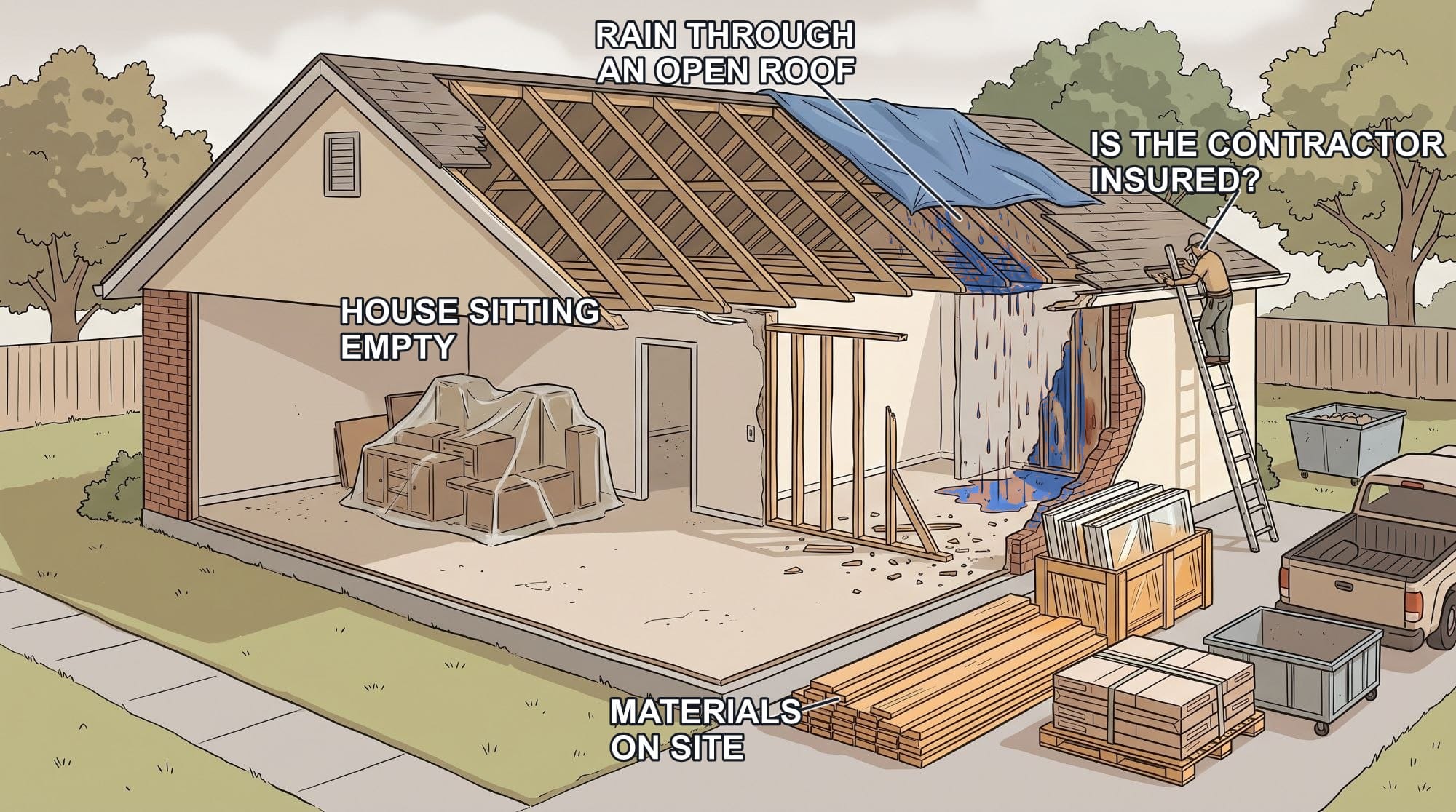
      Construction-related damage may not be covered. Standard homeowner’s policies typically exclude damage that occurs as a direct result of construction activity. If a wall collapses during demolition or materials are damaged by rain through an open roof, you may be left holding the bill. A “Builder’s Risk” policy (also called a dwelling under construction policy) can bridge this gap.

      Personal property on-site is at risk. Materials and equipment stored at your home during a renovation may not be covered under your existing policy, especially if they’re stolen or damaged. Ask about additional coverage for building materials.

      The Risk of Hiring an Uninsured Contractor

      This is where many homeowners make a costly mistake: hiring a contractor without verifying their insurance. If a worker is injured on your property or a subcontractor causes damage to a neighbor’s home, you could be held liable if the contractor doesn’t have proper coverage.

      What Contractor Insurance Should Include

      Before signing any contract, always request a Certificate of Insurance from your contractor and verify that it includes the following:

      General Liability Insurance: This is the baseline requirement. General liability covers property damage and bodily injury caused by the contractor’s work. At minimum, look for $1 million per occurrence and $2 million aggregate coverage. For larger projects, higher limits are appropriate.

      Workers’ Compensation Insurance: If a contractor or their employee is injured while working on your property, workers’ comp covers their medical bills and lost wages. Without it, an injured worker may be able to sue you directly. This coverage is required by law in most states for any contractor with employees.

      Commercial Auto Insurance , If the contractor or their crew is driving vehicles to and from your property for work purposes, personal auto insurance won’t cover accidents that occur in the course of that work. Make sure their vehicles are covered under a commercial policy.

      Umbrella or Excess Liability: For larger renovation projects, it’s worth asking whether your contractor carries an umbrella policy that extends their general liability limits. This provides an extra layer of protection if a claim exceeds their base coverage.

      Important: Ask to be listed as an Additional Insured on the contractor’s general liability policy. This means their policy will respond on your behalf if a covered claim arises from their work on your property.

      Don’t Overlook the Cleanup

      Large renovation projects generate a significant amount of debris: old drywall, lumber, fixtures, roofing materials, and managing that waste is part of the job. Many homeowners and contractors rely on a dumpster rental service to handle the heavy lifting of debris removal. Beyond convenience, having a designated dumpster keeps your worksite organized, which reduces trip-and-fall hazards that could lead to injury claims. A cluttered jobsite is a liability waiting to happen, so proper debris management isn’t just good practice: it’s a risk management strategy.

      Before You Renovate: A Quick Insurance Checklist

      Here’s what we recommend every homeowner do before starting any significant renovation project:

      Call your insurance agent and let them know the scope and timeline of the project

      Review your dwelling coverage limits so they will reflect the home’s post-renovation value

      Ask about a Builder’s Risk policy if your project involves significant structural changes

      Verify contractor insurance: request a Certificate of Insurance and confirm it includes general liability and workers’ comp

      Request additional insured status on your contractor’s liability policy

      Clarify vacancy clauses if you plan to move out during construction

      Update your policy once the renovation is complete to reflect the home’s new value

      We’re Here to Help

      Renovations are a great way to improve your home and your quality of life: as long as you’re protected while it’s happening. If you have questions about your current coverage or want to make sure you’re properly insured before your next project, give us a call. We’re happy to walk you through your options and make sure there are no gaps when it matters most.

      Coverage Options

      Coverage We Write

      Longmeadow Insurance is an independent agency in Wilmette with offices across Chicago and the suburbs. If any of this applies to your situation, we can review your current policy and tell you what it actually covers.

      Call 847.242.1040 or request a quote online.
    2. Roof Coverage Insurance in Chicago: Key Issues for Homeowners

      If you’re a homeowner in the Chicago area, you’ve likely noticed something troubling: roof coverage insurance has become increasingly expensive and difficult to obtain. What was once a standard part of homeowners insurance has transformed into a complex challenge, with some insurers dramatically raising deductibles or limiting coverage altogether. Understanding why this happened and how to understand today’s market can save you thousands of dollars.

      The Storm Chasing Problem: How Fraud Changed Everything


      The root of Chicago’s roof insurance crisis lies in a pattern of abuse that emerged over the past decade. After major hailstorms swept through the region, unscrupulous contractors began what became known as “storm chasing.” These operators would canvass neighborhoods, offering free roof inspections and promising homeowners brand new roofs at no cost through insurance claims.

      The scheme was straightforward but costly. Contractors would identify minor hail damage on roofs, sometimes damage that was years old or even questionable, then file insurance claims on behalf of homeowners. They’d push for full roof replacements when repairs would have sufficed, inflating costs and sometimes even creating or exaggerating damage to justify their claims.

      For homeowners, it seemed like a windfall. For insurance companies, it became an epidemic of fraudulent and inflated claims. Insurers found themselves paying for complete roof replacements on homes where the existing roof had years of serviceable life remaining. The fundamental insurance principle was violated: carriers were paying to upgrade old, depreciated roofs rather than restoring homes to their pre-loss condition.

      The Market Response: Higher Premiums and Reduced Coverage

      The insurance industry’s response has been dramatic and, for many homeowners, painful. Faced with mounting losses from roof claims, insurers have taken several steps to protect themselves:

      -Skyrocketing premiums have hit neighborhoods that experienced high claim volumes particularly hard. Some homeowners have seen their insurance costs double or triple, even without filing claims themselves.

      -Coverage restrictions have become the new normal. Many insurers now exclude certain roof types entirely or offer only actual cash value coverage, which depreciates the roof’s value rather than providing replacement cost coverage.

      -Increased deductibles represent perhaps the most significant change. State Farm and other major carriers serving the Chicago area have begun implementing percentage-based deductibles specifically for roof damage. In many cases, these deductibles now equal or exceed the cost of a complete roof replacement, effectively making the coverage worthless for many claims. A homeowner with a 300,000 dollar home might face a 2% wind and hail deductible of 6,000 dollars, while a new roof costs 15,000 to 20,000 dollars. However, carriers are increasingly pushing these deductibles even higher, sometimes to amounts that would cover most or all of a roof replacement.

      Good News for Responsible Homeowners

      Despite these market challenges, quality coverage remains available for homeowners who’ve maintained their properties responsibly. At Longmeadow Insurance, we work with multiple carrier partners who recognize that not all roofs represent the same risk.

      If you have a well-maintained roof or have recently replaced your roof, we can secure comprehensive coverage with reasonable deductibles. These policies provide the protection you need without the punitive pricing that has become common in the market. Insurers are willing to offer competitive terms when they can verify that a roof is in good condition and hasn’t been the subject of questionable claims.

      The key is documentation. If you’ve replaced your roof in recent years, keep all receipts, permits, and contractor information. For existing roofs, periodic professional inspections can document their condition and support your case for better coverage terms.

      Special Challenges: Wood and Flat Roofs

      Wood shake roofs and flat roofs present unique insurance challenges today’s market. Many standard carriers have stopped insuring these roof types entirely, viewing them as higher risk for both damage and claims.

      Wood roofs face concerns about fire risk and durability, while flat roofs have historically generated more leak-related claims than pitched roofs. However, coverage isn’t impossible to find. We maintain relationships with specialty market partners who will consider these roof types, evaluating each property individually based on the roof’s age, condition, and maintenance history.

      If you have a wood or flat roof, expect the insurance process to be more involved. You may need a professional roof inspection, and premiums will likely be higher than for standard asphalt shingle roofs. However, with the right approach and documentation, adequate coverage is achievable.

      A Strategic Option: Self-Insuring Newer Roofs

      For homeowners with recently installed roofs, there’s an often-overlooked strategy that can generate significant savings: voluntarily excluding or limiting hail coverage.

      Consider the math. If you installed a new roof two years ago with a 25 to 30 year expected lifespan, what’s the real risk of needing a full replacement from hail damage in the next several years? While hail can certainly damage a roof, catastrophic damage requiring complete replacement is relatively rare, especially on newer installations.

      By accepting a higher deductible specifically for hail damage or even excluding hail coverage entirely for a period, you can often reduce your premium by hundreds of dollars annually. Over five years, that’s thousands of dollars in savings that you’re essentially banking against the possibility of hail damage.

      This approach makes the most sense if you have adequate savings to cover a roof replacement if needed and if your roof is new enough that you’d be paying for protection you’re unlikely to use. It’s self-insurance in its purest form, and it can be a smart financial strategy for the right homeowner.

      Working with the Right Agent Matters

      Understanding today’s roof insurance market requires expertise and market access. At Longmeadow Insurance, we understand the challenges Chicago-area homeowners face. We don’t just place coverage with a single carrier; we shop your risk among our various market partners to find the combination of coverage, deductibles, and pricing that works for your specific situation.

      If you’re struggling with renewal terms from your current insurer, trying to find coverage for a specialty roof, or looking to optimize your coverage strategy for a newer roof, we can help. The market has changed, but options remain for informed homeowners working with knowledgeable agents.

      The storm chasing era may have disrupted the insurance market, but it doesn’t have to leave you without good options. With proper documentation, strategic thinking, and access to the right insurance markets, you can still secure the roof coverage you need at a price you can afford.

      Related Coverage

      Coverage We Write

      Longmeadow Insurance is an independent agency in Wilmette with offices across Chicago and the suburbs. If any of this applies to your situation, we can review your current policy and tell you what it actually covers.

      Call 847.242.1040 or request a quote online.
    3. Personal Insurance – Trust and LLC Ownership: Key Coverage Issues

      Titling a home or vehicle in a trust or LLC can change how a personal insurance policy should be written. You own your house, you own your car, and you insure them, simple, right? But as people explore estate planning strategies or asset protection techniques, they often discover that transferring property into trusts or LLCs can complicate what was once straightforward.

      Let’s break down how different ownership structures affect your insurance coverage and what you should expect when working with your insurance agent.

      Living Trusts: Usually No Big Deal


      A revocable living trust is one of the most common estate planning tools, and for good reason. It helps you avoid probate, maintain privacy, and simplify the transfer of assets to your beneficiaries after you pass away. The good news? Transferring your home or vehicle into a living trust typically doesn’t create major insurance headaches.

      Because you maintain complete control over a revocable living trust during your lifetime (you can modify it, revoke it, or transfer assets in and out) insurance companies generally treat property held in a living trust the same as property you own personally. You’re still the beneficial owner, and the trust is essentially just a legal wrapper around your assets.

      That said, you should always notify your insurance company before transferring property into any trust. Most policies require this, and failing to update your policy could potentially create coverage issues down the road.

      Irrevocable Trusts: More Complicated Territory


      Here’s where things get trickier. Unlike a revocable trust, an irrevocable trust means you’re giving up ownership and control of the asset. You typically can’t modify the trust terms or take the property back, and you’re no longer the beneficial owner in the eyes of the law.

      Insurance companies view this differently because the risk profile has changed. When your home is in an irrevocable trust, you’re no longer the legal owner, the trust is. This can affect everything from underwriting to claims handling.

      Some of the complications you might encounter include:

      -Higher premiums or more limited coverage options. Not all insurance carriers are comfortable insuring property in irrevocable trusts, which can limit your choices and potentially increase costs.

      -Additional documentation requirements. Your insurance company will likely want to review the trust document itself to understand the arrangement, who has what rights, and how claims would be handled.

      -Loss of certain discounts or policy features. Some insurers offer discounts or special provisions for owner-occupied homes that may not apply when property is in an irrevocable trust.

      -Potential issues with mortgage requirements. If you still have a mortgage on the property, your lender will need to approve the transfer, and they may have their own insurance requirements that complicate matters further.

      The bottom line: if you’re considering putting your home into an irrevocable trust, talk to your insurance agent before you do it. What seems like a smart estate planning or asset protection move could create insurance complications that undermine those benefits or add unexpected costs.

      Montana LLCs for Vehicle Registration: The Hidden Costs

      You may have heard about Montana LLCs as a way to avoid sales tax or registration fees in your home state, particularly for luxury vehicles, RVs, or exotic cars. The strategy involves forming an LLC in Montana (which has no sales tax) and registering your vehicle there, even though you live elsewhere. Setting aside the legal and ethical questions around this practice (many states consider it tax evasion and are cracking down) let’s focus on the insurance implications.

      When you register a vehicle in an LLC’s name, you’re creating a commercial insurance situation. Your personal auto insurance policy typically won’t cover a vehicle owned by a business entity, even if you’re the only member of that LLC. This means you’ll likely need:

      -A commercial auto policy, which is almost always more expensive than personal auto insurance, sometimes significantly so. The cost difference can easily wipe out any tax savings you thought you were getting.

      -Additional liability coverage, because commercial policies often have different minimum requirements and exclusions than personal policies.

      -More complex claims processes, since you’re now dealing with commercial underwriting and claims departments that may have different procedures and timelines.

      -Potential coverage gaps, if you’re not careful about how the policy is structured and who’s listed as drivers.

      Moreover, if your insurance company discovers that you’re actually using the vehicle personally in a different state than where it’s registered, you could face policy cancellation or even denial of claims. Insurance fraud is a serious matter, and misrepresenting where a vehicle is principally garaged is a quick way to find yourself without coverage when you need it most.

      Working with Your Insurance Agent

      The key takeaway here is simple: communicate with your insurance agent before you make any changes to how you hold title to insured property. A knowledgeable agent can guide you through the process and help you understand the costs and potential complications upfront.

      Living trusts? They’re routine, and your agent should handle them easily. Irrevocable trusts and LLC ownership? These require careful planning, additional documentation, and likely some extra cost. Make sure those costs and complications are worth whatever benefit you’re seeking from the ownership change.

      Estate planning and asset protection are important, but they shouldn’t come at the expense of adequate insurance coverage. The best approach is to coordinate between your estate planning attorney, your insurance agent, and your financial advisor to confirm that your overall plan makes sense and doesn’t create unexpected problems.

      After all, the point of insurance is to protect you when something goes wrong. Don’t let well-intentioned planning create gaps in that protection.

      Coverage Options

      Coverage We Write

      Longmeadow Insurance is an independent agency in Wilmette with offices across Chicago and the suburbs. If any of this applies to your situation, we can review your current policy and tell you what it actually covers.

      Call 847.242.1040 or request a quote online.