
Category: Boat and Lake Property

Boat, marine and lake house coverage.

  • Lake Property Insurance in Southeastern Wisconsin

    Lake Property Insurance in Southeastern Wisconsin

    Lake property in southeastern Wisconsin brings a different insurance profile than a standard suburban home. In areas such as Salem Lakes, Paddock Lake, Silver Lake, Twin Lakes, Powers Lake, Bristol, Trevor, and western Kenosha County, homeowners may have shoreline exposure, boats, docks, detached structures, seasonal occupancy, septic systems, wells, and recreational vehicles.

    A normal homeowners policy may be appropriate for some year-round homes, but it should not be assumed. The way the property is used matters. A primary residence, family cottage, short-term rental, vacant winter property, and newly purchased lake home can each require different underwriting.

    The goal is to protect the structure, contents, liability, and recreational exposures without leaving avoidable gaps.

    Occupancy Drives the Policy

    Insurance companies care whether the home is primary, secondary, seasonal, rented, vacant, or under renovation. Seasonal use can affect theft, water damage, heating, frozen pipes, and inspection requirements. Short-term rental activity can create a business exposure that may be excluded without proper coverage.

    Owners should be clear about how often the property is occupied, whether guests use it, whether it is rented, and who checks on it during the off-season. Accuracy matters because claim problems often begin with occupancy assumptions.

    Water Exposure Is More Than Flood Insurance

    Lake homes should review flood exposure, surface water, sewer or septic backup, sump pump failure, shoreline conditions, and drainage. Standard homeowners policies exclude flood damage, and water backup coverage usually requires an endorsement.

    A property does not need to be directly on the water to have meaningful water exposure. Low-lying lots, heavy rain, frozen ground, and drainage patterns can all create problems. Owners should evaluate both flood insurance and water backup options.

    Docks, Lifts, Boats, and Recreational Equipment Need Review

    Docks, boat lifts, boats, personal watercraft, trailers, ATVs, snowmobiles, kayaks, paddleboards, and other recreational equipment may not be adequately covered by the homeowners policy. Some items require separate policies or endorsements.
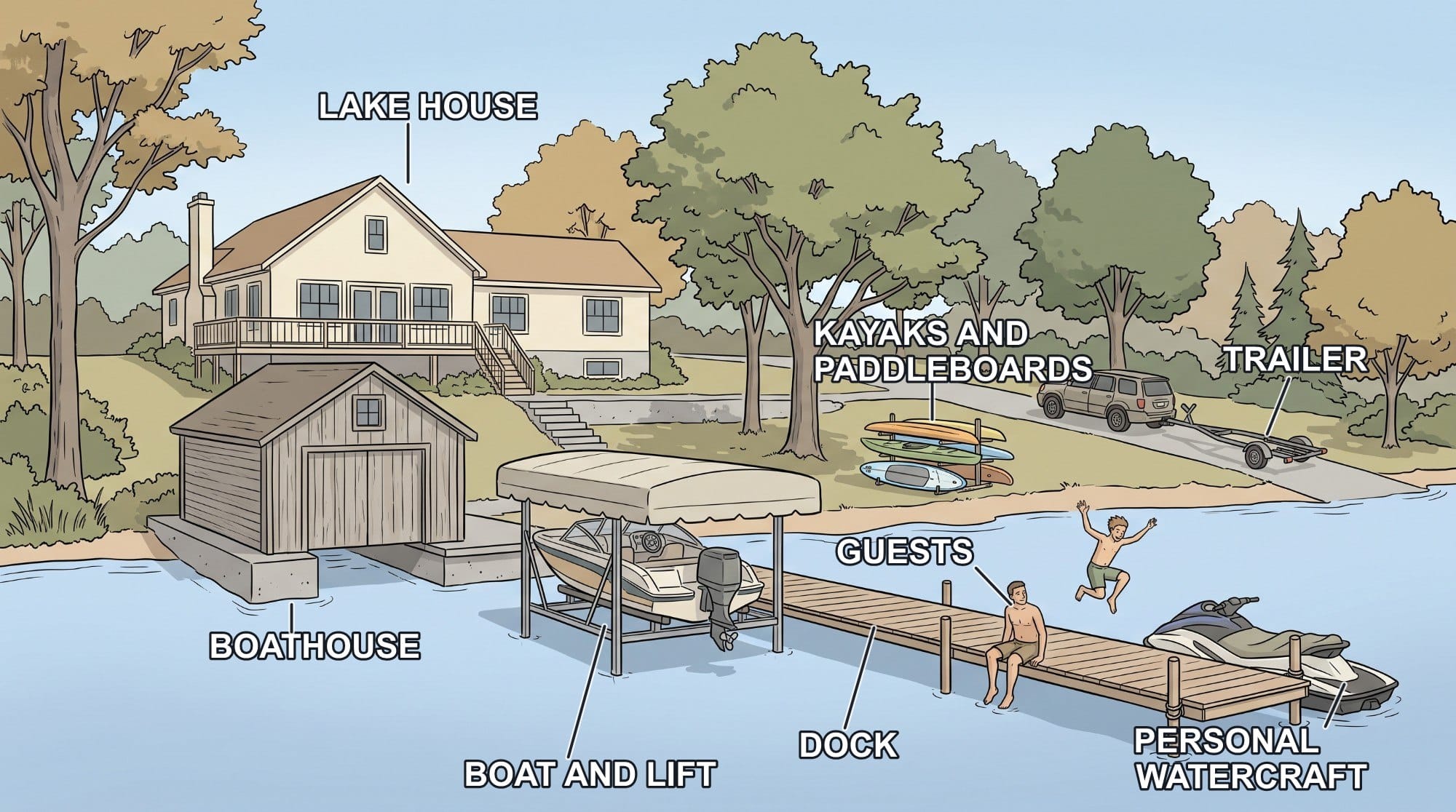
    Liability is also important. Guests using a boat, walking on a dock, swimming, or riding recreational vehicles can create serious injury exposure. Owners should coordinate homeowners, boat, recreational vehicle, and umbrella coverage.

    Detached Structures and Outbuildings Can Be Undervalued

    Lake and rural properties often include detached garages, sheds, workshops, barns, boathouses, guest spaces, or storage buildings. Default other-structures coverage may not be enough if these buildings are substantial or improved.

    The policy should list and value these structures accurately. Owners should also confirm whether any structure used for business, rental, farming, or storage of commercial equipment requires special treatment.

    Wisconsin and Illinois Households Need Coordination

    Many southeastern Wisconsin lake property owners live or work in Illinois. That creates coordination questions involving auto garaging, umbrella policies, primary residence coverage, vehicles kept at the lake, and liability across multiple properties.

    The best approach is to review the full household program together rather than insuring the lake property in isolation.

    Common Lake Property Insurance Mistakes

    The first mistake is failing to disclose rental or occasional guest use. A property used by paying guests can create a different exposure than a family-only cottage.

    The second mistake is assuming docks, lifts, boats, and recreational vehicles are automatically covered. They often need separate review.

    The third mistake is underestimating off-season water and freeze risk. A small leak or frozen pipe can become severe if nobody is checking the property.

    Questions for Lake Property Owners

    Who uses the property? Is it rented? Is it occupied year-round? Are there boats, docks, lifts, ATVs, trailers, or outbuildings? Is there a septic system, well, wood stove, or shoreline exposure? Who checks the home during winter?

    These answers shape the policy and help determine whether additional coverage is needed.

    Liability Around Water

    Water increases liability risk. Swimming, boating, docks, guests, children, alcohol, and recreational equipment can all create serious injury scenarios. Umbrella coverage should be reviewed alongside the property and boat policies.

    A Practical Lake Property Example

    Consider a seasonal lake home that is checked only occasionally during winter. A frozen pipe bursts, water runs for days, and damage spreads through flooring, walls, furniture, and mechanical systems. The claim may depend on occupancy, heat maintenance, inspection practices, water shutoff, and policy language. Lake property owners should plan for the months they are not there, not only the weekends they are.

    When comparing quotes, ask whether the policy solves this real-world problem or only produces a lower premium. Strong insurance planning begins with the claim scenario, then works backward to the coverage, deductible, limit, and endorsement choices that would matter when money is actually at stake.

    It is also worth reviewing coverage before the renewal deadline rather than after the invoice arrives. A thoughtful review gives enough time to compare markets, correct rating details, gather documentation, adjust deductibles, and decide which coverage improvements are worth the cost. Rushed insurance decisions tend to focus only on premium, while better decisions compare premium, coverage quality, claim scenarios, and the financial consequences of being wrong.

    Coverage Review Checklist

    • Disclose whether the property is primary, seasonal, rented, or vacant

    • Review flood and water backup coverage

    • Insure docks, lifts, boats, and recreational vehicles properly

    • Value detached structures separately

    • Consider umbrella liability coverage

    • Protect against frozen pipe and off-season losses

    • Coordinate Wisconsin property with Illinois home and auto policies

    Bottom Line

    Longmeadow Insurance can help owners in Salem Lakes, western Kenosha County, and nearby Wisconsin communities review lake property, home, auto, boat, and umbrella coverage.

    How Longmeadow Insurance Can Help

    Longmeadow Insurance is an independent agency based in Wilmette, Illinois. We help homeowners, condo owners, landlords, families, and businesses compare coverage options and understand the tradeoffs before a claim occurs.

    If you would like a coverage review, call 847.242.1040 or request a consultation through Longmeadow Insurance.

    Lake property insurance has seasonal and waterfront complications

    A lake home in Southeastern Wisconsin may be a primary residence, weekend home, seasonal cabin, short-term rental, family property, or future retirement home. Each use creates different insurance questions. Seasonal occupancy, vacancy, winterization, docks, detached structures, boats, lifts, seawalls, and guest use all affect the coverage review.

    A standard homeowners approach may miss important details if the property is not occupied year-round or if waterfront features are not properly described. The policy should match how the home is actually used and maintained.

    Waterfront does not mean every water loss is covered

    Waterfront owners should separate flood, surface water, sewer or drain backup, seepage, sump overflow, ice damage, wind damage, and accidental discharge from plumbing. These are different claim scenarios with different coverage rules. A lender may not require flood insurance, but that does not mean flood exposure is irrelevant.

    Docks, lifts, boats, personal watercraft, and detached structures may need separate review. Some items may not be covered automatically, or may be subject to sublimits, exclusions, or special conditions.

    What to gather before a lake property quote

    Useful details include year built, roof age, updates, occupancy pattern, winterization plan, rental use, distance to water, flood information, dock/lift details, detached structures, boats, claims history, and who owns the property. Longmeadow Insurance can help Illinois and Wisconsin lake-property owners compare practical coverage options.

    Related insurance guides

    Coverage We Write

    Longmeadow Insurance is an independent agency in Wilmette with offices across Chicago and the suburbs. If any of this applies to your situation, we can review your current policy and tell you what it actually covers.

    Call 847.242.1040 or request a quote online.
  • Wisconsin Lake House Insurance: What Second-Home Owners Should Review

    Wisconsin Lake House Insurance: What Second-Home Owners Should Review

    A Wisconsin lake house is not just another homeowners policy with a different address. Seasonal occupancy, docks, boats, guest use, storms, freezing temperatures, detached structures, rental activity, and distance from fire protection can all change the insurance picture.

    This matters for lake homes in southeastern Wisconsin, Lake Geneva, Delavan, Twin Lakes, Powers Lake, Lauderdale Lakes, Green Lake, Door County, and the many smaller lake communities Illinois families use as second homes. The same issues often apply to Michigan lake houses as well, especially when the home is seasonal, remote, rented part of the year, or paired with boats and water toys.

    The goal is simple: make sure the policy reflects how the property is actually used before a fire, freeze, storm, dock injury, boat incident, or rental claim exposes a gap.

    Primary Topic
    Wisconsin lake house insurance

    Second Homes Are Underwritten Differently Than Primary Homes

    A primary home is usually occupied year-round. A lake house may sit vacant for weeks, close for the winter, host guests without the owner present, or be used heavily only during summer weekends. That occupancy pattern affects theft, water damage, fire, freeze, vandalism, and liability risk.

    The insurance company needs to know whether the home is seasonal, year-round, rented, vacant for long periods, or used by family and friends. A policy written as a normal primary residence may not fit a Wisconsin or Michigan lake house if the use is materially different.

    Owners should also confirm who has access to the property, whether there is a caretaker, how utilities are managed in winter, and whether smart water shutoff or temperature monitoring devices are installed.

    Replacement Cost Can Be Harder Near the Water

    Lake homes can be expensive to repair. Access may be limited, local contractors may be busy during storm seasons, materials may be specialized, and shoreline rules can affect rebuilding. Older cottages may also have additions, finished walkout basements, boathouses, garages, decks, piers, and custom features that are not obvious in a basic estimate.

    The dwelling limit should be based on realistic reconstruction cost, not purchase price or tax value. Land value near a lake can distort the number. Insurance is focused on the structure and covered property, not the market premium for waterfront land.

    Detached structures need their own review. Garages, sheds, boat houses, guest houses, piers, lifts, decks, seawalls, and permanent docks may not be fully covered unless scheduled, endorsed, or included within adequate other-structures limits.

    Water Damage Is Not One Coverage

    Lake property owners often think water near the house means water is covered. That is not how policies work. A burst pipe, sewer backup, sump overflow, surface water, flood, seepage, ice movement, and water entering from the lake can all be treated differently.

    Standard homeowners policies usually exclude flood. Sewer backup and sump overflow often require an endorsement. Service line coverage may be separate. Shoreline erosion, seepage, and gradual water intrusion can be limited or excluded.

    A lake house coverage review should include flood options, sewer backup, sump pump failure, service line, freezing pipes, winterization expectations, and whether the property has a basement, crawl space, or low-lying mechanical systems.

    Liability Extends Beyond the House

    Lake homes create liability risks that are easy to underestimate. Guests can slip on docks, fall on stairs, use kayaks or paddleboards, swim from the property, drive golf carts or ATVs, bring dogs, consume alcohol, or use fire pits and grills. A serious injury can exceed the base liability limit quickly.

    Owners should review personal liability limits, medical payments coverage, umbrella insurance, and whether boats, jet skis, ATVs, golf carts, short-term rentals, and paid events are excluded or require separate coverage.

    If friends or extended family use the lake house without the owner present, the policy should still match the real exposure. Informal use can still create formal claims.

    Short-Term Rental Can Change Everything

    Many Wisconsin and Michigan lake houses are rented for part of the season. Even occasional rental activity can change the insurance requirement. A personal homeowners or seasonal dwelling policy may restrict business use, short-term rental, platform rentals, or tenant-caused damage.

    Owners should disclose rental activity before listing the home. The policy may need a rental endorsement, landlord form, commercial package, or specialty short-term rental coverage depending on frequency, services, occupancy, and revenue.

    Do not rely only on a rental platform protection program. Those programs are not a substitute for properly structured property and liability coverage.

    Coverage Review Checklist

    • Confirm the home is insured as seasonal, secondary, rental, or year-round based on actual use

    • Review replacement cost for the house and detached structures

    • Check coverage for docks, lifts, boathouses, garages, decks, and seawalls

    • Review flood, sewer backup, sump overflow, service line, and freezing-pipe exposures

    • Confirm liability coverage for guests, docks, swimming, water toys, and recreational vehicles

    • Disclose any short-term rental activity before listing the property

    • Consider umbrella coverage for higher-risk lake property ownership

    Bottom Line

    Longmeadow Insurance can help Illinois families review Wisconsin and Michigan lake house coverage before seasonal use, rental activity, or a claim creates a problem.

    How Longmeadow Insurance Can Help

    Longmeadow Insurance is an independent agency based in Wilmette, Illinois. We help families, second-home owners, and boat owners understand coverage tradeoffs before a claim occurs.

    If you would like a coverage review, call 847.242.1040 or request a consultation through Longmeadow Insurance.

    Coverage We Write

    Longmeadow Insurance is an independent agency in Wilmette with offices across Chicago and the suburbs. If any of this applies to your situation, we can review your current policy and tell you what it actually covers.

    Call 847.242.1040 or request a quote online.
  • How to Cover Boat Risks at a Lake House

    How to Cover Boat Risks at a Lake House

    A lake house often comes with boats, docks, lifts, trailers, kayaks, paddleboards, jet skis, guests, and family members who all want to get on the water. That creates a coverage problem if the insurance program treats the home and boat as separate, unrelated risks.

    Some small watercraft may receive limited coverage under a homeowners policy, but larger boats, faster boats, jet skis, valuable boats, and liability-heavy usage usually require a separate boat or personal watercraft policy. The details matter before someone is injured or the boat is damaged.

    A good lake house review should connect the homeowners policy, boat policy, umbrella policy, auto policy, trailer exposure, dock coverage, and any rental or guest-use issues.

    Primary Topic
    boat insurance for lake house

    Do Not Assume the Homeowners Policy Covers the Boat

    Homeowners policies may provide very limited coverage for small boats, canoes, kayaks, or low-horsepower watercraft. That does not mean a meaningful boat exposure is protected. Length, horsepower, speed, value, ownership, storage, and use can all determine whether coverage exists.

    A separate boat policy is usually the safer route for motorboats, personal watercraft, higher-value boats, or boats used frequently by guests and family. The policy can address physical damage, liability, medical payments, uninsured boaters, wreck removal, fuel spill liability, and equipment.

    The first question is not whether the boat is at a lake house. The first question is what the boat is, how it is used, who operates it, where it is stored, and what could go wrong.

    Physical Damage Needs to Include More Than the Hull

    Boat owners often focus on the hull value, but claims can involve motors, electronics, fishing gear, covers, anchors, batteries, safety equipment, trailers, lifts, and accessories. Some items may have sublimits or require scheduling.

    Ask whether the policy provides agreed value, stated value, or actual cash value. The difference matters after a total loss. Also ask how the policy treats depreciation on motors, lower units, canvas, electronics, and older boats.

    Storage location matters too. A boat kept on a lift, in a boathouse, at a marina, in a driveway, or on a trailer may face different risks and underwriting questions.

    Liability Is the Bigger Risk

    The most serious boat claim is often not the boat itself. It is an injury. Boat liability claims can involve swimmers, passengers, skiers, tubers, other boaters, dock collisions, alcohol allegations, inexperienced operators, children, or guests operating equipment they do not understand.

    A lake house owner should confirm boat liability limits and coordinate them with umbrella insurance. Some umbrellas require underlying boat limits. Some umbrellas exclude certain watercraft unless listed. If the umbrella does not know about the boat, the extra liability layer may not work as expected.

    Operator rules also matter. Policies may restrict young operators, unlicensed operators, paid operators, or anyone using the boat without permission.

    Docks, Lifts, and Trailers Create Separate Questions

    Docks and boat lifts are not automatically handled the same way by every policy. A permanent dock, seasonal pier, floating dock, lift, canopy, or boathouse may fall under homeowners coverage, other structures, scheduled property, inland marine, or a separate endorsement depending on the policy.

    Trailers create another layer. Physical damage to the trailer may be part of the boat policy, but liability while towing may involve the auto policy. Theft of the trailer, roadside incidents, and storage away from the residence should all be reviewed.

    If the boat moves between a primary home, lake house, marina, and repair shop, the policy territory and storage terms should match that reality.

    Guest Use and Family Use Should Be Discussed Honestly

    Lake houses invite informal use. A neighbor borrows the pontoon. A cousin drives the jet ski. A teenager pulls a tube. Friends visit for the weekend. Those are normal lake-house scenarios, but they can create serious coverage questions.

    Boat policies can treat permissive operators differently. Some may require operators to meet age, licensing, or experience requirements. Some may limit coverage if the boat is rented, loaned regularly, used for paid rides, or involved in business activity.

    The policy should be built around how the boat is actually used, not the clean version that appears on a quote form.

    Coverage Review Checklist

    • List every boat, jet ski, kayak, paddleboard, trailer, lift, and dock exposure

    • Confirm whether each watercraft needs its own policy or endorsement

    • Review agreed value, stated value, or actual cash value settlement terms

    • Check liability limits and umbrella compatibility

    • Ask how young operators, guests, and permissive users are handled

    • Confirm trailer coverage while stored and while being towed

    • Review dock, lift, canopy, and boathouse coverage separately

    Bottom Line

    Longmeadow Insurance can review the home, boat, dock, trailer, and umbrella coverage together so a lake-house boating claim does not fall between policies.

    How Longmeadow Insurance Can Help

    Longmeadow Insurance is an independent agency based in Wilmette, Illinois. We help families, second-home owners, and boat owners understand coverage tradeoffs before a claim occurs.

    If you would like a coverage review, call 847.242.1040 or request a consultation through Longmeadow Insurance.

    Coverage We Write

    Longmeadow Insurance is an independent agency in Wilmette with offices across Chicago and the suburbs. If any of this applies to your situation, we can review your current policy and tell you what it actually covers.

    Call 847.242.1040 or request a quote online.
  • Boat Insurance on Lake Michigan: Permanent Dock vs. Trailer Launch Risks

    Boat Insurance on Lake Michigan: Permanent Dock vs. Trailer Launch Risks

    Lake Michigan is not the same as a small inland lake. Weather changes quickly, waves can build, marinas and harbors create congestion, and boats are often larger, more valuable, and exposed to different risks. Insurance should reflect that reality.

    One of the biggest coverage questions is how the boat is kept. A boat permanently docked in Lake Michigan or kept at a marina has a different risk profile than a boat stored on a trailer and launched for each trip. Neither option is automatically better. They simply create different insurance issues.

    Owners should review physical damage, liability, navigation territory, marina requirements, haul-out plans, trailer exposure, storm risk, and umbrella coordination before the season starts.

    Primary Topic
    Lake Michigan boat insurance

    A Permanently Docked Boat Has Constant Water Exposure

    A boat kept in the water faces ongoing exposure to storms, waves, dock contact, theft, vandalism, fire, sinking, stray electrical current, bilge pump failure, fuel leaks, and marina incidents. The owner may not be present when the problem starts.

    The policy should address sinking, partial sinking, storm damage, collision with docks or other boats, theft of equipment, emergency services, wreck removal, pollution or fuel spill liability, and damage while the boat is moored, docked, or in storage.

    Marinas may also require specific liability limits, additional insured wording, proof of insurance, or contractual obligations. Owners should not sign a slip agreement without understanding what the contract requires and what the policy actually provides.

    Trailer Launching Reduces Some Risks and Adds Others

    A trailered boat is not exposed to water and marina risks every day. That can reduce certain dockside concerns. But trailering creates its own hazards: towing accidents, theft from storage, trailer failure, launch-ramp damage, loading and unloading mistakes, roadside breakdowns, and damage while parked away from home.

    Liability while the trailer is being pulled may involve the auto policy, while physical damage to the boat and trailer may involve the boat policy. Owners should confirm how those policies interact before assuming the trailer is fully covered.

    Trailered boats also move between locations. The policy should allow the navigation territory and storage locations the owner actually uses, including Lake Michigan launches, inland lakes, winter storage, repair facilities, and travel through neighboring states.

    Lake Michigan Navigation Territory Matters

    Boat policies often define where the boat can be operated. Lake Michigan use, Great Lakes use, inland lake use, river use, and coastal navigation may be treated differently. A policy written casually for inland use may not fit a boat operating from Chicago, Wilmette, Waukegan, Kenosha, Racine, Milwaukee, New Buffalo, or other Lake Michigan harbors.

    Owners should confirm the approved navigation territory, lay-up period, storage requirements, operator restrictions, and whether the policy changes outside the normal boating season. If the boat travels to Michigan, Wisconsin, Indiana, or across larger stretches of open water, say so during underwriting.

    A claim outside the permitted territory can become an avoidable fight.

    Storm Planning Is Different for Docked Boats

    A permanently docked boat needs a storm plan. That may include dock line setup, fenders, bilge pump maintenance, battery checks, canvas care, haul-out arrangements, winterization, and marina procedures. The insurance company may expect reasonable care, especially before known severe weather.

    Some policies include named-storm or haul-out provisions in coastal settings. Lake Michigan policies may not look exactly like ocean policies, but the principle is similar: the owner needs to understand what the policy expects when severe weather is forecast.

    Documentation helps. Keep records of maintenance, winterization, storage contracts, marina agreements, photos, and safety equipment.

    Liability Can Be Larger on Big Water

    Lake Michigan boating often involves higher speeds, larger boats, more passengers, crowded harbors, breakwalls, commercial traffic, swimmers, paddlecraft, and changing weather. Liability limits should be selected with that environment in mind.

    Umbrella insurance should be coordinated with the boat policy. The umbrella may require specific underlying limits or may exclude certain watercraft if not scheduled. Owners should verify this before relying on a personal umbrella for a serious boating injury claim.

    The more people, distance, speed, and open-water exposure involved, the more important it is to get the liability structure right.

    Coverage Review Checklist

    • Tell the insurer whether the boat is docked, moored, stored, or trailered

    • Confirm Lake Michigan and Great Lakes navigation territory

    • Review marina slip contract insurance requirements

    • Check sinking, storm, theft, vandalism, wreck removal, and fuel spill coverage

    • Confirm trailer physical damage and towing liability coordination

    • Review lay-up, winter storage, and storm preparation expectations

    • Coordinate boat liability with umbrella coverage

    Bottom Line

    Longmeadow Insurance can help boat owners compare docked, marina, moored, and trailered Lake Michigan risks before choosing coverage for the season.

    How Longmeadow Insurance Can Help

    Longmeadow Insurance is an independent agency based in Wilmette, Illinois. We help families, second-home owners, and boat owners understand coverage tradeoffs before a claim occurs.

    If you would like a coverage review, call 847.242.1040 or request a consultation through Longmeadow Insurance.

    Coverage We Write

    Longmeadow Insurance is an independent agency in Wilmette with offices across Chicago and the suburbs. If any of this applies to your situation, we can review your current policy and tell you what it actually covers.

    Call 847.242.1040 or request a quote online.
  • Charter Boat Insurance: Why a Cheap Personal Marine Policy May Not Cover You

    Charter Boat Insurance: Why a Cheap Personal Marine Policy May Not Cover You

    Chartering a boat is not the same risk as taking friends out for a weekend ride. Once money changes hands, the insurance question changes. Paid passengers, captained trips, bareboat arrangements, fishing charters, sightseeing, sunset cruises, lessons, and event use can push the exposure outside a cheap personal marine policy.

    This is where boat owners get into trouble. They buy a low-cost personal boat policy, then assume it will respond if they occasionally charter the boat, accept payment for trips, list it through an app, or let someone else operate it. That assumption can be dangerous.

    Charter activity should be disclosed and insured correctly before the first paid trip. The issue is not just premium. It is whether the policy will respond at all after an injury, collision, sinking, fuel spill, passenger claim, or regulatory problem.

    Primary Topic
    charter boat insurance

    Paid Use Can Kick the Boat Out of Personal Coverage

    Personal marine policies are generally priced for private pleasure use. They may exclude business use, commercial use, carrying people for a fee, rental, lease, charter, paid instruction, guided fishing, or any activity where compensation is involved.

    Compensation can be broader than an obvious ticket sale. It may include a charter fee, fuel reimbursement, platform payment, event package, tips, barter, shared expenses, or indirect business benefit. The policy language controls, but the owner should not assume casual paid use is harmless.

    If the claim involves a paid passenger and the policy excludes commercial or charter use, the owner may face both an uncovered claim and a lawsuit.

    Different Charter Models Create Different Insurance Needs

    A captained charter, bareboat charter, fishing charter, dinner cruise, sailing lesson, rental, peer-to-peer listing, and corporate outing are not identical risks. Each can involve different operator responsibility, passenger exposure, contracts, safety requirements, and underwriting standards.

    A captained charter may require proof of captain credentials and commercial liability. A bareboat arrangement may require a proper rental or charter agreement and clarity about who operates the vessel. A fishing charter may involve gear, hooks, alcohol, weather decisions, and passenger movement around the vessel.

    The insurance should be matched to the actual operation, not described generically as occasional boat use.

    Regulations and Licensing Can Affect Coverage

    Charter operations may be subject to federal, state, or local rules depending on vessel size, passenger count, waters used, operator credentials, inspection status, safety equipment, and whether passengers are carried for hire. Requirements can vary for inland lakes, Lake Michigan, Great Lakes operations, and different jurisdictions.

    Common issues include captain licensing, passenger limits, safety gear, registration, inspection, drug and alcohol testing requirements, business licensing, dock or marina rules, and compliance with navigable waters regulations. The exact requirements depend on the operation.

    Insurance companies may ask about these issues because noncompliance can increase claim risk or affect whether the operation is eligible for coverage. Owners should get proper legal and regulatory guidance before taking paid passengers.

    Contracts and Waivers Do Not Replace Insurance

    Charter agreements, waivers, platform terms, and passenger releases can help clarify responsibilities, but they do not replace insurance. A seriously injured passenger can still sue. A marina, platform, event host, or corporate customer may still demand defense, indemnity, or additional insured status.

    The policy should be reviewed for passenger liability, crew or captain exposure, damage to the vessel, damage to other property, medical payments, pollution or fuel spill liability, wreck removal, defense costs, contractual liability, and additional insured requirements.

    If the owner uses a captain, the relationship should be clear. Is the captain an employee, contractor, vessel owner, or hired operator? The answer can affect coverage and liability.

    Cheap Policies Usually Have Cheap Assumptions

    A cheap personal marine policy may be perfectly reasonable for private use, but the price is based on limited assumptions. Private use, limited operators, no paid passengers, normal navigation territory, personal liability, and standard storage are very different from a commercial charter exposure.

    Charter insurance may cost more because the risk is larger. More passengers, less familiar operators, alcohol, weather pressure, business expectations, public advertising, contracts, and regulatory scrutiny all raise the stakes.

    The expensive mistake is not paying for proper coverage. The expensive mistake is discovering after a claim that the low-cost policy was never intended to cover the operation.

    Coverage Review Checklist

    • Disclose any paid, rented, guided, platform, or charter use before operating

    • Confirm whether the policy excludes business, commercial, rental, or passenger-for-hire activity

    • Identify whether the operation is captained, bareboat, fishing, sightseeing, instructional, or event-based

    • Review captain licensing, passenger limits, inspection, safety, and local regulatory requirements

    • Check liability limits, defense costs, medical payments, wreck removal, and fuel spill coverage

    • Review contracts, marina requirements, and additional insured requests

    • Do not rely on a personal marine policy for undisclosed charter activity

    Bottom Line

    Longmeadow Insurance can help boat owners evaluate whether a personal marine policy is enough or whether charter, commercial marine, or specialty coverage is needed before paid passengers come aboard.

    How Longmeadow Insurance Can Help

    Longmeadow Insurance is an independent agency based near Lake Michigan in Wilmette, Illinois. We help families, second-home owners, and boat owners understand coverage tradeoffs before a claim occurs.

    If you would like a coverage review, call 847.242.1040 or request a consultation through Longmeadow Insurance.

    Coverage We Write

    Longmeadow Insurance is an independent agency in Wilmette with offices across Chicago and the suburbs. If any of this applies to your situation, we can review your current policy and tell you what it actually covers.

    Call 847.242.1040 or request a quote online.