
Two optional coverages on a homeowners policy sound like they cover the same thing. Service line coverage and water backup coverage both involve pipes, both involve water, and both are added to a homeowners policy as optional endorsements. They solve completely different problems, and owning one does nothing for the other.
The distinction is easiest to see by walking from the street to the basement.
What Each One Pays For
Service line coverage pays to fix the buried pipe. Water backup coverage pays for what the water ruined inside the house. One is about digging. The other is about drywall, flooring, and contents.
From the Street to the Basement
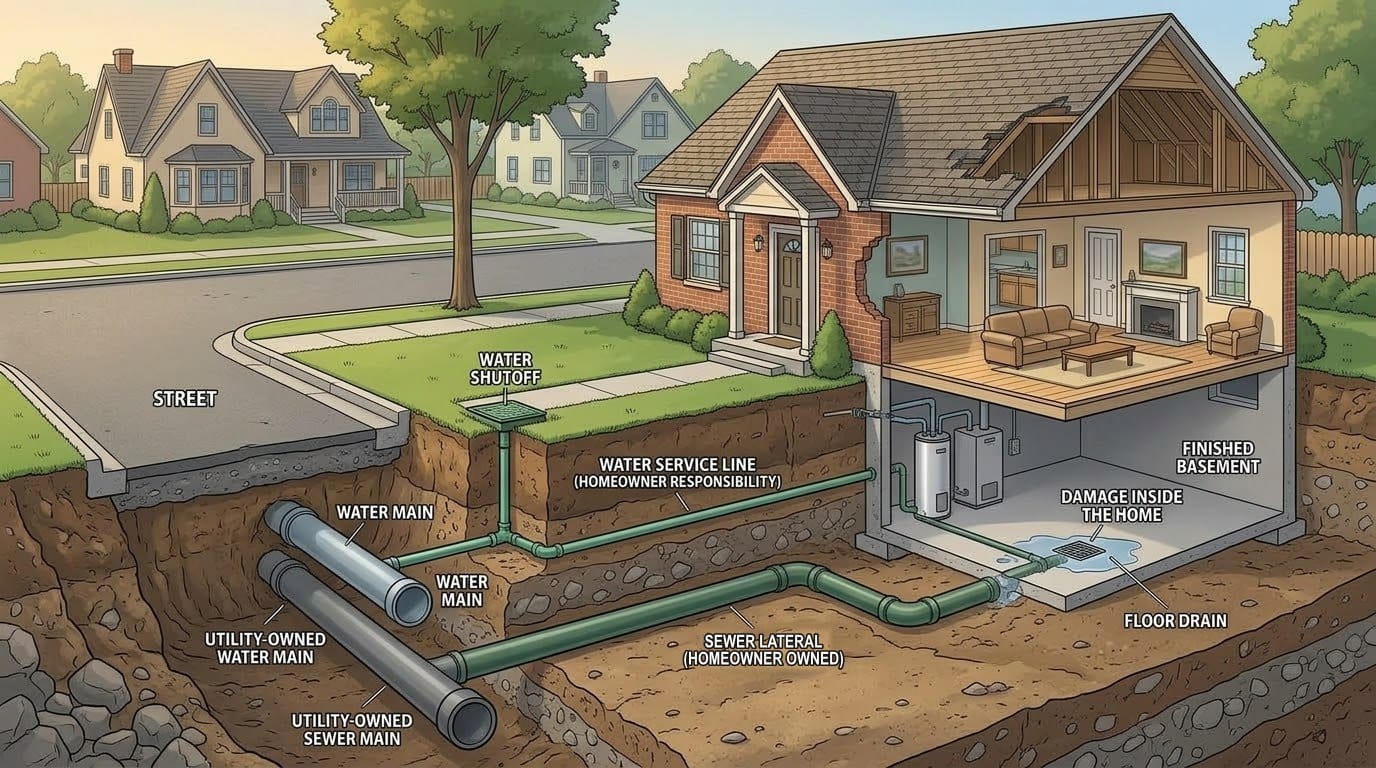
The two green runs crossing the yard, the water service line and the sewer lateral, are the pipes service line coverage is written for. The water pooling around the floor drain is what water backup coverage is written for. A policy can carry one, both, or neither, and many carry neither until someone asks.
What Service Line Coverage Generally Does
Service line coverage, sometimes sold as buried utility lines coverage, responds when an underground line serving the house fails on the part of the run you are responsible for.
- Which lines. Typically water, sewer, gas, electric, steam, and communication lines such as cable, telephone, and fiber, where they are buried on your property and serve your home.
- Which causes. Forms commonly include wear and tear, rust and corrosion, mechanical breakdown, tree root intrusion, freezing, rodent damage, and collapse. The exact list is the important part, and it varies.
- What it pays for. Excavation, repair or replacement of the line, and restoration of lawn, plantings, and hardscape disturbed by the work. Some forms add loss of use and expediting expenses.
- Limits. Commonly in the range of $10,000 to $20,000, with a separate deductible that is usually lower than the main policy deductible.
- What it does not do. It does not pay for water damage inside the house caused by a backup. That is the other endorsement.
What Water Backup Coverage Generally Does
Water backup and sump overflow coverage responds to water or sewage that backs up through a sewer, a drain, or a sump, or overflows from a sump system.
- What it pays for. The damage. Drywall, flooring, trim, cabinetry, mechanical systems, furniture, and contents, plus cleanup and mitigation, subject to the limit and any terms on mold.
- Limits. Often offered at $5,000, $10,000, $25,000, $50,000, or higher. A finished lower level reaches a low limit quickly.
- What it does not do. It generally does not pay to dig up and replace the pipe that failed. Excavating and replacing a lateral is expensive, and that is what service line coverage exists for.
We have covered this endorsement in depth elsewhere rather than repeating it here. See sewer backup coverage in Illinois for the detail, and sewer backup versus flood insurance for how surface water is treated differently again.
The Claim That Needs Both
Here is the scenario that makes the distinction concrete, and it is not unusual on a street lined with mature parkway trees.
Roots work into an old clay sewer lateral and block it. During a heavy rain, sewage backs up through the basement floor drain and stands in a finished lower level. A plumber scopes the line and finds the lateral has collapsed twenty feet from the house, under the lawn.
Two separate bills follow. The remediation, drywall, flooring, and contents replacement inside the house is the water backup claim. The excavation, the new lateral, and putting the lawn back is the service line claim. A homeowner with only one of the two endorsements pays for the other half themselves.
Illinois Homeowners Own More Pipe Than They Expect
The portion of the water service line running from the connection point into the house is generally the property owner’s to maintain and repair. Where that responsibility begins differs by municipality. In some communities it starts at the water main, and in others the village maintains the line as far as the shutoff box in the parkway and the owner takes it from there. Your public works department can tell you which applies on your street.
Separately, Illinois has a statewide program under which community water supplies are required to replace lead service lines. That program addresses lead specifically and is handled through the water utility. It does not change who is responsible for an ordinary break, a root intrusion, or a corroded copper line, which is the exposure service line coverage is written for.
Add the housing stock to that. Wilmette, Winnetka, Evanston, Oak Park, and much of the North Shore and near suburbs have homes with original clay laterals, aging copper or galvanized service lines, and large parkway trees whose roots have had decades to find a joint. The pipes are old, the trees are established, and the excavation runs under mature landscaping that is not cheap to restore.
How to Check What You Have
- Pull the declarations page and read the endorsement list, not the coverage summary.
- Look for wording along the lines of service line, buried utility lines, or equipment and service line coverage.
- Look separately for water backup, backup of sewers and drains, or sump overflow.
- Note the limit and the deductible on each one, because they are usually different from the main policy deductible.
- If either is missing, ask what it costs to add. Both are typically modest additions relative to the exposure.
Questions Worth Asking Your Agent
- Which causes of loss does the service line form actually name, and is normal wear included?
- Does the service line limit cover excavation and landscape restoration, or only the pipe?
- Are communication and electrical lines included, or only water and sewer?
- Is the water backup limit sized for a finished basement rather than a storage area?
- Does water backup cover both building damage and personal property?
- How is a sump failure treated if the cause was a power outage rather than the pump itself?
Longmeadow Insurance is an independent agency in Wilmette with offices across Chicago and the suburbs. Send a declarations page and we will tell you which of these two you have, at what limits, and what the other one would cost. Start through the contact page or call 847.242.1040.
Frequently Asked Questions
What is the difference between service line and water backup coverage?
Service line coverage pays to repair or replace a buried utility line on your property, including excavation and landscape restoration. Water backup coverage pays for damage inside the home when water or sewage backs up through a sewer, drain, or sump. One fixes the pipe, the other fixes the basement.
Does my homeowners policy already include either one?
Usually not automatically. Both are typically optional endorsements that have to be added. Check the endorsement list on the declarations page rather than assuming, because a policy summary will not always make it obvious.
Who owns the water line between the street and my house?
Generally the homeowner is responsible for the private portion of the service line, though where that responsibility begins varies by municipality. Some villages maintain the line to the shutoff box in the parkway. Your public works department can confirm the boundary for your address.
Does service line coverage pay for tree root damage?
Root intrusion is commonly listed among the covered causes, which matters a great deal on older streets with mature parkway trees. Confirm it on the specific form, since the list of covered causes is the part that varies most between carriers.
If my sewer line collapses and the basement floods, am I covered twice?
Not twice for the same damage, but each endorsement addresses its own part of the loss. Water backup responds to the interior damage and cleanup, and service line responds to the excavation and pipe replacement. Each has its own limit and deductible, and a household with only one of them pays for the other half.
Is a flood policy the answer instead?
No. Flood insurance addresses surface water from outside affecting normally dry land, which is a third category again. Water arriving through a drain, water arriving through a broken buried pipe, and water arriving across the yard and through a window well are treated as three different problems by three different coverages.
This article provides general educational information, not a coverage determination or legal advice. Service line and water backup forms, covered causes, limits, and deductibles vary by carrier and policy. Municipal ownership boundaries for service lines vary by community. Coverage and claim payment depend on the applicable policy, endorsements, limits, exclusions, conditions, and the facts of the loss.
Coverage We Write
Call or text 847.242.1040 or request a quote online.