
Flood and Water Backup Insurance on the North Shore
Coverage at a Glance
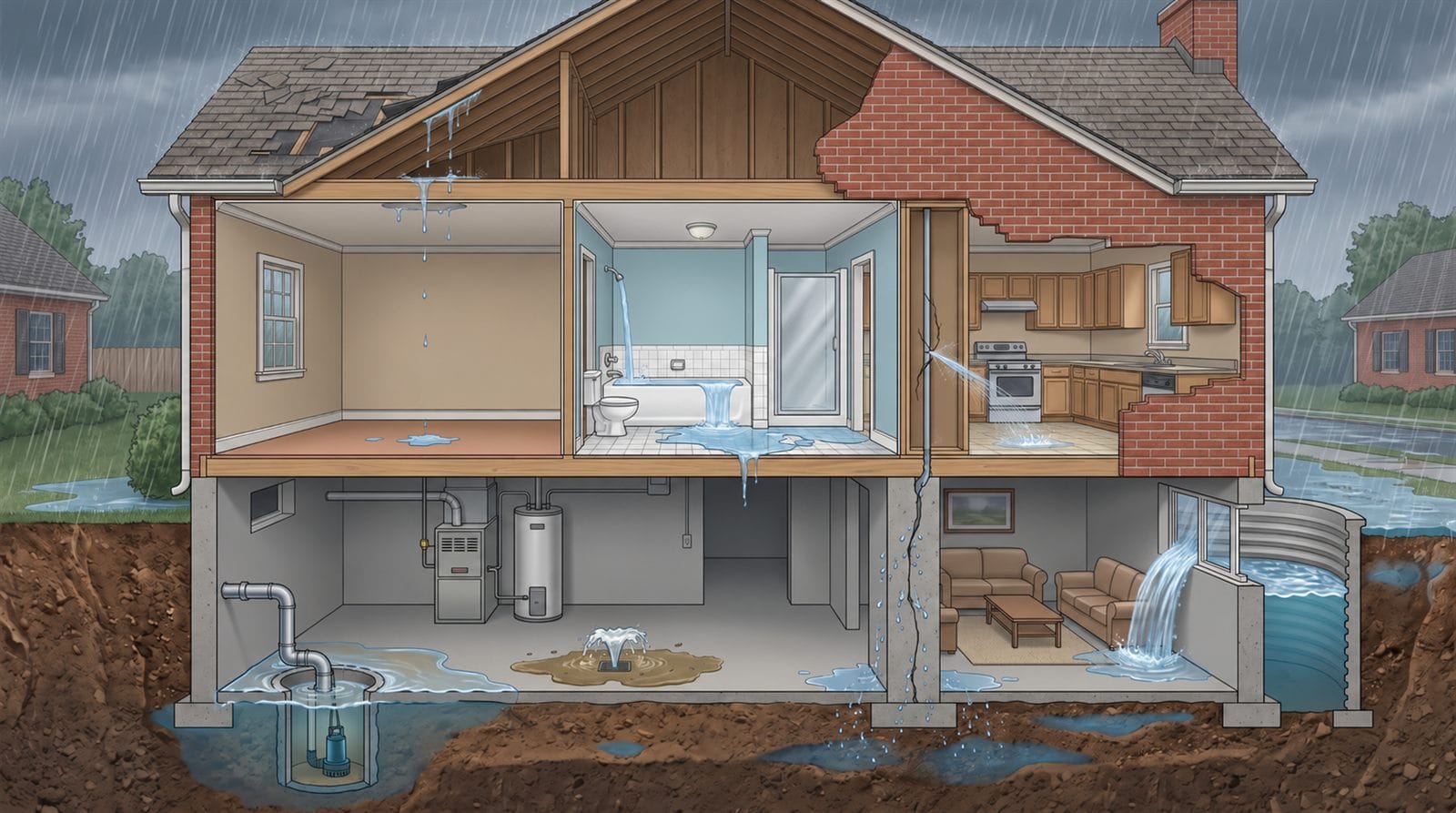
Seven separate examples of how water can enter a home. Select each one, or a coverage name below the picture, to see which policy usually responds.
- Homeowners insurance
Storm-related roof leak
Rain entering through a roof damaged by a covered storm can cause covered damage inside your home. Roof repairs and interior damage are evaluated under your policy’s terms. An aging roof or long-term leak is a different situation; insurance does not replace routine maintenance.
- Homeowners insurance
Overflowing bathtub
An accidentally overflowing bathtub can damage floors, ceilings, and rooms below. Sudden and accidental water damage is generally covered by homeowners insurance, subject to your deductible and policy terms. Repeated leakage or deterioration over time may be excluded.
- Homeowners insurance
Burst water pipe
A suddenly burst supply pipe can soak walls, flooring, and belongings. Homeowners insurance often covers the resulting water damage. Repairing the failed pipe itself may be your responsibility, and exclusions or conditions can apply to freezing, neglected leaks, and maintenance.
- Water backup / sump overflow endorsement
Sump pump overflow
If your sump system fails or cannot keep up, water can overflow into the basement. Added water backup and sump overflow coverage can help with resulting covered damage. Check the limit, deductible, and power-failure provisions. Replacing the failed pump itself may require different coverage.
- Sewer and drain backup endorsement
Floor drain backup
Water or sewage backing up through a floor drain generally requires added water backup coverage. This can help with covered cleanup and damage, up to the selected limit. If widespread flooding caused the backup, flood coverage and its rules may also come into play.
- Flood insurance: qualifying event required
Surface water entering a basement window
Surface floodwater entering through a basement window generally falls outside standard homeowners coverage. Flood insurance may respond if the event meets its definition of flooding. Under the NFIP, flooding must affect at least two properties, including yours, or two acres of normally dry land. Basement coverage is limited.
- Cause-dependent, often excluded
Water seeping through foundation walls
Water seeping through foundation walls is not automatically a covered flood. Groundwater seepage without a qualifying flood is generally excluded under standard homeowners and NFIP policies. If seepage directly results from a qualifying flood, flood coverage may apply, subject to basement restrictions.
- Homeowners insurance
- Water backup endorsement
- Flood insurance
- Cause-dependent, often excluded
A flooded basement doesn’t mean everything in it is covered. NFIP coverage restricts basement finishes and belongings, including carpeting, sofas, and televisions. Private flood policies and expanded water endorsements may differ.
These examples illustrate possible coverage. The cause of loss and your policy’s terms, exclusions, limits, and deductibles determine coverage.
Standard homeowners policies exclude flood. They also exclude sewer and drain backup unless someone specifically added it. Those two exclusions account for a large share of the uncovered losses we see on the North Shore, and both can be closed: flood with a separate policy, backup with an endorsement.
Flood and Water Backup Are Different Problems
People use the word flood for any water in a basement. Insurance does not.
- Flood is rising surface water from outside the home. Lake overtopping, an overwhelmed creek, or water moving across the ground and into the structure. It requires a separate flood policy through the NFIP or a private carrier.
- Sewer and drain backup is water forced up through your own drains, floor drains, or sump when the municipal system is saturated. It requires an endorsement on your homeowners policy.
- Service line coverage handles the buried pipe between the street and your house, which is the homeowner’s responsibility in most North Shore municipalities.
A single storm can produce both at once. Carrying one and not the other leaves half the exposure open.
FEMA Maps Do Not Show Where Water Goes
Lender flood requirements follow FEMA zones. FEMA zones follow modeled surface water. Neither accounts for the storm sewer capacity in an older suburb, the drainage ditches in Glencoe, or the way a heavy rain moves through a neighborhood built before current stormwater standards.
The practical result is that many homes taking water are outside a mandatory flood zone. Flood policies for those addresses are usually priced well below in-zone coverage.
NFIP and Private Flood
The National Flood Insurance Program caps residential building coverage at $250,000 and contents at $100,000. For much of the North Shore housing stock those limits are well short of rebuild cost.
Private flood options can offer higher limits or additional features. We compare building and contents limits, basement finishes, additional living expenses, waiting periods, and exclusions against the NFIP quote for your address.
Water Backup Limits Are Usually Too Low
When water backup is present on a policy at all, it is frequently written at $5,000 or $10,000. Restoring a finished basement with drywall, flooring, mechanicals, and contents runs well past that.
Most carriers will write $25,000, $50,000, or higher for a modest premium increase. If your basement is finished, this is the first limit we look at.
Four Kinds of Basement Water and What Covers Each
Homeowners describe all of these as flooding. Insurance treats them as four separate causes of loss, covered under different policies or not at all, and the policy wording controls the outcome rather than the everyday word.
| What happened | What it is called | What responds |
|---|---|---|
| Water rises from outside and enters at or below grade, including from a creek, a lake or overwhelmed streets | Flood | Excluded from the homeowners policy. Needs a separate NFIP or private flood policy |
| Water backs up through a floor drain, a sewer line or a failed sump pump | Water or sewer backup | Excluded unless the backup endorsement is added. Sump failure is sometimes a separate grant |
| A supply line, appliance hose or fixture inside the house discharges suddenly | Sudden and accidental discharge | Generally covered by the homeowners policy as written |
| Water enters slowly through foundation walls, or a leak goes unnoticed over weeks | Seepage or continuous leakage | Almost always excluded as a maintenance issue, regardless of endorsements |
One heavy storm can produce more than one of these in the same basement, and an adjuster will apportion the loss between them. A household carrying only the endorsement for one cause can find most of a single claim uncovered.
The fourth row is the one to act on rather than insure. Groundwater seepage without a qualifying flood is generally excluded. If a covered flood causes the seepage, flood coverage may apply, subject to policy restrictions. For the everyday version of this risk, grading, downspout extensions, and a working sump with battery backup do more than any policy change. Our guide to sewer backup coverage in Illinois covers the second row in detail.
Checking Your Own Address
Two official sources are worth looking at before you decide, and both are free.
- FEMA’s Flood Map Service Center shows the current effective flood map for a specific address, which is what a lender uses to decide whether coverage is required.
- FloodSmart, the NFIP’s own site, explains what an NFIP policy covers and what its limits are.
Read the map as a regulatory boundary rather than a risk assessment. It tells you whether a lender will require coverage. It does not tell you whether water can reach your house, and flood claims regularly come from outside the high-risk zones.
Common Questions
Do I need flood insurance if I am not in a flood zone?
Often yes. Being outside a mandatory zone means the lender will not force it, not that the risk is absent. Coverage outside those zones usually costs less than in-zone coverage, and we can price your address.
How long before flood coverage starts?
NFIP policies carry a 30-day waiting period in most circumstances. Buying during a forecast does not work. Private carriers sometimes offer shorter waits.
Does flood insurance cover my finished basement?
NFIP coverage in a basement is limited, particularly for finished surfaces and belongings. Compare the private policy’s specific basement provisions before paying for additional coverage.
Will a sump pump failure be covered?
Water damage from an isolated pump failure is generally covered only under a water backup or sump overflow endorsement; a standard homeowners policy excludes it. If the sump overflows or backs up because of a qualifying flood, that is a different analysis: flood coverage may apply, subject to its basement restrictions.
Related Coverage
- Home insurance, where water backup is endorsed
- Condo insurance for lower-floor and garden units
- Our guide to flood insurance on the North Shore
- Sewer backup versus flood insurance explained
Where We Write Flood Coverage
Lakefront and low-lying exposure varies block by block. We write flood and water backup coverage from our offices in Wilmette, Evanston, Elmhurst, Elk Grove Village, Antioch, Lakeview, Wicker Park, and North Center, and throughout Winnetka, Glencoe, Highland Park, and Skokie.
Get a Flood Insurance Quote
Send us your address and your current homeowners declarations page. We will tell you what your flood zone says, what your policy currently does about water, and what it costs to close the gap. Call 847.242.1040 or request a quote online.