
Short answer: the best time to look at umbrella insurance is just before a new liability exposure starts, not after. For most North Shore families that moment is a teenager getting a license, buying or renting out a property, adding a pool or a dog, joining a board, or a jump in savings or income. How much coverage to buy and what it costs are covered in our umbrella cost and sizing guide; this post is about when to act and what has to be in place first.
Umbrella insurance is extra liability coverage that sits above your auto, homeowners, landlord and watercraft policies and pays after their limits are used up. Families tend to think about it once, at a renewal, and then forget it. The trouble is that the exposures an umbrella is meant to sit over change between renewals: a new driver, a new property, a new role in the community. Each of those is a reason to check the umbrella before the change takes effect.
The Moments That Should Trigger an Umbrella Review
| Moment | Why it matters | What to check |
|---|---|---|
| A teen gets a learner’s permit or license | Young drivers raise the odds of a serious crash with several injured people | The driver is listed on the auto policy and disclosed to the umbrella carrier |
| You buy a rental property or rent out a condo | Tenant and guest injuries now attach to a property you do not live in | Whether the umbrella accepts the rental, the number of units and the ownership entity |
| You add a pool, trampoline or a new dog | Premises injuries and dog bites are frequent, and some carriers restrict them | Eligibility, safety requirements, and that the home policy’s liability limit meets the umbrella’s minimum |
| You join a board, coach, or volunteer | Defamation and decision-related claims can follow community roles | Personal injury coverage on the umbrella and the organization’s own insurance |
| You buy a boat, a second home or recreational vehicles | Each brings its own liability policy that the umbrella must sit over | Required underlying limits on the new policy and that it is listed on the umbrella schedule |
| You hire a nanny or other household help | An injured worker in your home can bring a claim | Workers’ comp for household employees and how the umbrella treats employment claims |
| Net worth or income jumps | A sale, inheritance or new role puts more within reach of a judgment | Whether your current limit still fits |
| A child leaves for college with a car, or an adult child moves home | Driver and vehicle assignments change | Garaging, named insureds and who is listed as a household driver |
Our post on umbrella insurance and teen drivers covers the most common of these moments in detail, and our guide to insuring one rental property in Chicago covers the landlord side.
What Has to Be in Place Before You Buy
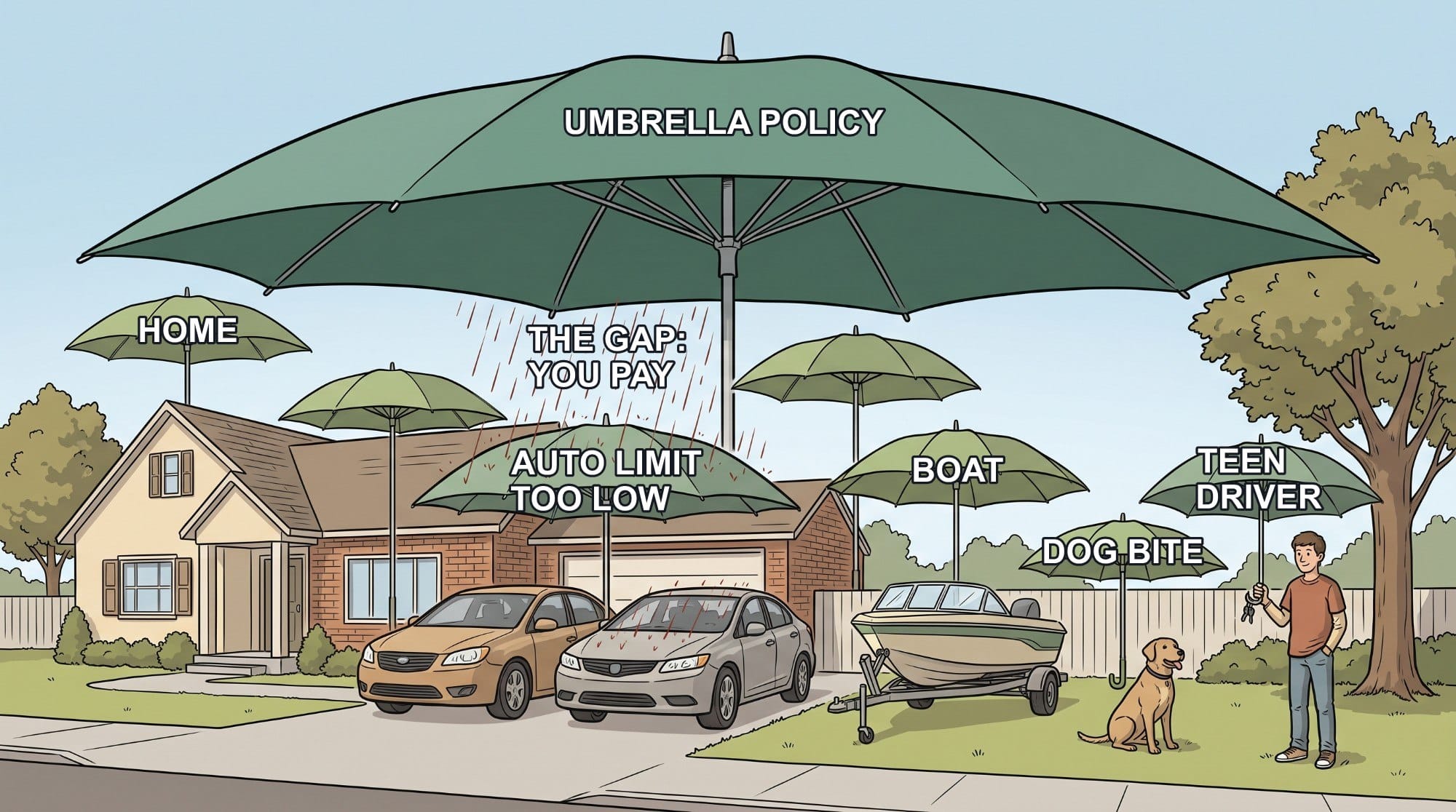
An umbrella does not stand on its own. Carriers require minimum liability limits on the policies underneath it, commonly $250,000 per person and $500,000 per accident on auto and $300,000 on homeowners, and they want every household driver, vehicle and property disclosed. If an underlying limit is set below what the umbrella requires, you pay the difference yourself before the umbrella responds.
Eligibility is the other piece. Carriers differ on rental properties held in an LLC or trust, short-term rentals, certain dog breeds, recreational vehicles and households with a recent serious violation. It is far better to learn that a carrier will not accept an exposure before you need the coverage. Do not leave a pool, a dog or a rental off an application to get a lower price; if it is excluded or creates an underwriting problem, you want to know now. Our post on trust and LLC ownership explains how entity-owned homes and cars affect coverage.
How Umbrella Timing Goes Wrong
Umbrella problems usually come from timing, not from the umbrella itself. If the auto policy renews in March, the homeowners policy in July and the umbrella in September, the required underlying limits may not line up all year. A vehicle added midterm, a new rental property, or a teen who gets licensed between renewals can leave a gap if nobody tells the umbrella carrier.
The fix is simple. Keep the declarations pages together, tell your agent about changes before they happen when you can, and check the umbrella’s schedule after each change to an underlying policy. The schedule should list every vehicle, property and boat the umbrella is meant to sit over. If something is missing, ask why.
Some changes do not feel like insurance events but still are: a new job with a longer commute, a side consulting project, a parent moving into the household, lending a car, hosting a fundraiser or joining a condominium board. Some of those fit under the umbrella, some need another policy, and some are excluded. The point is to find out while there is still time to adjust.
What an Umbrella Will Not Do
- Business and professional claims. Claims from a business, a profession or employment are common exclusions. A separate business policy is usually needed.
- Your own injuries and property. An umbrella is liability coverage. It pays for harm you cause to others, not damage to your own home or car.
- Intentional acts. Deliberate harm is excluded.
- Uninsured and underinsured drivers, unless you ask. Some umbrellas offer uninsured and underinsured motorist coverage, some do not, and some require specific selections. Ask rather than assume.
How Much Coverage, and What It Costs
Umbrellas are sold in million-dollar increments, and the first million is the most expensive. A $1 million umbrella typically runs $150 to $350 a year. The right limit depends on what you own, what you earn and the exposures above. Our umbrella cost and sizing guide walks through limits from $1 million to $5 million and the risk factors that call for more.
A Practical Review Checklist
- List all household members, licensed drivers, vehicles and where each vehicle is garaged.
- List homes, condos, rental properties, boats and recreational vehicles, and who owns each one.
- Note pets, pools, trampolines, volunteering, coaching and board seats.
- Gather the current declarations pages for your auto, home, landlord and watercraft policies.
- Compare umbrella options by limit, exclusions, required underlying limits and price.
- Recheck the umbrella schedule whenever a driver, vehicle or property changes.
Send us the declarations pages for your auto, home and any landlord or watercraft policies, and we will show you what an umbrella would sit over and what it takes to qualify.
Frequently Asked Questions
When should a family get umbrella insurance?
Before a new liability exposure starts: a teen getting a license, buying or renting out a property, adding a pool or a dog, joining a board, or a significant increase in savings or income.
Is umbrella insurance only for wealthy families?
No. Future earnings, teen drivers, rental properties and the chance of a severe accident matter as much as current assets, and many middle-income households find the coverage worth having.
Can I buy an umbrella without high auto and home limits?
Usually not. Carriers require minimum underlying limits, commonly $250,000 per person and $500,000 per accident on auto and $300,000 on homeowners. If you drop below them, you pay the gap yourself before the umbrella responds.
Does umbrella insurance cover rental properties?
It can, but eligibility depends on the carrier, the number of units, how the property is owned and whether it is a short-term rental. Check before you buy or rent out the property.
Does an umbrella cover business activities?
Often not, or only in limited ways. Business, professional and employment claims are common exclusions, and a separate business policy is usually needed.
This article provides general educational information, not legal advice or a coverage determination. Umbrella eligibility, required underlying limits and exclusions differ between carriers, and how a policy responds depends on its language.
Coverage We Write
Call or text 847.242.1040 or request a quote online.