
Adding a teen driver is one of the clearest moments to review umbrella insurance. Careful teens are still inexperienced, and inexperience raises the chance of a serious accident that turns into a liability claim larger than standard auto limits.
Families often focus on the premium increase when a teen is added to the policy. That is understandable. But the bigger question is whether the family’s liability protection still fits the risk. A major injury accident can involve medical bills, lost wages, legal defense, pain and suffering, and long-term care costs.
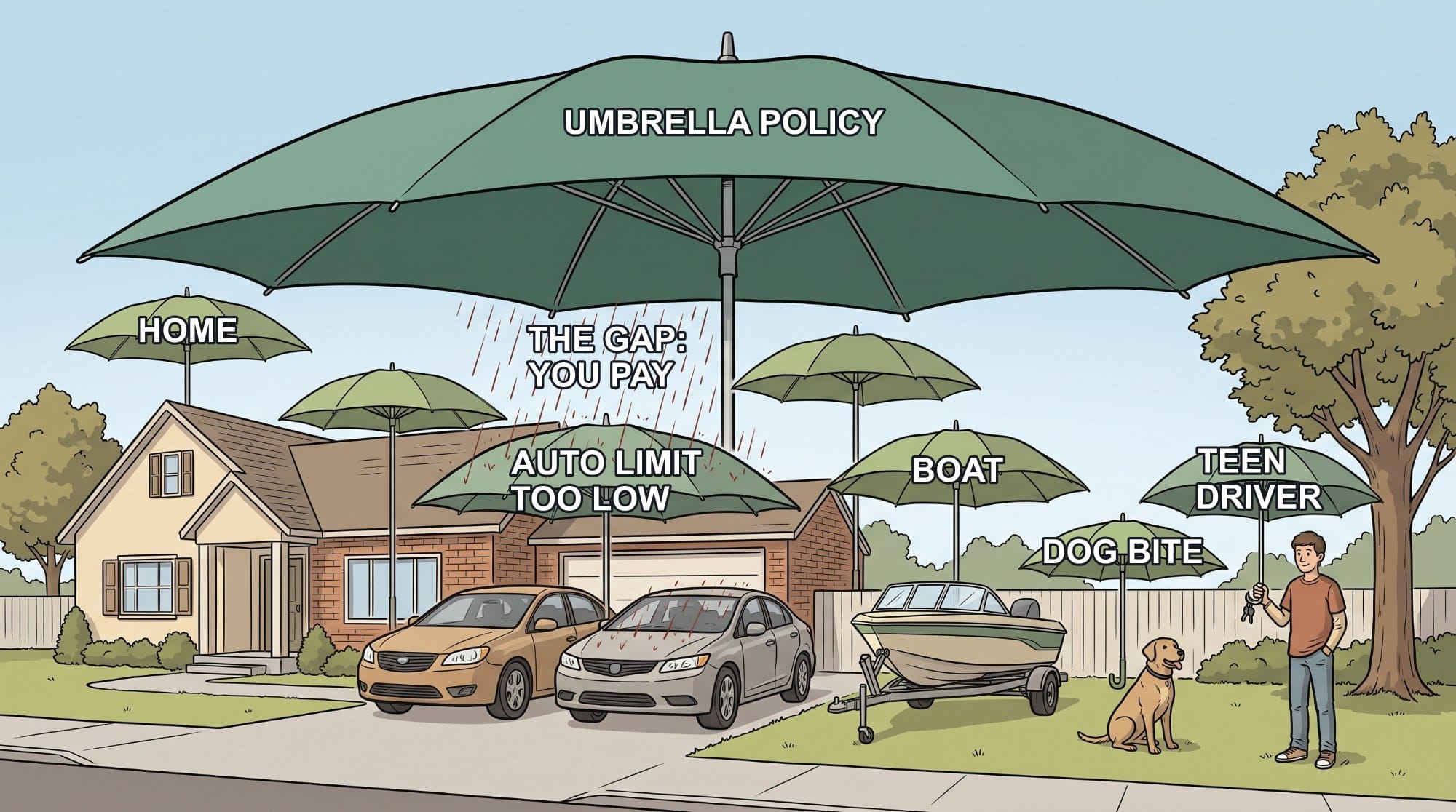
Umbrella insurance is designed to add an extra layer of liability protection over auto, home, renters, condo, and certain other policies.
Auto Liability Limits Can Be Exhausted Quickly
A car insurance policy includes bodily injury and property damage liability limits. If an insured driver causes an accident and the damages exceed those limits, the family may be personally exposed for the difference. In a severe accident involving multiple vehicles, pedestrians, cyclists, or long-term injuries, damages can climb quickly.
Higher auto liability limits are the first step. Umbrella coverage is the next layer. It can provide additional protection once the underlying auto limits are exhausted, subject to policy terms.
Teen Drivers Add More Than Premium
Teen drivers are new to judgment under pressure. Night driving, passengers, weather, phones, parking lots, school traffic, and unfamiliar roads all increase risk. Even responsible teens can make mistakes.
Parents should use the insurance change as a broader risk review. That includes driver training, household rules, vehicle selection, telematics options, good student discounts, and liability limits.
Umbrella Coverage Is Usually Cost-Effective
Umbrella policies often provide $1 million or more of additional liability coverage for a relatively modest premium compared with the protection provided. Pricing depends on vehicles, drivers, homes, underlying limits, claims history, and household characteristics.
The policy usually requires certain minimum underlying limits on auto and home policies. That means umbrella planning should be coordinated with the rest of the insurance program rather than added in isolation.
Families With Assets or Income Should Pay Attention
Umbrella insurance is especially important for households with savings, home equity, investment accounts, business ownership, professional income, rental properties, or future earnings to protect. A lawsuit does not only threaten current cash in the bank. It can threaten long-term financial plans.
Families sometimes underestimate their exposure because they do not consider home equity, retirement contributions, college savings, or future income. Liability planning should reflect the household’s overall financial picture.
Umbrella Insurance Also Covers More Than Auto Claims
Although teen drivers are a strong reason to consider umbrella coverage, the policy can also respond to certain claims involving injuries at the home, dog bites, rental property liability, defamation, or other covered personal liability events. Coverage varies by policy, so the details matter.
For many families, the teen driver is the reason they finally buy one.
Common Family Liability Mistakes
Families often raise deductibles to save money but leave liability limits unchanged. Deductibles address small property claims. Liability limits address catastrophic lawsuits. They are different decisions.
Another mistake is buying umbrella coverage for one policy period and never revisiting the limit. Assets, income, home equity, vehicles, drivers, and risk factors change over time.
A third mistake is forgetting that college, borrowed vehicles, part-time jobs, and different garaging situations can affect coverage for young drivers.
How Much Umbrella Coverage Is Enough
There is no universal answer. A practical review considers home equity, savings, investments, income, future earnings, rental properties, business ownership, vehicles, drivers, and lifestyle exposures. Many families start with $1 million, but higher limits may be appropriate.
The key is to choose a limit intentionally rather than accepting whatever default was quoted years ago.
Risk Management for Teen Drivers
Household driving rules matter. Limit passengers, restrict late-night driving, prohibit phone use, set weather rules, monitor grades, and choose vehicles with strong safety features. Insurance protects finances after a loss, but prevention protects people first.
A Practical Teen Driver Example
Consider a teen driver who causes a multi-car accident with serious injuries. The family’s auto liability limit may respond first, but medical bills and legal demands can exceed that limit. Without umbrella insurance, the family may have personal exposure. With coordinated auto and umbrella coverage, the household has an additional layer of protection for the kind of claim that can alter long-term financial plans.
Review coverage well before the renewal date, while there is still time to change it.
Coverage Review Checklist
- Increase auto liability limits before adding umbrella coverage
- Review all household drivers and vehicles
- Ask about good student and driver training discounts
- Consider telematics if appropriate
- Set household driving rules in writing
- Match umbrella limits to assets and income
- Review coverage again when the teen leaves for college
Raise Liability Limits Before Your Teen Starts Driving
Longmeadow Insurance can help families compare auto and umbrella options when adding a teen driver.
How Longmeadow Insurance Can Help
Longmeadow Insurance is an independent agency based in Wilmette, Illinois. Send us your current declarations pages and we will tell you what they cover, and where the gaps are, before we quote anything.
For a coverage review, call 847.242.1040 or request a consultation online.
Teen drivers make liability limits more important
Adding a teen driver changes the household’s liability exposure as well as the premium. A serious accident can involve injuries, multiple vehicles, passengers, pedestrians, bicycles, property damage, lawsuits, and claims that exceed the underlying auto policy limits.
Umbrella insurance can provide additional liability protection above the auto and homeowners policies, but it usually requires minimum underlying limits. Families should review those requirements before assuming the umbrella will respond.
College, borrowed cars, and household drivers
Teen and college-age drivers can create coverage questions when they take a car to school, drive a roommate’s vehicle, live away from home, remain household members, or return during breaks. Vehicle ownership, garaging address, driver listing, and liability limits should all be reviewed together.
Longmeadow Insurance can help families compare premium, liability limits, umbrella coverage, and student/driver discounts without losing sight of the bigger risk.
Related Insurance Guides
- How location affects Illinois auto insurance rates
- Life insurance application and underwriting process
Coverage We Write
Call 847.242.1040 or request a quote online.