
Start the insurance review while you still have time to investigate the property. Use this checklist to gather roof and building details, review water exposure, and coordinate the policy effective date with your lender before closing.
Shopping for homeowners insurance can reveal issues that matter before closing, including roof age, prior claims, water exposure, flood concerns, replacement cost, occupancy, and lender requirements. Starting early gives you time to solve problems rather than scramble.
On this page
- Start the insurance review during the contract period
- Roof age and condition can affect eligibility
- Water history matters
- Replacement cost is different from purchase price
- Coordinate the policy with lender and closing requirements
Start the insurance review during the contract period
Do not wait until the week of closing. Once you have a signed contract, begin gathering information for insurance quotes: address, purchase price, closing date, lender information, roof age, updates, square footage, and inspection details.
If underwriting questions come up, you want time to answer them before the lender needs proof of insurance.
Roof age and condition can affect eligibility
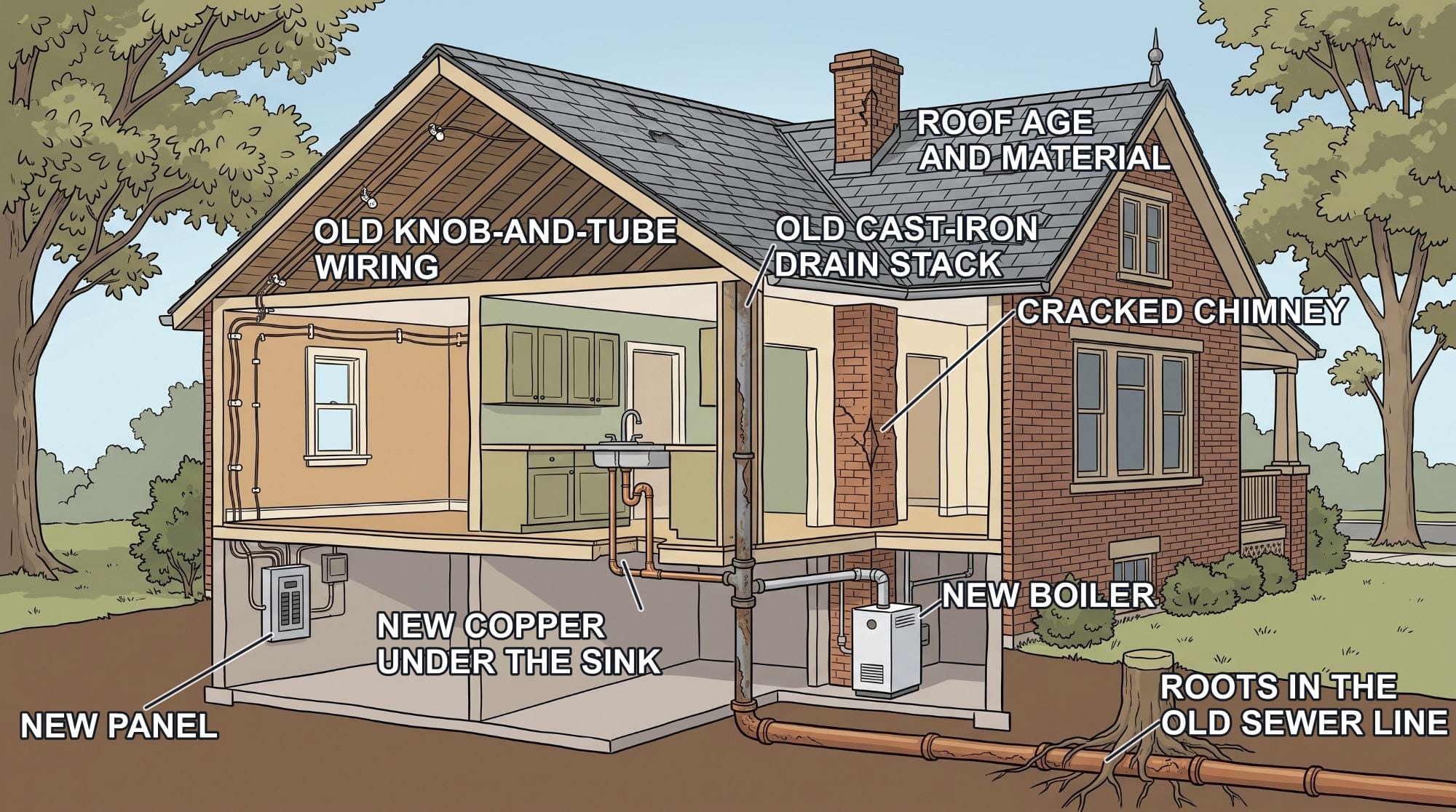
Roof age is one of the most common underwriting questions. Older roofs, visible wear, prior storm damage, or missing documentation can affect pricing or eligibility.
Ask the seller for roof age, permits, invoices, warranties, and any claim history. If the inspection raises roof concerns, discuss them before closing.
Water history matters
Basement seepage, sewer backup, sump pump failure, prior flood, grading issues, and window well problems should all be reviewed. Insurance coverage depends on how water enters the home, so one endorsement does not solve every water issue.
Consider water backup coverage and evaluate flood insurance separately, even when the lender does not require flood coverage.
Replacement cost is different from purchase price
A home may sell for more or less than it costs to rebuild. Land value, school district, lot size, and market competition affect purchase price. Insurance should focus on rebuilding the structure.
Custom finishes, older construction, additions, detached garages, finished basements, and local code requirements can all influence the replacement cost estimate.
Coordinate the policy with lender and closing requirements
The lender will need evidence of insurance with the correct mortgagee clause and effective date. If escrow is involved, billing details must also be correct.
For condos, request the master policy and bylaws early. The unit-owner policy should coordinate with the association’s responsibilities and deductible structure.
A Timeline From Contract to Closing
Insurance is rarely the thing that delays a Chicago-area closing, but when it is, it is because someone started in the last week. This is the order that works.
- Contract accepted. Send the address to your agent that day. A pull on prior claims at the property, the roof age, and the flood zone tells you early whether this house is straightforward or not.
- Inspection completed. The report answers most underwriting questions at once: roof, electrical, plumbing, heating, and any water staining in the lower level. Forward it.
- Two to three weeks out. Quotes finalized and the replacement cost estimate reviewed against the actual construction rather than the purchase price.
- One week out. Bind coverage effective on the closing date and send the declarations page and paid receipt to the lender and the title company.
- Closing day. Confirm the effective date matches. If the closing moves, the policy date has to move with it, and that does not happen automatically.
What Can Stop a Policy From Being Issued
A handful of findings turn a routine quote into a problem, and all of them are better discovered during attorney review than the week of closing. The usual ones are an open claim on the seller’s policy, a roof past twenty years with no replacement date, knob and tube wiring or a fuse box, a buried oil tank, and prior water losses on the property’s claim history, which follows the address rather than the owner. Any of these narrows the carrier list, and two of them together can leave you with one option instead of six.
Frequently asked questions
When should I start shopping home insurance during a purchase?
As soon as the contract is moving forward. Waiting until the final week can create avoidable closing stress.
Do I need flood insurance if the lender does not require it?
Maybe. Lender requirements are not the same as actual water risk.
What if the roof is old?
An older roof may still be insurable, but underwriting may ask questions or offer different terms.
Talk with a local independent insurance agency
We review insurance options with Chicago suburban homebuyers during the contract period, so the policy is bound and the lender has proof before closing day. To start a review, use our get a quote form or call 847.242.1040.
Coverage We Write
- Home insurance on the North Shore
- Flood and water backup coverage
- Umbrella insurance
- Personal insurance overview
Call 847.242.1040 or request a quote online.