
Wholesale & Distributor Insurance
Coverage at a Glance
Select a numbered marker on the illustration, or a coverage name below it, to see where each coverage applies.
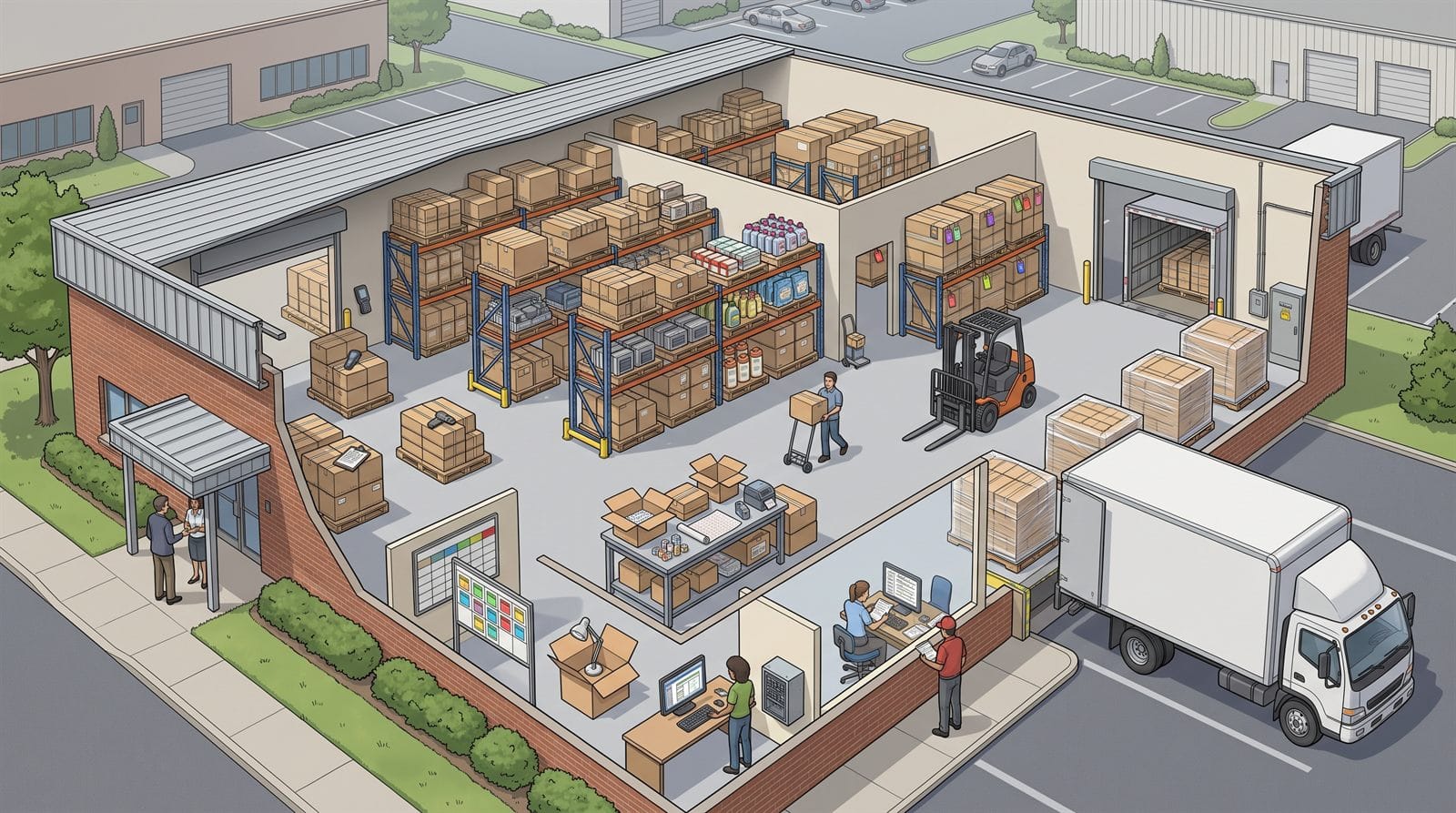
- Commercial property
Protect the building that keeps goods moving.
Commercial property insurance can help repair or replace insured buildings, improvements, and equipment after a covered loss. If you lease, review your responsibilities alongside the landlord’s coverage. Include the cost of restoring racks, offices, and specialized warehouse installations.
- Inventory and stock coverage
Does your limit reflect what’s actually on the shelves?
Review coverage for inventory you own, including peak stock levels and goods stored at additional locations. Ask how stock is valued and whether seasonal increases apply. A limit based on an average month may fall short when the warehouse is full.
- Warehouse legal liability
Your customers’ inventory needs a different coverage check.
Warehouse legal liability can help when you’re legally responsible for covered loss or damage to goods entrusted to you. It isn’t automatically all-risk property insurance for those goods. Review storage agreements, declared values, handling services, and any broader property protection you promise customers.
- Cargo and transportation insurance
Who protects the shipment between locations?
Cargo or transportation insurance can protect qualifying goods in transit. The right form depends on whether you own the goods, haul them for others, or arrange transportation. Review loading, unloading, temporary storage, shipment values, and when your responsibility begins and ends.
- Commercial auto
The truck and its load need different protection.
Commercial auto insurance can address covered liability from business vehicle accidents, with separate options for vehicle damage. Cargo protection is a separate question. Review drivers, delivery routes, rented vehicles, and employee-owned vehicles used for business.
- Logistics errors and omissions
A shipping mistake can create a financial claim.
Logistics errors and omissions coverage may help with covered claims involving mistakes in transportation arrangements, documentation, or other insured services. Review the services you perform and contractual obligations you accept. It doesn’t guarantee every delivery deadline or pay every contractual penalty.
- Cargo theft and fraudulent pickup
What if the pickup is fraudulent?
Cargo theft can involve impersonated carriers, fake pickup instructions, or diverted shipments. Ask how your coverage treats fraudulent release, voluntary parting, and identity-verification requirements. An ordinary theft provision may not cover every situation where goods are handed to the wrong party.
- Fulfillment services liability
Handling someone else’s goods adds responsibility.
Packing, labeling, kitting, and fulfillment services can introduce exposures beyond storage. Review coverage for damage to customer goods and financial claims arising from service errors. Tell us about every service you provide so warehouse liability and E&O protection can be coordinated.
- Products liability
You can face a product claim even if you didn’t manufacture it.
Products liability coverage can help with covered claims alleging that something you distribute caused bodily injury or property damage. Disclose imported goods, private-label products, and any modifications you make. Product recall expenses generally need a separate coverage review.
- Workers’ compensation
Protect the people doing the lifting.
Workers’ compensation pays medical bills and lost wages for covered work injuries and illnesses, and Illinois requires it from your first employee. Review warehouse staff, drivers, temporary workers, and any off-site duties. Staffing-agency arrangements don’t eliminate the need to clarify insurance responsibilities.
- Business income and extra expense
What happens to income when shipments stop?
Business income coverage replaces lost profit, plus continuing expenses like rent and payroll, while you recover from covered physical damage. Extra expense coverage may help fund temporary space or other recovery arrangements. Ask about transit-related income protection; ordinary delays and missed sales don’t automatically qualify.
- Dependent property coverage
A supplier’s loss can become your interruption.
Dependent property coverage may help with qualifying income losses when covered physical damage at a supplier, customer, or other covered business disrupts your operations. Review critical locations and overseas dependencies. Ordinary shortages, congestion, insolvency, and price changes generally aren’t covered triggers.
- Cyber insurance
A system outage can stop picking, packing, and dispatch.
Cyber insurance can help with covered attacks, recovery costs, and qualifying business interruption. Review warehouse software, connected equipment, and outside technology providers. Ask about system-failure and dependent-business coverage; routine downtime isn’t automatically insured.
- Equipment breakdown and utility services
A breakdown and a utility outage are different events.
Equipment breakdown coverage can address qualifying mechanical or electrical failures. Utility services coverage may address specified losses from an off-site interruption. Review repair costs, damaged inventory, and income losses under each, along with waiting periods and exclusions.
- General and excess liability
Visitors create liability beyond your inventory.
General liability insurance can help with covered claims involving a visitor’s injury or damage to other property. Goods entrusted to you need a separate warehouse or cargo review. Consider excess liability for serious claims, and verify which underlying policies it follows.
Send us your current policies, your peak inventory values, and any storage agreements, and we will check them against each coverage above.
Illustrative coverage options. Coverage depends on your role, commodities, contracts, locations, and transportation arrangements. Policy terms, limits, deductibles, and exclusions apply.
Wholesale & Distributor Insurance for Illinois Logistics Operations
A distributor’s losses happen wherever the goods are: in storage, during loading, in transit, and at a customer’s or third party’s site. That holds for a food distribution warehouse in Skokie, an industrial supply company in Northbrook, and a consumer goods distribution center in Evanston.
Key Coverages for Wholesalers & Distributors
- Equipment Breakdown: Protects warehouse equipment such as conveyor systems, refrigeration units, loading dock equipment, and warehouse management technology against mechanical and electrical failure.
- Income Protection (Actual Loss Sustained): If a covered event shuts down your distribution operation, income protection covers your lost income for the restoration period, up to the policy’s limits.
- Dependent Properties Coverage: Your business depends on both suppliers and customers. If a key manufacturer or retail partner suffers a loss that disrupts your order flow, this coverage protects your income.
- Data Breach Response: Distribution companies manage customer accounts, payment data, and proprietary pricing information. This covers breach notification, forensic investigation, and credit monitoring costs.
- Employment Practices Liability: Warehouses and distribution centers employ large workforces with high turnover, which creates exposure for claims of discrimination, harassment, and wrongful termination.
- Data Breach Liability: Extends beyond response expenses to cover third-party lawsuits and regulatory penalties from a data breach.
Who We Insure
- Food and beverage distributors
- Industrial and building supply wholesalers
- Consumer goods distributors
- Pharmaceutical and medical supply distributors
- Automotive parts distributors
- Electronics and technology wholesalers
- Import/export operations
- Third-party logistics (3PL) providers
For a wholesale distributor insurance quote, send us your current declarations pages and inventory values, or call 847.242.1040.
Serving wholesalers and distributors in Wilmette, Northfield, Winnetka, Glencoe, Kenilworth, Evanston, Northbrook, Highland Park, Glenview, Skokie, and across Chicago’s North Shore.
Logistics Businesses Need Coverage for the Full Flow of Goods
A wholesaler or distributor’s risk does not stop at the warehouse door. Inventory can be damaged in storage, in transit, at third-party locations, during loading and unloading, or while dependent on a key supplier or customer. Coverage should match the way goods actually move.
Illinois wholesalers should review property, stock, inland marine, cargo, commercial auto, hired/non-owned auto, general liability, products liability, business income, equipment breakdown, cyber, crime, and warehouse legal liability where applicable.
Business Income and Dependent Property Exposure
Distributors can lose revenue even when their own building is unharmed. A supplier shutdown, customer shutdown, utility failure, transportation interruption, or damage at a third-party warehouse can interrupt operations. Dependent property and business income coverage should be reviewed carefully.
The right limit depends on gross revenue, seasonality, inventory turnover, supplier concentration, customer concentration, and how long it would take to resume normal operations after a loss.
Contract and Certificate Requirements
Large customers, landlords, logistics partners, and manufacturers often require certificates with specific wording. Additional insured, waiver of subrogation, primary/non-contributory language, cargo requirements, and product liability limits should be reviewed before the certificate is needed urgently.
Related Insurance Guides
Coverages for Wholesalers and Distributors
- Property with accurate inventory values. Review seasonal stock peaks. If a coinsurance condition applies, carrying less than its required value can reduce a partial-loss payment; agreed-value and waiver provisions can change that calculation.
- Products liability. Distributors are routinely named in claims about products they did not manufacture. Vendors endorsements from your suppliers help, but they do not replace your own coverage.
- Motor truck cargo and inland marine. Property in transit is not covered by the property policy at your warehouse.
- Commercial auto. Owned trucks and delivery vehicles, plus hired and non-owned auto where you use third-party carriers.
- Business income and contingent business income. Covers your own shutdown, and the case where a key supplier’s loss halts your operation.
- Workers compensation. Warehouse class codes reflect material handling and lift truck exposure.
- Equipment breakdown. Refrigeration, conveyors, and racking systems fail mechanically, which standard property forms exclude.
Peak Season and Reporting Forms
Distributors with seasonal inventory swings should not insure to an annual average. Peak season endorsements raise the limit for defined months. A reporting form goes further, charging premium against actual monthly values so you are neither underinsured at peak nor paying for capacity you do not use in the slow months.
Third-Party Logistics and Bailee Exposure
If you store or handle goods belonging to your customers, that property is not yours and is not covered by your own stock limit. Warehouse legal liability or a bailee form covers property of others in your care, custody, or control.
Your warehouse receipts and service agreements also matter. Contractual limitations of liability, often stated per pound, can cap your exposure substantially, but only if the agreements are written and consistently used.
Cargo in Transit
Motor truck cargo covers goods on your own trucks. When you tender freight to a common carrier, their liability is limited by federal rules and by their own tariff, usually to far less than the value of the shipment. Shippers interest coverage fills that gap for high-value loads.
Related Coverage
Erie and Other Wholesale and Distribution Markets
Wholesale and distribution is a class Erie Insurance writes, and as an appointed Erie agent we quote it for operations across Chicagoland. Property, general liability, and commercial auto on one program suits businesses running their own delivery fleets.
Inventory values, warehouse construction, whether you hold property of others, and cargo exposure all move this class between carriers. We compare Erie against the other markets that want distribution risks and place the account on the terms that fit the operation.