
Manufacturing Insurance
Coverage at a Glance
Select a numbered marker on the illustration, or a coverage name below it, to see where each coverage applies.
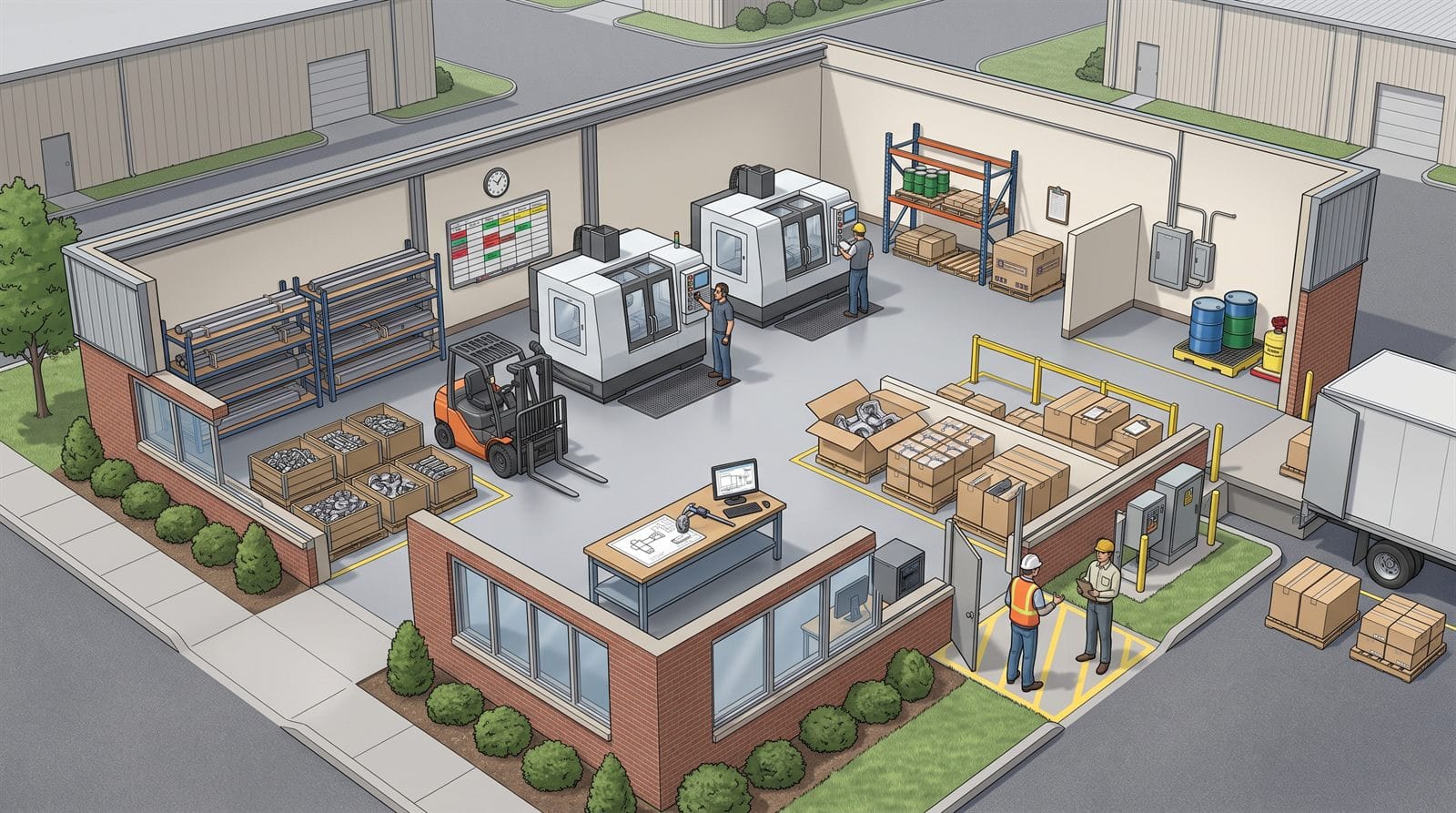
- Commercial property
Could you restore the facility after a major loss?
Commercial property insurance can help repair or replace insured buildings, equipment, and inventory after a covered loss such as fire. Review replacement values, lease responsibilities, and code-upgrade protection. Specialized construction and installation costs can make rebuilding more expensive than expected.
- Equipment Breakdown
One machine failure can stop the whole operation.
Equipment breakdown coverage can help with qualifying sudden mechanical or electrical failures of insured machinery. Review repair, replacement, and related income-loss protection. Ordinary wear, maintenance, and gradually deteriorating equipment generally aren’t covered breakdowns.
- Business income and extra expense
Your expenses continue when production stops.
Business income coverage replaces lost profit, plus continuing expenses like rent and payroll, while you recover from covered physical damage. Extra expense coverage may help fund temporary arrangements. Review restoration periods against the time needed to replace machinery, reinstall it, and resume production.
- Inventory and stock valuation
Stock changes value as it moves through production.
Raw materials, work in process, and finished goods can require different valuation considerations. Review your inventory limits against peak values and accumulated labor and production costs. Tell us about customer-owned materials or tooling in your care; ownership affects how coverage should be arranged.
- Workers’ compensation
Protect the people who keep production moving.
Workers’ compensation pays medical bills and lost wages for covered work injuries and illnesses, and Illinois requires it from your first employee. Review actual job duties, temporary staffing arrangements, and any installation or service work away from the plant. Employee injury protection is separate from customer liability coverage.
- Products Liability
What if your product causes an injury?
Products liability coverage can help with covered claims alleging that your product caused bodily injury or damage to other property. Claims may involve manufacturing defects, design, or instructions and warnings. Tell us where your components are used and which industries your customers serve.
- Manufacturers E&O
A defective part can cost a customer money without causing an injury.
Manufacturers E&O can address certain covered financial-loss claims involving defects in your products or work. For example, an out-of-spec component might disrupt a customer’s production. Review the policy’s triggers and exclusions; it isn’t a blanket guarantee of product performance or reimbursement for your own rework.
- Product Recall
Who pays to get affected products back?
Product recall coverage may help with specified expenses to notify customers, retrieve products, and handle a qualifying recall. Recall triggers vary, and ordinary quality problems may not qualify. Replacement products, rework, customer losses, and reputational damage aren’t automatically included.
- Dependent property coverage
What if a key supplier can’t deliver after a fire?
Dependent property coverage may help with qualifying income losses when covered physical damage at a supplier or customer disrupts your operations. Review named locations, overseas dependencies, and limits. Ordinary shortages, late deliveries, insolvency, and price increases generally aren’t covered triggers.
- Utility services coverage
A utility failure can stop an undamaged plant.
Utility services coverage may help when a qualifying off-premises power, water, or communications interruption causes insured damage or income loss. Review covered causes, waiting periods, and transmission-line restrictions. Not every outage qualifies, even when production must stop.
- Cyber insurance
A cyberattack can reach the production floor.
Cyber insurance can help with covered attacks, recovery costs, and qualifying business interruption. Review both office systems and manufacturing controls, including reliance on outside providers. Physical machinery damage and cyber-related shutdowns can fall under different policies or exclusions.
- Pollution liability
A spill can create costs beyond cleanup.
Pollution liability coverage can address specified cleanup, bodily injury, and property-damage claims involving covered pollution conditions. Review stored materials, waste handling, and any off-site disposal exposure. Ordinary general liability and property policies may leave substantial environmental gaps.
- Cargo and inland marine
Does your inventory stay protected in transit?
Cargo or inland marine coverage can protect qualifying goods while moving between your facility, outside processors, warehouses, and customers. Review ownership, shipment values, transport methods, and geographic limits. A carrier’s liability may not reimburse the full value of your shipment.
- Commercial auto
Your vehicle exposure extends beyond the plant.
Commercial auto insurance can protect against covered liability from business vehicle accidents, with separate options for vehicle damage. Review owned, hired, and employee-owned vehicles used for work. Cargo protection is a separate question from damage to the truck.
- General liability and umbrella
Visitors create a different injury exposure from employees.
General liability insurance can help with covered claims when your operations injure a visitor or damage someone else’s property. A serious claim can exceed primary limits. Review commercial umbrella or excess protection, including whether it follows your products liability coverage.
Send us your current policies and equipment schedule, and we will mark which of these coverages you already have.
Illustrative coverage options. Coverage must match your products, processes, and markets. Policy terms, limits, deductibles, and exclusions apply.
Manufacturing Insurance & Commercial Coverage for Illinois Producers
For a precision machine shop in Skokie, a food production facility in Northbrook, or a fabrication shop in Evanston, the largest claims usually come from products after they leave the plant and from the months a line sits idle after a loss.
Manufacturing programs differ in what they build into the base policy and what they sell as endorsements, so we compare the coverage along with the price.
Key Coverages for Manufacturers
- Products Liability: Part of a standard general liability policy, it protects your business against claims that a product you manufactured caused bodily injury or property damage after it left your facility.
- Equipment Breakdown: Covers mechanical and electrical failure of your production equipment, CNC machines, robotics, HVAC systems, and computerized controls.
- Income Protection: Covers lost income if a covered loss shuts down your production line.
- Off-Premises Utility Failure: If a power outage or utility disruption outside your facility halts production, this coverage fills the income gap.
- Dependent Properties Coverage: Protects your revenue when a key supplier or customer suffers a loss that disrupts your supply chain or order flow.
- Peak Season Coverage: Provides additional coverage during your busiest production periods when inventory levels are at their highest.
- Accounts Receivable Protection: Covers losses if your receivable records are destroyed, keeping cash flow going.
- Data Breach Response: Covers notification, forensic investigation, and credit monitoring costs if your systems are compromised.
- Manufacturer’s Errors & Omissions: Available optional coverage for claims arising from design defects, specification errors, or failure to meet contractual performance standards.
- Employment Practices Liability: Protects against employee claims of discrimination, harassment, wrongful termination, and other employment-related issues.
Who We Insure
- Metal fabrication and machine shops
- Food and beverage manufacturers
- Plastics and packaging producers
- Electronics and component manufacturers
- Chemical and specialty product manufacturers
- Woodworking and furniture manufacturers
- Printing and publishing operations
For a manufacturing insurance quote, send us your current declarations pages and equipment schedule, or call 847.242.1040.
Serving manufacturers in Wilmette, Northfield, Winnetka, Glencoe, Kenilworth, Evanston, Northbrook, Highland Park, Glenview, Skokie, and across Chicago’s North Shore.
Business Insurance Resources
Coverages a Manufacturer Needs
- Products and completed operations liability. The core exposure. Covers injury or damage caused by what you make, after it leaves your control and often years later.
- Commercial property with equipment breakdown. Standard property forms exclude mechanical and electrical failure, which is how production equipment usually fails.
- Business income with extended period. If a press or line goes down, the lost margin usually exceeds the equipment cost. Lead times on replacement machinery drive how long that period needs to be.
- Product recall. Separate from products liability. Recall covers the cost of retrieving and replacing product, which liability coverage does not.
- Workers compensation. Manufacturing class codes carry higher rates, which makes safety programs and return-to-work policies financially significant.
- Inland marine. For goods in transit and property at other locations.
Business Income Is Usually the Weak Point
A fire that destroys a production line does two kinds of damage. The equipment loss is visible and gets insured. The revenue loss while you wait months for replacement machinery is larger and routinely underinsured.
Set the period of restoration against real lead times for your specific equipment, not a default twelve months. Add extended business income so coverage continues while you win customers back after restarting. Contingent business income matters too if a single supplier or a single large customer would stop your operation.
Products Liability and Your Contracts
Manufacturers supplying larger companies are typically asked to name the customer as an additional insured and to indemnify them for claims arising from the product. Vendors endorsements handle the first. The second is a contractual obligation that your policy may or may not fully support.
If you make components that go into someone else’s finished product, the question of whose policy responds when the finished product fails is worth settling before a claim, not after.
Property Valuation
Keep machinery values current as replacement costs change. If a coinsurance condition applies and the insured value falls below its requirement, a partial-loss payment can be reduced. Check any agreed-value or waiver provision as part of the renewal review.
Related Coverage
Erie and Other Manufacturing Markets
We are an appointed Erie Insurance agent and quote Erie on manufacturing accounts that fit its appetite. Where it fits, having property, general liability, commercial auto, and workers compensation with one carrier simplifies both certificates and claims.
Manufacturing appetite is narrower than most classes. Products liability exposure, the materials and processes involved, equipment values, and prior losses determine which carriers will look at the account at all. We work several markets here and place Erie where it is the strongest option rather than by default.