
Restaurant & Hospitality Insurance
Coverage at a Glance
Select a numbered marker on the illustration, or a coverage name below it, to see where each coverage applies.
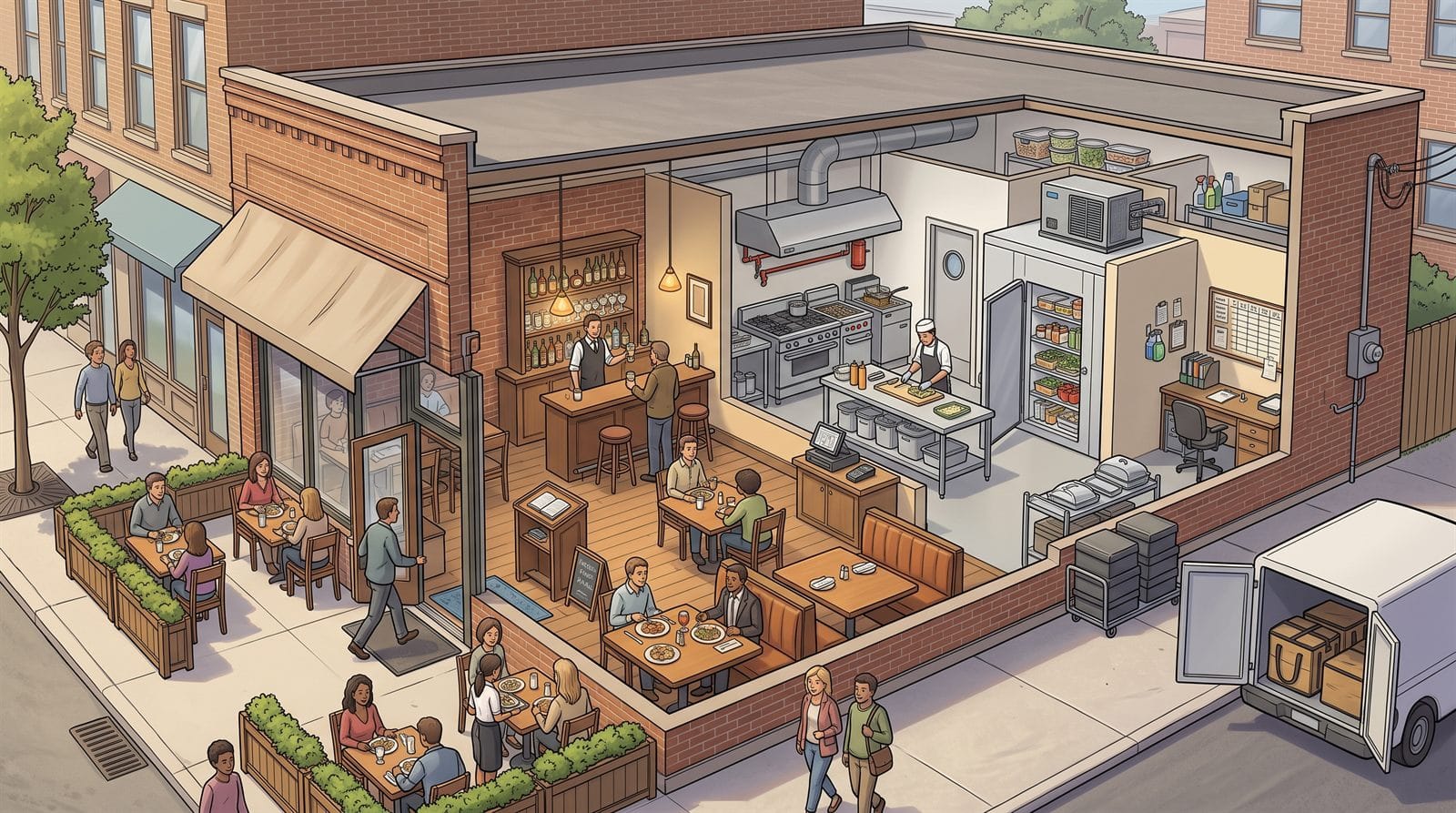
- General liability
What if a customer slips and falls?
General liability insurance can help with covered claims when your business is legally responsible for a customer’s injury or damage to someone else’s property. It can include legal defense costs. Employee injuries generally fall under workers’ compensation instead.
Patio and events: Tell us about outdoor seating, events, and shared or public areas so we can review the location and contractual requirements.
- Commercial property
A kitchen fire can damage more than the kitchen.
Commercial property coverage can help repair or replace insured equipment, furnishings, inventory, and building property after a covered fire. If you lease the space, review your improvements and lease responsibilities. The landlord’s insurance doesn’t automatically protect your restaurant’s investment.
- Business income and extra expense
The bills keep coming when the doors are closed.
Business income coverage replaces lost profit, plus continuing expenses like rent and payroll, while you recover from covered physical damage. Extra expense coverage may help you reopen or operate temporarily elsewhere. Waiting periods, restoration periods, and limits matter; not every closure qualifies.
- Products-completed operations (food liability)
What if a customer says your food made them sick?
General liability’s products-completed operations coverage may respond to covered injury claims involving food you serve, including foodborne illness or an allergic reaction. Tell us about your menu, preparation, and off-site sales. Replacing food or recovering your own lost income involves separate coverage questions.
- Liquor liability
Alcohol service creates a separate liability exposure.
Liquor liability insurance can help with covered claims alleging that your alcohol service contributed to injury or property damage. Restaurants selling alcohol should not rely on ordinary host liquor coverage. Review exclusions, service practices, and whether your excess policy includes liquor liability.
- Workers’ compensation
Protect the people behind every service.
Workers’ compensation can provide medical and wage-replacement benefits for covered work-related injuries or illnesses, including burns, cuts, and lifting injuries. Review all employee roles, including kitchen staff, servers, and delivery drivers, so your workers comp policy reflects how the restaurant operates.
- Equipment breakdown
What if essential equipment suddenly fails?
Equipment breakdown coverage can help with qualifying mechanical or electrical failures of refrigeration, cooking, or other insured equipment. Ask about repair costs and related income losses. Ordinary wear, maintenance, and replacing worn-out equipment generally aren’t covered breakdowns.
- Spoilage coverage
A cooler failure can wipe out your inventory.
Spoilage coverage can help replace perishable stock damaged by specified events, such as a covered refrigeration failure. Review limits against your busiest inventory periods. Power interruptions, contamination, and equipment repairs may be handled differently and need separate coverage checks.
- Food contamination coverage
What if contamination forces you to shut down?
A food contamination endorsement may help with specified cleanup costs, lost income, or extra expenses following a qualifying incident. Some forms require a public health authority to suspend operations. It doesn’t cover every inspection failure, closure, or communicable-disease event.
- Utility services coverage
An outage next door can stop your service.
An off-premises utility failure may leave you without refrigeration, lighting, or cooking equipment even when your restaurant is undamaged. Utility services coverage may help with qualifying property or income losses. Covered causes, waiting periods, and overhead-line exclusions vary.
- Cyber insurance
Your payment system is part of your risk.
Cyber insurance can help with covered data breaches, cyberattacks, and related response costs. Ask about payment-card information, ransomware, and income loss from system outages, including failures involving outside providers. A payment processor’s protection doesn’t necessarily cover your business’s losses.
- Employment practices liability
Staffing disputes can become expensive claims.
Employment practices liability insurance can help defend covered claims involving discrimination, harassment, or wrongful termination. Ask about allegations involving customers as well as employees. Wage-and-hour disputes, unpaid wages, and tip-related claims often have significant exclusions or limited protection.
- Crime coverage
Cash and employee theft need specific protection.
Crime coverage can address specified losses involving money, theft, forgery, or employee dishonesty. Review cash limits, deposits in transit, and who has access to funds. Ordinary property coverage may provide only limited protection for money, and unexplained shortages may be excluded.
- Commercial auto and delivery
Delivery creates risks beyond your dining room.
Business-owned delivery vehicles need appropriate commercial auto coverage. If employees use their own cars, review hired and non-owned auto liability and their delivery-use coverage. Don’t assume a personal auto policy or third-party delivery platform fully protects your restaurant.
- Off-site catering coverage
Does your coverage follow you to an event?
Off-site catering can involve food liability, transported equipment, venue requirements, and alcohol service. Confirm that these operations are covered before accepting the booking. Ask about property in transit and any additional insured endorsements required by the venue.
Send us your current policies and your annual liquor sales, and we will check them against each coverage above.
Illustrative coverage options. Multiple policies or endorsements may be required. Coverage depends on your operations, policy terms, limits, deductibles, and exclusions.
Restaurant & Hospitality Insurance for Chicago’s North Shore
A fine dining room in Winnetka, a cafe in Wilmette, a pizza shop in Northfield, and a caterer in Evanston face the same short list of claims: grease fires, slip-and-falls, foodborne illness, liquor liability, and kitchen injuries. What changes from one to the next is how much of each.
Restaurant programs differ most in what they build into the base policy, such as spoilage and equipment breakdown, so we compare those features along with the price.
Key Coverages for Restaurants & Food Service
- Equipment Breakdown: Commercial kitchens run on expensive, specialized equipment: ovens, refrigeration units, walk-in coolers, POS systems, hood ventilation. Equipment breakdown coverage protects against mechanical and electrical failure.
- Ammonia Contamination: Some restaurant programs include it for businesses with commercial refrigeration. Covers cleanup costs and product loss from ammonia leaks.
- Income Protection (Actual Loss Sustained): If a fire or covered event shuts down your restaurant, income protection pays your lost income while you rebuild, up to the policy’s time limit.
- Refrigerated Products: Covers spoilage of perishable inventory, and some programs pay up to the full business personal property limit instead of a smaller sublimit.
- Data Breach Response: Restaurants process hundreds of credit card transactions daily. This covers notification costs, forensic investigation, and credit monitoring when payment systems are compromised.
- Non-Owned & Hired Auto Liability: Covers liability when employees use their own vehicles or rented vehicles for deliveries or catering. It is often left off restaurant policies, so confirm it is on yours.
- Liquor Liability: Essential for any establishment serving alcohol. Covers bodily injury and property damage claims arising from the sale or service of alcoholic beverages.
- Food Contamination (Business Income): If a health department closure, contamination event, or foodborne illness outbreak forces you to shut down, this specialized coverage addresses the income loss beyond what standard property policies cover.
- Employment Practices Liability: Restaurants have high employee turnover, which brings discrimination and harassment claims. EPLI pays defense and settlement costs on covered claims, though wage-and-hour disputes are usually excluded or limited.
Who We Insure
- Full-service restaurants and fine dining
- Fast casual and quick-service restaurants
- Cafes, bakeries, and coffee shops
- Bars, taverns, and brewpubs
- Catering companies and food trucks
- Pizza delivery and takeout operations
- Banquet halls and event venues
For a restaurant insurance quote, send us your current declarations pages and annual liquor sales, or call 847.242.1040.
Serving restaurants and hospitality businesses in Wilmette, Northfield, Winnetka, Glencoe, Kenilworth, Evanston, Northbrook, Highland Park, Glenview, Skokie, and across Chicago’s North Shore.
Business Insurance Resources
Related Articles
Restaurants Combine Property, Liability, Food, Liquor, and Employment Exposure
Restaurants, cafes, bars, caterers, bakeries, and hospitality businesses have a dense risk profile. A single location may need building or tenant improvement coverage, business personal property, spoilage, equipment breakdown, food contamination, liquor liability, general liability, workers compensation, cyber/POS protection, and business income.
Coverage should match whether the business offers dine-in, delivery, catering, food trucks, alcohol service, outdoor seating, private events, or leased equipment.
Spoilage, Equipment Breakdown, and Shutdown Risk
A refrigerator failure, power outage, fire, water loss, or ventilation problem can create spoiled stock, cleanup costs, repairs, lost reservations, payroll pressure, and temporary closure. Restaurants should review spoilage limits, equipment breakdown, utility interruption, business income, and extra expense coverage together.
Liquor Liability and Event Exposure
Any restaurant or hospitality business serving alcohol should review liquor liability, server training, event contracts, off-premises catering, and additional insured requirements. Private events, festivals, and landlord agreements may require certificates with wording that should be addressed before the event date.
Related Insurance Guides
Erie Restaurant Insurance and Other Markets We Access
Longmeadow Insurance is an appointed Erie Insurance agent, and Erie is one of the carriers we go to first for restaurant and hospitality risks in Illinois. Erie writes restaurants as a core commercial class, with general liability, commercial property, business income, and workers compensation available on the same program, which keeps the account together rather than split across three companies.
Erie is not the only market we use here, and it is not always the right one. Liquor liability appetite, delivery operations, seating count, cooking equipment, and prior loss history all move a restaurant between carriers. We quote Erie alongside the other regional and national markets that want this class and show you the comparison rather than presenting a single option.