
Contractors Insurance
Coverage at a Glance
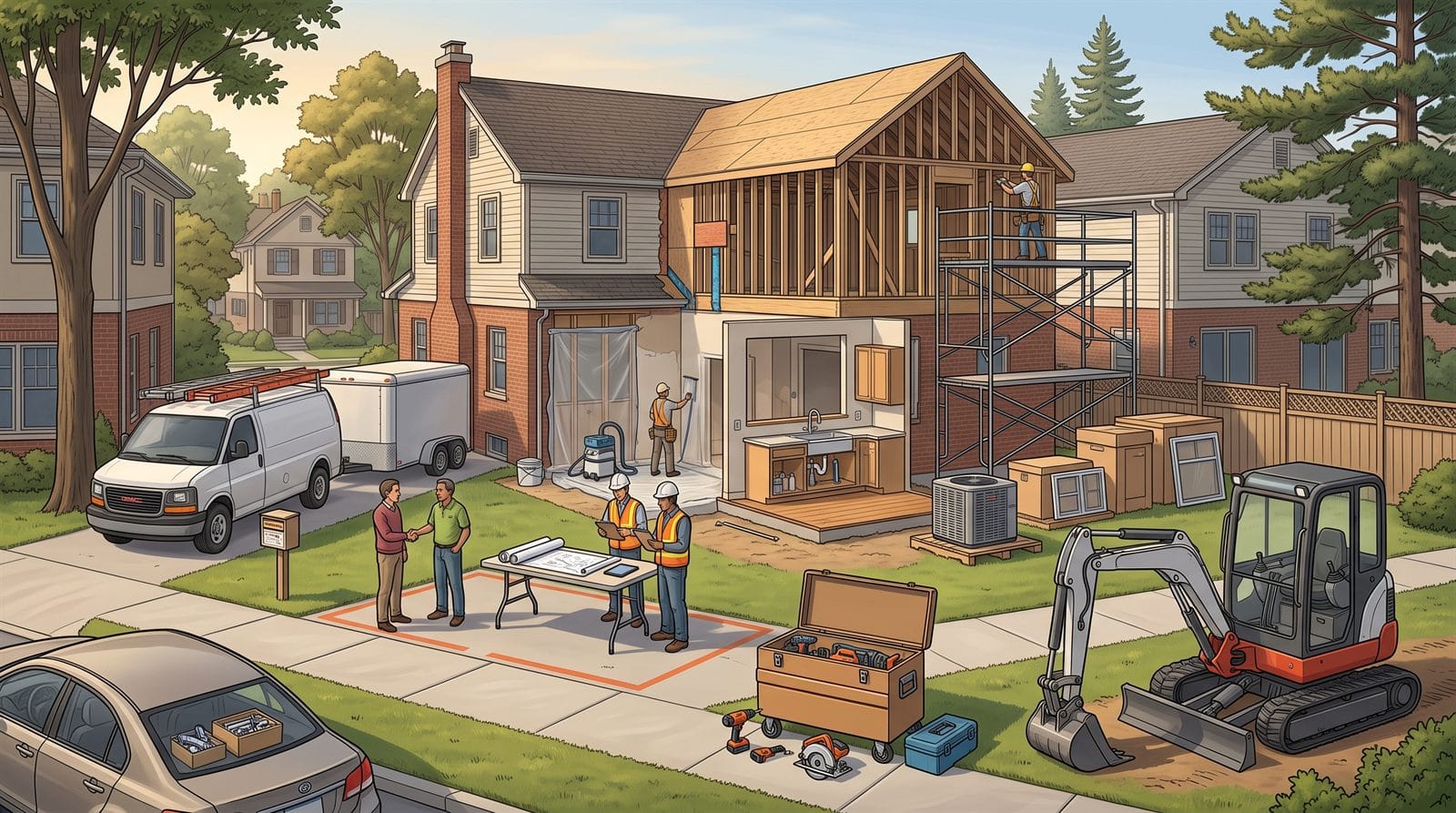
Select an object on the jobsite, a numbered marker, or a coverage name below the picture to see where each coverage applies.
- General liability
What if your work injures a customer?
General liability insurance can help with covered claims when your operations injure someone who isn’t your employee. It can help pay damages and legal defense costs. Employee injuries generally need workers’ compensation protection instead.
- Third-party property damage
An accident can affect property outside your jobsite.
If your operations accidentally damage a neighbor’s property, general liability coverage may help. Damage to property you’re actively working on, holding, or controlling can involve exclusions. Tell us what you do and where you work so we can check those restrictions.
- Workers’ compensation
Protect the people doing the work.
Workers’ compensation pays medical bills and lost wages for covered work injuries and illnesses, and Illinois requires it from your first employee. Review your crew, owners, and subcontractor arrangements carefully. Calling someone an independent contractor doesn’t by itself determine their status or eliminate your insurance responsibilities.
- Builders risk
Who insures the project before it’s finished?
Builders risk coverage can protect insured construction work and materials against covered physical losses during the project. Confirm who purchases it, which parties are insured, and when coverage ends. For renovations, explicitly check protection for the existing building as well as the new work.
- Installation floater
Materials need protection before installation.
An installation floater can help protect materials and equipment destined for a project while in transit, temporarily stored, or awaiting installation. Coverage periods and locations vary. Coordinate it with the project’s builders risk policy so responsibility is clear.
- Contractors equipment coverage
Could you keep working if your tools disappeared?
Contractors equipment coverage can protect eligible tools against covered theft or damage at jobsites, in storage, and during transport. Ask about item limits, scheduled equipment, deductibles, and overnight vehicle-storage requirements. Auto insurance generally doesn’t replace the tools inside your van.
- Rented and leased equipment
Rented equipment can become your financial responsibility.
Check coverage for equipment you rent, lease, or borrow, not just equipment you own. Review physical damage limits and rental-contract obligations, including possible continuing rental charges after a loss. Don’t assume the rental company’s damage waiver covers every exposure.
- Commercial auto
Your vehicles are part of the business.
Commercial auto insurance can cover qualifying liability claims from business vehicle accidents. Collision and comprehensive are separate protections for vehicle damage. Review every van, truck, trailer, and driver, including how vehicles are titled and used.
- Hired and non-owned auto
What if an employee uses a personal car for a supply run?
Hired and non-owned auto liability can help protect your business when employees use personal vehicles for work or when the business rents vehicles. It generally doesn’t pay to repair the employee’s car. Review hired-auto physical damage separately when renting.
- Products-completed operations
Your exposure doesn’t end when you leave.
A connection that leaks after the job is finished can damage a customer’s home. Products-completed operations coverage may respond to qualifying injury or property-damage claims. It isn’t a workmanship warranty; repairing your defective work itself may be excluded.
- Contractors professional liability
Do you provide design advice or technical recommendations?
Design-build work, specifications, and other professional services can create claims that general liability doesn’t cover. Contractors professional liability may help with covered errors or omissions. Tell us if you design, recommend systems, or take responsibility for professional services.
- Contractors pollution liability
Older buildings can introduce environmental risks.
Dust, mold, lead, asbestos, and spills can create pollution-related claims. Standard liability coverage may exclude them. Contractors pollution liability can address certain covered conditions, but covered substances, cleanup costs, and operations vary, so disclose the work you perform before starting.
- Coverage-planning topic: contracts
Does your insurance match the contract?
Customers and general contractors may require additional insured coverage, completed operations protection, or other endorsements. A certificate of insurance summarizes coverage; it doesn’t create it. Have insurance requirements reviewed before signing.
Verify subcontractors’ policies and endorsements before they start work. Collect certificates that reflect the coverage your contract requires, and confirm that additional insured and completed operations endorsements are actually in place rather than assumed.
- Coverage-planning topic: surety bonds
Does the job require a bond?
License, permit, performance, and payment bonds serve different purposes. A surety bond guarantees specified obligations to another party; it isn’t liability insurance for your business. If the surety pays a valid claim, you may have to reimburse it.
Your crew, tools, vehicles, and contracts should be covered for the work you actually do.
Illustrative coverage options. Multiple policies or endorsements may be required. Coverage depends on your operations, policy terms, limits, deductibles, and exclusions.
Contractors Insurance for Builders & Tradesmen on Chicago’s North Shore
Most North Shore contractors buy insurance because a contract requires it. General contractors, electricians, and plumbers on new construction in Glenview are asked for specific limits, additional insured status, and proof of workers compensation before they start, and the policy has to match what the contract asked for.
Some contractor programs include primary and non-contributory wording and a blanket waiver of subrogation in the base policy, and others add them by endorsement. We check which you have before you sign a contract that requires them.
Why Contractors Need More Than a Basic GL Policy
Many contractors buy a general liability policy and assume they’re covered. But construction work involves complex contractual relationships, expensive tools, job-site hazards, and professional judgment calls that create exposures a basic policy doesn’t address.
Key Coverages for Contractors
- General Liability with Primary & Non-Contributory: Your policy pays first for the additional insured, without asking their own insurer to share the loss. Most commercial job sites and GC contracts require it, so confirm the wording is on your policy.
- Waiver of Subrogation: Prevents your insurer from going after the project owner or GC after paying a claim. It is another common contract requirement, so confirm it is on your policy.
- Contractor’s Tools & Equipment: Covers your tools, materials, and equipment, and some programs extend to laptops, non-owned detached trailers, and money and securities on the job site.
- Contractor’s Errors & Omissions: Protects against claims arising from your professional judgment: design recommendations, material selections, or project management decisions that result in a loss.
- Pollution Liability (Designated Sites): Covers environmental cleanup costs and third-party claims if your work inadvertently releases pollutants at a job site. Renovation and demolition contractors working in older buildings need it most.
- Voluntary Property Damage: Pays for damage you cause to a customer’s property during your work even when you are not legally liable, so you can fix it without a dispute.
Who We Insure
- General contractors and construction managers
- Electricians, plumbers, and HVAC contractors
- Roofing and siding contractors
- Painters and drywall contractors
- Landscaping and hardscaping contractors
- Remodeling and renovation specialists
- Masonry and concrete contractors
For a contractors insurance quote, send us your current declarations pages and a sample contract, or call 847.242.1040.
Serving contractors and tradesmen in Wilmette, Northfield, Winnetka, Glencoe, Kenilworth, Evanston, Northbrook, Highland Park, Glenview, Skokie, and across Chicago’s North Shore.
Contractor Insurance Resources
- How Subcontractors Impact Your Insurance Costs
- Structuring Contractor Coverage in Chicago
- Winter Service Liability Risks
The Coverages a Contractor Needs
- General liability with completed operations. The completed operations piece responds to damage that shows up months or years after you finish. Some cheaper policies restrict or exclude it, which is exactly the coverage a contractor cannot do without.
- Workers compensation. Required in Illinois from your first employee, and demanded by nearly every general contractor and municipality you work for.
- Commercial auto. Personal auto policies exclude business use. Trucks, vans, and trailers hauling tools and materials belong on a commercial policy.
- Inland marine, or tools and equipment coverage. Commercial property covers property at your scheduled location. Tools in a truck or at a job site need inland marine.
- Installation floater. Covers materials headed for a project while they are in transit, stored, or waiting to be installed.
- Builder’s risk. Covers the structure under construction against fire, wind, theft, and vandalism during the build.
- Commercial umbrella. Most general contractors now require $2 million or more in total limits. An umbrella reaches those limits far more cheaply than raising the underlying policy.
Subcontractors Are Your Biggest Cost Variable
Missing subcontractor insurance documents can affect both coverage planning and the premium audit. The insurer may include uninsured or undocumented labor in its calculation, depending on the work and audit rules. Your general liability may address your own liability arising from subcontracted work; it does not replace the subcontractor’s insurance. Collect the required certificates and endorsements before work begins.
Collect certificates before work starts, not at audit time. Require the sub to name you as an additional insured, and confirm their limits at least match what your own contract with the owner requires.
Classification and Audit
Contractor premiums are built on payroll and receipts by classification code. Roofing, excavation, and structural work price very differently from finish carpentry or interior remodeling. Contractors who perform several trades are frequently coded entirely into the highest-rated one, which is expensive and often correctable with proper records.
Keep payroll separated by trade, keep subcontractor certificates on file, and keep clean job records. Those three habits do more for a contractor’s insurance cost than shopping the policy every year.
Common Questions
What limits do general contractors usually require?
$1 million per occurrence and $2 million aggregate is the common floor, with many now requiring a $1 million or higher umbrella above it, plus additional insured status on a primary and non-contributory basis and a waiver of subrogation.
I am a one-person operation. Do I need workers compensation?
Sole proprietors can generally exclude themselves, but most general contractors will not let you on site without a policy, and some require a ghost policy specifically so a certificate exists.
Does my policy cover faulty workmanship?
Generally not the cost to redo your own defective work. It can respond to resulting damage that the faulty work causes to other property. The distinction turns on specific policy wording, which is worth reading before a dispute rather than during one.
Erie Contractor Insurance and Other Markets
We are an appointed Erie Insurance agent, and Erie is competitive on many contractor and tradesman classes in Illinois. Having general liability, commercial property, commercial auto, and workers compensation available from one carrier matters more for contractors than for most businesses, because certificates and additional insured endorsements are simpler to produce when the account is not split.
Contractor appetite varies sharply by trade, though. A carrier that is competitive on finish carpentry or interior remodeling may decline roofing, excavation, or structural work outright. We place this class across several markets and quote Erie against them rather than assuming any single company is the answer.