
Professional Office Insurance
Coverage at a Glance
Select a numbered marker on the illustration, or a coverage name below it, to see where each coverage applies. Dashed markers are coverage-planning topics rather than individual policies.
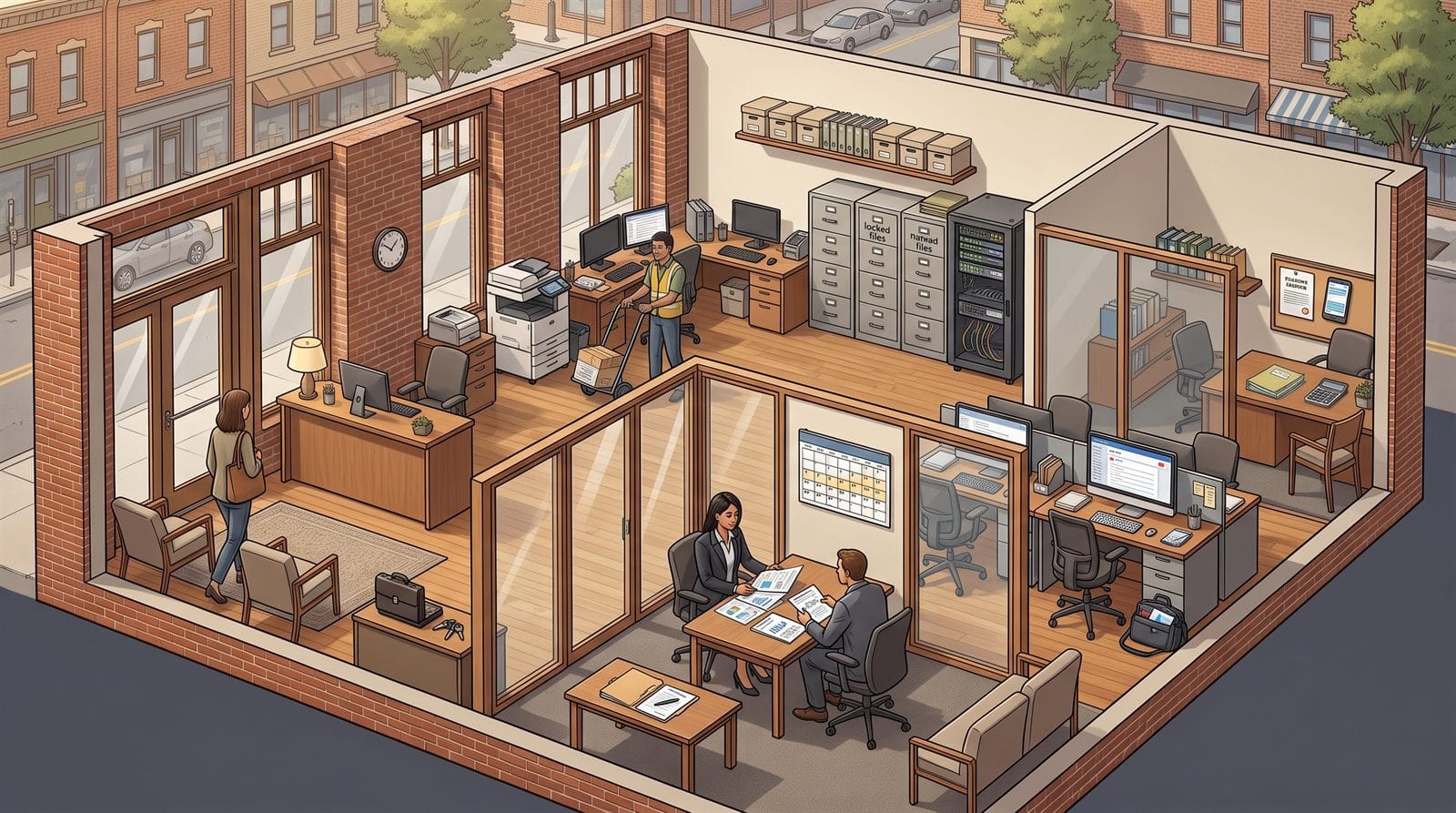
- Errors and omissions (professional liability)
What if a client says your advice cost them money?
Errors and omissions insurance, also called professional liability, can help with covered claims alleging negligence, mistakes, or omissions in your professional services. It may pay defense costs and covered damages. Your policy’s definition of professional services should match the work you actually provide.
Would defending a claim reduce my coverage limit?
Defense costs may reduce the amount available to pay damages. Review this alongside your deductible or retention when choosing limits.
- Coverage-planning topic: claims-made timing
A claim can arrive long after the work is finished.
Many E&O policies require claims to be made and reported within specified periods, with the underlying work occurring on or after a retroactive date. Review continuity when changing insurers, retiring, or closing the practice. An extended reporting period may help with later claims involving earlier work.
- Coverage-planning topic: contracts
Does your policy match what you promise clients?
Your contracts may include insurance requirements, indemnity obligations, or promises beyond your normal professional duties. Review them alongside your E&O coverage before signing. Don’t assume every contractual dispute, performance guarantee, refund demand, or obligation you accept is insured.
- General liability
What if someone is injured at your office?
General liability insurance can help with covered claims involving a visitor’s injury or damage to someone else’s property. This is different from a claim that your professional advice caused financial harm. Most practices need to consider both exposures.
- Commercial property
Could you replace the equipment that keeps you working?
Commercial property coverage can help repair or replace insured furniture, computers, equipment, and improvements after a covered loss. If you lease, review your buildout and lease responsibilities. The building owner’s insurance doesn’t automatically cover your office contents.
- Business income and extra expense
Lost office time can mean lost income.
Business income coverage replaces lost profit, plus continuing expenses like rent and payroll, while you recover from covered physical damage. Extra expense coverage may help fund a temporary office or other recovery measures. Waiting periods and restoration limits apply; not every interruption qualifies.
- Cyber insurance
One compromised account can expose client information.
Cyber insurance pays the response costs after a covered breach or ransomware attack. Review notification, forensic investigation, data recovery, and liability protection. Ask how cyber and E&O policies coordinate when a technology incident also affects your professional services.
- Cyber business interruption
What if your systems stop working?
Cyber business interruption coverage may help with qualifying income losses caused by a covered cyber event or system failure. Review waiting periods and dependence on cloud, software, and other providers. Ordinary property business-income coverage may not respond to a digital outage.
- Valuable papers and records
Some records cost more to recreate than to replace.
Valuable papers and records coverage can help with qualifying costs to research, restore, or reconstruct damaged documents after a covered loss. Review paper files and electronic records separately. This protection doesn’t automatically cover the financial consequences of losing a client’s information.
- Portable equipment coverage
Does your equipment coverage follow you?
Laptops and other business equipment may need protection while at home, at client locations, or in transit. Review off-premises limits, theft conditions, and accidental-damage coverage. Replacing a stolen laptop and responding to exposed client data are separate insurance questions.
- Workers’ compensation
Office work still involves employee injury risks.
Workers’ compensation pays medical bills and lost wages for covered work injuries and illnesses, and Illinois requires it from your first employee. Review office duties, remote work, and client-site travel. Owner participation and employee classification also affect how coverage is arranged.
- Employment practices liability
Employment decisions can lead to separate claims.
Employment practices liability insurance pays defense costs and covered damages when an employee claims discrimination, harassment, or wrongful termination. These claims generally aren’t the purpose of your E&O policy. Review exclusions and any protection for claims involving applicants, clients, or other third parties.
- Social engineering and crime
What if a payment request is an impersonation?
A fraudulent message can redirect a vendor payment or trick someone into transferring funds. Ask specifically about social engineering, funds-transfer fraud, and employee dishonesty. These are different exposures, and ordinary cyber coverage may not cover a payment your employee was deceived into authorizing.
- Hired and non-owned auto
Client visits can create auto liability for the firm.
Hired and non-owned auto liability can help protect the business when employees use personal vehicles for work or the firm rents vehicles. It generally doesn’t repair the employee’s own car. Business-owned vehicles need a separate commercial auto review.
Send us your current policies and a sample client agreement, and we will tell you which of these your firm already carries.
Illustrative coverage options. Coverage must match your profession and services. Policy terms, reporting requirements, limits, deductibles, and exclusions apply.
Professional Office Insurance for North Shore Businesses
An accounting practice in Wilmette, a consulting firm in Northbrook, and a law office in Evanston share one core exposure: a client who says your advice cost them money. General liability does not respond to that claim; errors and omissions coverage does.
Most offices can put property, general liability, and business income on one business owner policy, with errors and omissions written separately by a specialty carrier.
Why Professional Offices Need Coverage Built for Them
Unlike retail or manufacturing, professional service businesses face risks centered around intellectual work product, client data, and the advice they provide. Standard commercial policies often miss these exposures.
Key Coverages for Professional Offices
- Equipment Breakdown: Covers mechanical and electrical failure of your office technology: servers, HVAC, phone systems, and specialized equipment that keeps your practice running.
- Income Protection (Actual Loss Sustained): If a covered event forces your office to close, income protection covers lost billings based on your actual loss, up to the policy’s time limit.
- Data Breach Response Expenses: Professional offices handle sensitive client information daily. This coverage handles notification costs, forensic investigation, credit monitoring, and legal expenses when a breach occurs.
- Accounts Receivable Protection: If your billing records are destroyed in a covered loss, this coverage pays the outstanding fees you can no longer collect.
- Employment Practices Liability: Protects your firm against employee claims of discrimination, harassment, wrongful termination, and other employment-related actions. Wage-and-hour disputes are usually excluded or limited.
Who We Insure
- Accounting and CPA firms
- Management and business consultants
- Marketing and advertising agencies
- Architects and engineering firms
- Law offices and legal practices
- Financial advisors and wealth managers
- IT consulting and staffing firms
- Real estate offices and property managers
- Medical and dental offices
For a professional office insurance quote, send us your current policies and a sample engagement letter, or call 847.242.1040.
Serving professional firms in Wilmette, Northfield, Winnetka, Glencoe, Kenilworth, Evanston, Northbrook, Highland Park, Glenview, Skokie, and across Chicago’s North Shore.
Professional Offices Need More Than a Basic Business-Owner Policy
Professional firms on the North Shore often have modest physical property but significant liability, data, and client-service exposure. Accountants, consultants, attorneys, architects, engineers, financial professionals, marketing firms, IT consultants, and real estate offices all depend on advice, deadlines, client records, and professional judgment.
A basic property and general liability package may protect the office space, but it may not address errors and omissions, cyber incidents, client data, employment practices, crime/social engineering, or business income after a technology or premises loss.
E&O, Cyber, EPLI, and Business Income Should Be Reviewed Together
Professional liability or E&O responds to claims that your work, advice, or failure to act caused financial harm. Cyber coverage addresses data breach, ransomware, funds-transfer fraud, notification costs, and recovery expenses. Employment practices liability addresses employee claims such as discrimination, harassment, or wrongful termination. Business income coverage helps when a covered loss interrupts operations.
These coverages should not be purchased in isolation. A professional office can have one incident that touches several policies: a ransomware event can trigger cyber, lost income, client notification, contractual obligations, and reputational harm.
Local Firms Should Review Contracts and Client Requirements
Many professional firms sign client agreements requiring specific insurance limits, additional insured status, waiver of subrogation, cyber coverage, or professional liability. Longmeadow Insurance can review those requirements and help match coverage to the contracts the firm is actually signing.
Related Insurance Guides
Erie Business Insurance for Professional Offices
As an appointed Erie Insurance agent we place professional office accounts with Erie regularly. Offices are among the more straightforward commercial classes, and a business owner policy covering general liability, office contents, tenant improvements, and business income is often competitively priced.
Errors and omissions coverage is the piece that usually needs a separate market, since professional liability is underwritten by specialty carriers rather than bundled into a standard BOP. We build that layer alongside whichever carrier holds the package, comparing Erie with the other markets available to us.